In April, I stepped into a theater transformed. Gone were the tiers of formal seats dividing the stage from the audience. Instead, I was ushered into a tent holding a ticket marked Kurdistan and led through two countries to a seat on the floor of a raised platform. This was The Jungle, a refugee camp that existed from January 2015-October 2016, in Calais, France.
In May, the seats were back in their seemingly rightful place for a different, yet equally powerful immersive experience. Centered around a photo album featuring Nazi perpetrators vacationing at the concentration and death camps Auschwitz-Birkenau, the audience was pulled into a detective story, one where we glimpsed the practice of a curator at the United States Holocaust Memorial Museum (USHMM), and the search for meaning within this unexpected object. This was Here There Are Blueberries.
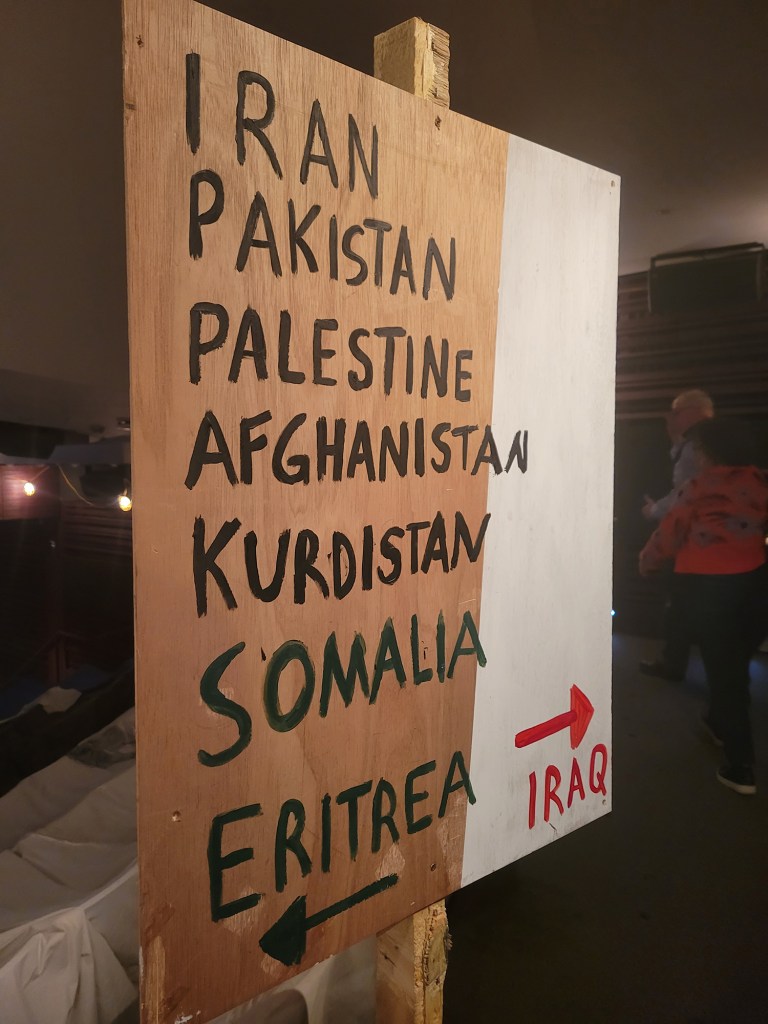
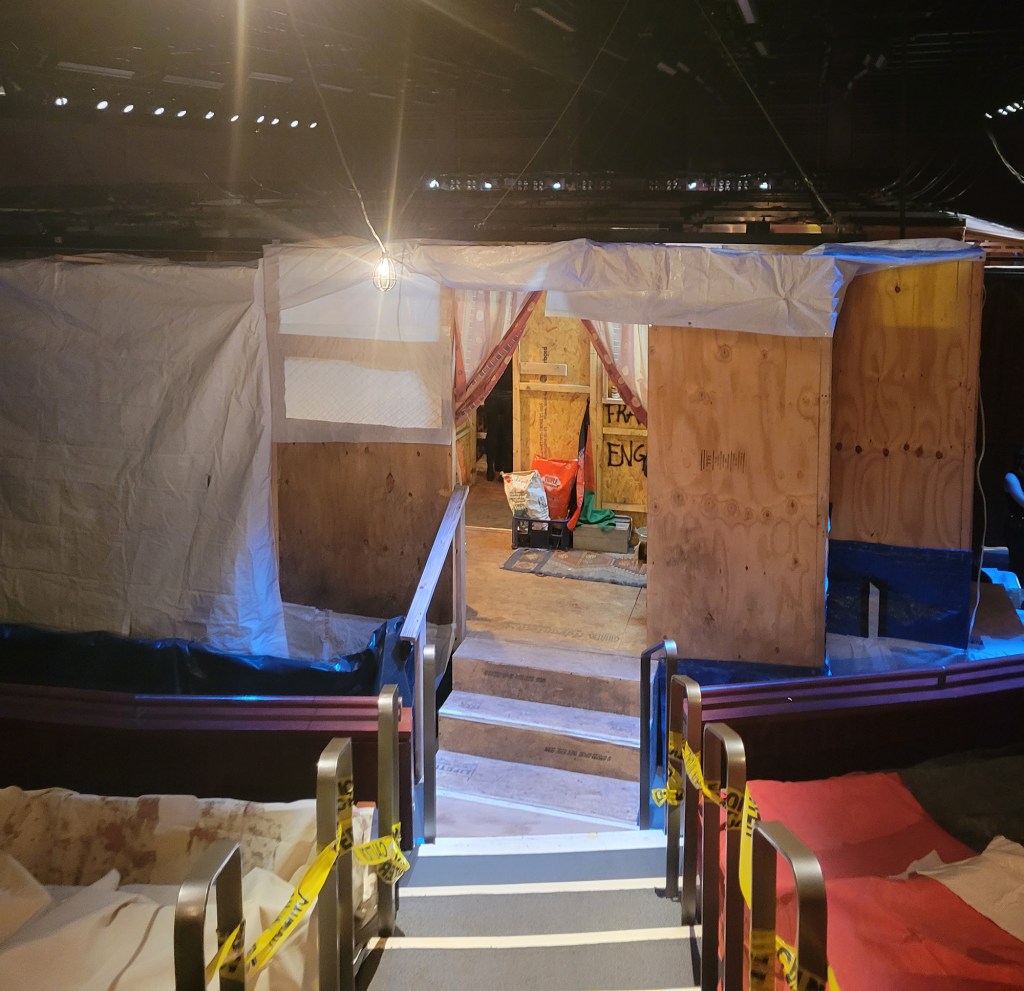
As theatrical performances, both shows were examples of effective stagecraft. Each production connected audience members to complex stories, and each actor’s performance was designed to ask a series of questions about the broader scope of humanity.
Our humanity.
In the first show (both were presented by the Shakespeare Theatre Company) we were directly a part of the experience. In the second we watched history unfold before our very eyes. Sitting within The Jungle—a Good Chance Theatre Production in partnership with Woolly Mammoth Theatre Company—we were a part of the community, collectively experiencing the despair, resilience, and trauma of being a refugee trying to find a place to call home. As observers in Blueberries we were presented with two fundamental questions: 1. What would we have done in their place? in tandem with curators interrogating the photographs as historians, trying to determine 2. How much did they know?
Both productions used a combination of in-person experiences coupled with multi-media in very specific and intentional ways. The Jungle emphasized that this treatment of refugees in France isn’t something that has gone away, using current news reports from on the ground aid workers, to remind the audience that this recent past is a story still in progress.

For Blueberries, Tectonic Theatre Project’s vision integrated projections and various live instrumentations, bringing these two dimensional images to life. For example, at one point the photo of the young women—from the Auschwitz communication offices—sitting on a fence eating blueberries as they are serenaded by a man with an accordion, is projected on the back screen of the stage. Using a practice the company described as “moment work” the actors took a beat before laughing into a microphone while an actor sauntered before us playing live accordion music.
For that moment, we were transported to this fence, hearing their laughter, sensing their mood, even while knowing that a few miles away human beings were being murdered in gas chambers. A contradiction brought to life.
But that’s just part of the story.
Reframing History
As plays, both The Jungle and Here There Are Blueberries were successful dramatic endeavors, leading the audience through incredibly deep and nuanced storytelling. However, when considered as productions of public history, these shows accomplish something else entirely.
For instance, Blueberries, highlights one of the fundamental principles laid out in the recent Reframing History project from the Frameworks Institute (which was developed with funding from the Mellon Foundation, in partnership with the American Association of State and Local History, the National Council on Public History, and the Organization of American Historians), which asked practitioners to “compare historical interpretation to detective work to deepen understanding of historical practice.” The play, above all else, revealed the process of “historical investigation” and how understanding these photographs required a range of sources, methods, and the ability to update understanding as new evidence came to light.
The Jungle illustrates yet another principle from the Reframing History project which is to use “concrete, location-specific, solutions-focused examples to build support for inclusive history.” By bringing the audience into this place, where we become a part—albeit in a theatrical sense—of the connection building between these people and their story. It is through this experience that I recognized the need to see the whole picture, to really understand the ramifications and broader narrative of 21st century migration.
For someone who was the “public” for both shows, it was even more visceral. I walked away feeling simultaneously overwhelmed, empowered, and uncertain. They made me feel uncomfortable. They made me feel aware.
Taking place at a time less than ten years ago, The Jungle compels us to open our eyes to things we don’t want to see. To realize that while this is a story set in Europe it is about any border crossing in any country. In the Shakespeare Theatre Live for The Jungle, Ammar Haj Ahmad (who plays the narrator, Safi) talked how while he recognized that as he is playing the part “it is one of these shows where the audience is five centimeters away and you can’t fake it. You have to be one hundred percent… I think it is hard to be an audience member because you are completely exposed with their emotions and their actions…And I think even in the performance itself we get to the point, by the end of the play, where we are in a spiritual place, as if having the same heartbeat.”
What happened in Calais is happening every day in many countries, even our own. We can ignore it because we don’t want to dwell, but it doesn’t make the suffering go away. For many of these refugees, they are looking for a way, to quote one of the characters who does make it to England, “to be a person again.”

In Here There are Blueberries, these images of Nazis going on vacation, were incongruous with our traditional understanding of these people—but monsters are not always born that way. The album makes us acknowledge that Nazi leaders and accomplices of the death camp were once accountants, candy shop owners, and young women who liked to eat blueberries on their day off. And so a nearly eighty year old photo album revealed that we all hold the opportunity—and capability—of making choices we think are right, but are really ethically wrong.
We are forced to confront, even as we want to deny it, that these individuals could be you—or me—and consequently, the shows push an even more prescient message that our moral fortitude is being challenged right now. In other words, we are asked to make different choices and to not—as Blueberries shared about the seemingly ordinary people in the pictures (who believed what they were doing was the right thing)—“see, without seeing…[or] hear, without hearing.”
In a lot of ways Blueberries as public history, mirrors yet another recommendation from the Reframing History project which positions history—and presentations of public history—as essential to making progress towards a just world.
During the post-show Shakespeare Hour Live for Here There Are Blueberries co-author Amanda Gronich, co-author and director Moisés Kaufman, and USHMM Curator Rebecca Erbelding (who this play is based on) discussed complicity and ethics. Gronich stated that there is “a huge range of allowance. Every day we are making choices not to get involved, not to stop something that we may feel is morally repugnant, but not enough that I will stop the actions of my day to stop it. It is this incredible sliding constant scale of how we involve ourselves…or not.”
As a follow up to Gronich’s statement, Kaufman asked Erbelding how she thinks about the question of ethics, to which she said, “[I think about ethics] all the time, but I think that we should keep trying. I fail every day, and I think if I keep thinking about it, I will try to do better tomorrow.”
Try to do better tomorrow. A phrase that urges us to ask of ourselves each and every day, how can we make more ethical choices? How can we move the needle forward? This is what I want, and I can only hope that elevating narratives like this will help us to get ever closer to that future that everyone deserves to have.
 ...this is what comes next