Here is the Rome & American exhibition review that I promised a few weeks back.
Context Matters
It was an intensely sweltering July when I traveled up to the National Constitution Center in Philadelphia, PA for the exhibition Ancient Rome & America. On the website for the exhibition (www.constitutioncenter.org/rome) there is the following statement.
Rome, like the United States, overcame a monarchy to become a republic. Long after the fall of ancient Rome, its heroes and legends have continued to influence future generations. From the battlefields of the revolution to the chambers of Congress, Rome became a part of America’s foundation. Through marble sculptures, paintings, jewelry, coins, and ceramics, Ancient Rome & America draws striking comparisons between Roman and American culture, from theories of government to slavery and civil war, to continental expansion and worldwide influence.
First of all, I would like to agree with the premise of the exhibition that the comparisons between Rome and America do certainly exist, especially during the early years of our republic. The significance and history of the classical period to our Founding Fathers is evidenced in our Constitution, and through our architecture. The problem with this exhibition isn’t proving that the connection exists, rather it is the way the information is presented that makes the argument seem almost superficial.
Organization:
The exhibit was divided up into a few different galleries. Three sections smaller in stature, followed by a longer gallery with an alcove, and then a fifth/sixth section that wound its way to a final, exhibit capping video that asked the requisite open ended question: “What does ancient Rome foretell about the fate of America?”
As I walked around I took note of the major section headings that to me, were grouped into these rough sections:
Section Headings:
Building a Republic: Legends and Founding Myths, Tale of 2 Generals (Cincinnatius and George Washington), Military Triumphs-Carthage
By the People for the People: Census, inspiration/Role of Written Law, Oration-Classically Speaking, Comparisons to Caesar
A Classical Revival: Architecture/Style, Remnants in the Ancient World: Grand Tour/Influences. Pompeii Herculaneum, American Documentation Founding Fathers/Mothers
Classical Style, Architecture/Entertainment, Monumental Cities, Brad and Circuses, Hollywood
Expansion/Empire Establishing Empire, Trade/Treasure,Enduring Legacy
It ends up I was close enough to the actual intended organization for the exhibition: Introduction, Building a Republic, A Classical Revival, and Expansion and Empire, Epilogue, but that didn’t matter much, because the flow from room to room (which incidentally was in a very odd exhibit gallery) broke up the sections in a way that seemed illogical and made the narrative of the exhibition feel sloppy. For example, the first room held a small introductory object/case display, and then hopped immediately into a comparison of the founding myths of Rome (Romulus & Remus) with the founding myths of the United States (George Washington and the Cherry Tree). The section was then broken up into another room that held a description of the role of Cincinnatius in American and Roman history, without any clear connection between the two sections of the story. Each case was color coded to indicate what part of the story was being told—red or blue with a spattering of gray in between. However the colors weren’t used consistently or all the way through the exhibit.
Narrative/Artifact Choices
One of the first things I learned in graduate school (and various internships) was that just putting two pieces of evidence together doesn’t make them connected. This exhibition repeatedly placed two “objects” or “themes” together and tried to point the finger to say “hey! Rome did influence America!” The first one was the two founding myths. While it is true that both nations/empires has myths and stories that surround the founding, they aren’t the only ones. The display tries to make it seem that Rome & America are the only two with grand myths that define/represent the countries ideals.
Additionally each major section began with two quotations….here is one set.
Virtues are held in the highest estimation in the very times which bring them forth. Tacitus
Great necessities call out great virtues. Abigail Adams
Sure, both quotations talk about virtue, a concept rooted in the British foundation of the American nation state, and Rome certainly had its own ideas about honor, virtue and war—but it doesn’t mean that Abigail was talking about the same thing as Tacitus. All through the exhibition these quotations have been isolated and presented without context or even contextual clues. We are to take it on face value that a true connection exists between the two ideas, born hundreds upon hundreds of years apart.
Lastly I’d like to make a note about objects. While it was really great to see the artifacts from Herculaneum and Pompeii there were points in the exhibition where the objects were really just out of place. While I recognize the need to acknowledge modern connects with Hollywood that section seemed like an afterthought (that existed in the middle of the exhibit) rather than incorporated into script. Also, this section was only music, and a variety of movie posters without much explanation or analysis of what those movies may say about 20th century America. Then there are the Super Bowl tickets.
At one point in the second to last section of the exhibit the designers presented two Super Bowl tickets (actually to the first Super Bowl I believe). The description starts to talk about how our sports arenas are reminiscent of gladiator arenas (though less brutal), but uses the fact that the Super Bowl still uses roman numerals as a “viola!” connection between modern society and Ancient Rome. Not a strong argument, or even a credible one. My fear is that this entire section of the exhibition was added as a way to create relevance/engage younger visitors. I doubt, that they were very successful.
Clearly I had much to say about the exhibit, but instead of going on about how the Expansion/Empire section may have been stronger if they had extended the idea of the American Empire out beyond the ideas of manifest destiny and westward expansion, I’m going to let Sarah Fell and Tony Torres let you know what they think.
Sarah Fell
As a classics nerd, I was excited to see the Ancient Rome in America exhibit at the Constitution Center. I think the exhibit started out strong, showing the influence Rome had on the Founding Fathers, the symbols of power America chose to use (eagles!), and the federal-style architecture we used for our seats of power. One of the more interesting points, to me, was the similarity between George Washington and Cincinnatus. I would have liked to see more about how America’s mythologizing about its own origins and heros compares to Rome’s. And I will not forget seeing a slave collar from America side-by-side with a slave collar from Rome. That was chilling.
Soon the exhibit started to lose me, though. As Priya mentions, one of the more perplexing choices was the Super Bowl tickets. Surely most cultures have some form of large sporting event, so apart from the Roman numerals, what makes the Super Bowl especially reminiscent of Roman gladiator games? There was also a wall of movie posters of different American films about Rome. But I left that, too, with more questions. Why the glut of movies about Rome at this point in America’s history? How do the portrayals of Rome in these movies compare or differ from reality? What does each film’s portrayal of Rome reveal about America? Why do we latch on to certain themes–decadence and excess, gladiators, slaves? These were two of the more provocative points in the exhibit so I wished the connections had been unpacked a lot more.
In the end the exhibit showed us a lot of things but didn’t really say anything. The video at the end consisted of a lot of Roman and American historians saying, essentially, that Rome and America are similar in a lot of ways, and in a lot of ways they are different. Maybe America will fall, like Rome did, or maybe it won’t. Had the exhibit been pared down to have a specific focus–say, America’s mythologizing about its founding, or American visions of Rome in film and literature–it would have been much more effective.
Tony Torres
I’ve always had a love affair with ancient Rome and with the Founding era of American history due to my once passionate libertarian beliefs. My passion for both led me to look forward to seeing the Ancient Rome & America exhibit in Philadelphia. Unfortunately, I too came away from the exhibit mostly disappointed. I thought that the exhibit displayed a lot of great artifacts, but presented very tenuous connections between most of them. Instead of delving in deeply into strong similarities between Rome and America, it chose to focus on superficial similarities. Some areas of the exhibit were stronger than others – the comparison of Washington to Cincinnatus and the comparisons of slavery in Rome and the American South, for example. Unfortunately, even those comparisons failed to show how they were similar or why Americans emulated Rome. It also ignored key differences. It would have been useful for example to discuss why George Washington felt Cincinnatus was a great model to follow as statesman, rather than say Julius Caesar. When comparing slavery, the exhibit had some great artifacts such as the slave collars that Sarah mentioned. What I would have liked to see, however, was discussion of the differences. There was little or no discussion of the fact that slavery had a racial element in the United States, but was based on conquest in Rome. There was no mention that the son of a freed slave became emperor of Rom Cincinnatus e, while the son of an American slave had zero chance of being president. Speaking of presidents, the exhibit failed to examine in critical ways the fears early Americans had about executive power and the fear that a president could become an American Caesar. This failure dovetails nicely with its failure to “go there” on the issue of imperialism.
The exhibit covered Roman conquest of Europe and the Mediterranean and compared it to the spread of American power across North America. While I think the comparison has some validity, it missed the point. America’s founding generation admired Roman republican virtues and institutions and the long stability they provided that civilization. They actively sought to emulate those admirable aspects of Roman society. What they feared though, was the darker side of Rome. America was to be a “New Rome” in republican form that set up institutions to prevent the accumulation of two much power in the hands of a king or emperor. America was also to be a country that sought peaceful relations and trade with all, but not conflict. This is most famously represented by John Quincy Adams’ famous statement that “America does not go abroad in search of monsters to destroy. She is the well-wisher to freedom and independence of all. She is the champion and vindicator only of her own.” Of course, America would fail to live up to those ideals in many ways over the next century in a half. Presidents, beginning with Lincoln, and then continuing with Teddy Roosevelt, Woodrow Wilson, FDR and every president since accumulated great powers far beyond what the founders intended. America would seek out its Manifest Destiny and conquer a continent. Where the exhibit fell short, is that it covered imperialism and Manifest Destiny and tried to link those to Rome. While the comparison is valid, I think modern American imperialism is a much better point of comparison. Roman imperialism eventually overextended Rome and caused it to rot from within. Similarly American adventurism abroad and the rise of our national security state has led to similar results at home. We’ve just lived through a decade in which Americans watched their standard of living decline, their personal and government debt skyrocket, while we’ve engaged in near permanent wars and continued to garrison the planet…even in places that have questionable value to the country as a whole and to the current wars we’re fighting.
My post is rambling a bit, so I’ll wrap up just by pointing out that while the comparison between Rome and America is tempting to make the two societies are still very different. Rome was never anywhere near as democratic as the modern United States. While the United States is one of the least egalitarian modern developed societies in the world today, it is far more equal than Rome. Education levels and literacy levels are much higher. Estimates of literacy rates in ancient Rome suggest that about ten percent of the population could read and write. While that was a great achievement compared to other pre-modern societies (including the Greeks who were far less literate), it pales in comparison to the nearly 100% literacy rates in the United States. America has always been highly literate, from colonial times on down to the present.
If I had designed the exhibit, I would have touched on all these themes in some detail. I would not have included movie posters without context. I would not have included super bowl tickets. I think the most important lesson Rome offers the United States is the following: history does repeat itself in some ways. The most important of which is a lesson that we fail to heed at our own peril. Every great power has fallen eventually. Nearly all of them have fallen for similar reasons. Many of them probably realized they were in decline and knew what needed to change. None of them made the necessary changes.
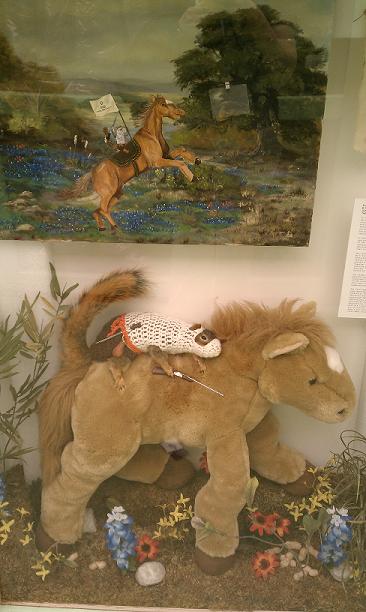 The city was sprawling, and parts of it reminded me of Levittown, Pennsylvania. But the area around the conference (downtown, and near Minute Maid Park) was great. There is a park there call the Discovery Green, that I wish I could have brought back to Pennsylvania. There were basic science experiences, such as seats with concave backs where two people could talk from a distance and still hear each other. There were PODS set up in which artists had created pieces, including a “box of curiosities” with an exhibit about Joaquin Squirrelieta: The Battle for Campo De Los Cacahuetes. This particular art piece spoke to me, seeing the artists’ interpretation of what museums—particularly history museums, are. And if this is the case, it needs to change. It was a funny and creative parody, but it would be a sad, sad museum.
 ...this is what comes next