Pandora, Alderaan, Caprica: The Many Faces of Earth

I’m writing this as a blizzard comes down outside my house and I figured its as good a time as any to write out the last of my movie posts. It will come as no surprise that I have seen James Cameron’s latest blockbuster Avatar, and like most viewers I was blown away by the 3D special effects and just how it transformed the movie experience. I’m also not surprised to hear that a sequel is already in the works.

That being said, at some point I heard some reviewer or the other (probably from Entertainment Weekly) pose the following question: Is Avatar a bigger movie than Star Wars?

It is a hard question to answer. First off are we comparing the first Star Wars movie (the one we know now as Episode IV, A New Hope) or are we comparing the whole series? Are we doing an overall comparison or just a technology to technology comparison? That is are we looking at how transformative the technology in Avatar is to the movie industry in the same vein as how path breaking the technology from a galaxy far, far, away was to special effects? If that’s the case then Avatar has only been out a few short weeks so can we really tell what its impact is, or is it simply amazing since it is the first to truly use 3D technology for the entire movie?

I’ve discussed this with a bunch of friends, some of whom see it as transformative only in the fifteen minutes of fame sense—that is, until the next 3D spectacular film comes out. Others, including me, see a story that pales in the face of even a surface scrutiny, especially sine the plot is reflective of Dances with Wolves and Disney’s Pocahontas put together.

But all of that has been talked about ad nauseum. My favorite thing about science-fiction, and one of the particular aspects of Avatar that I liked the most was the world-building. That is the creation of whole new cultures and histories that are, really, based on actual histories and stories from our world. True, many of them carry the same trophes (all knowing mystical energy that can be felt by a specific group of people), or try and successfully pull their own twists to a previously created tale (the recent Battlestar Galactica).

To some extent we see this process with historical fiction. That which looks at events like the Civil War and asks the infamous “what if” questions to create a new world that is still grounded in reality. Science Fiction, on the other hand, takes that question a step further, masking the harder questions in the cloak of something magical and mystical.

Avatar to some seemed a loose metaphor on our dependence on oil (unobtanium), while Star Wars has clear elements derived from Hitler’s Germany. One of my favorite things about the latest iteration of Battlestar Galactica is how it takes what we as a culture finds abhorrent (suicide bombings) and puts the good guys, the humans in the position of resorting to that violence, and for a moment, just one sliver of a moment you find yourself seeing the world through their eyes. BSG had no qualms about beating us over the head with their historical references, and analogies to the present and in the end just made me think.

It also might be said that these narratives are about the search for Utopia in the face of chaos. Looking for perfection when our own world seems to be rife with environmental destruction and political mistrust. I know one thing though—I think movies and stories like Avatar and Star Wars, and television shows like Lost and Battlestar Galactica give us a change in perspective and ultimately let us take a step towards understanding what makes us human.
Finding Passion: 3 Idiots and Up in The Air

For the second of my three movie themed posts this week I thought I would review two movies that are incredibly different in subject matter and scope—but still bear a sort of resonance on a common theme.

3 Idiots is a new movie from Bollywood that follows two college friends (Farhan and Raju) as they try and find the third of their group (Rancho) ten years after graduation. Through flashbacks we learn about their friendship in flashbacks at their college—a place similar to MIT but much more competitive. Like most Indian movies it has its fair share of drama, love and music. That being said it also takes a hard look at the pressures put on Indian kids to follow their parent’s dream rather than their own. It is also a very funny movie.

In stark contrast Up in the Air is a movie, to some extent, about loneliness and the need for human relationships. It follows frequent flier George Clooney as he travels around the country firing people from their jobs. While there are lighthearted moments, the movie is more serious than anything else and is ultimately about taking a hard look at your life and figuring out what is really worth sacrificing happiness for.

The way that the two movies link up is sort of chronological. In 3 Idiots we have three kids struggling to find the career, the job that will make them happy and excited about life. One is an engineering student because he loves it, but is stifled by the pressures of providing for his not-so-rich family (Raju).  The second is, once again, in school because its what is expected of him—but all through the movie you see him taking pictures—something his parents see as a hobby rather than a career (Farhan). The third, Rancho—well his is the role of the eye-opener. The one who can see all the flaws in the system and thinks he has the answers to make everything right. He is the questioner, he is the one who asks why we memorize definitions instead of thinking creatively. He is the one who asks why many students in India are encouraged towards the paths leading toward the most wealth, rather than the career they would be the most inspired. I often joke with my other Indian-American friends that there are only five acceptable careers for kids of Indian decent (Doctor, Lawyer, Finance/Business, Engineering, Dentist). It took some considerable convincing on my part to change my parent’s mind about the validity of being a historian—and I know that a lot of this has to do with the hard work and sacrifice my parents had in coming to this country and making their own way.

The idea of working toward something you love is also dealt with in Up in the Air. In this movie the questioner is Clooney’s character who asks the individuals he is firing what they could do if they could suddenly reinvent their life. He presents being fired as a way to make dreams come true, that now these individuals are free to take those steps they were too afraid or barred from taking earlier in life. Now they are free to take steps towards their passion.  He asks a father to look at his kids, and ask himself if the job he is losing is something that will make them look up to him. (A statement that I don’t necessarily agree with, since it is not what you do that makes your kids look up to you, but how you act and treat others.)

I know neither of these movies necessarily have anything to do with history, but they have to do a lot with the idea of finding your lot in life, your calling. That no matter what stage in life you are it is  not too late to step back and reevaluate what truly makes you happy. For me it is all about finding inspiration around me, and sharing that inspiration with others—and taking what comes next to inform and influence the mind and spirit at the same time.

What about you?

For the Love of the Game

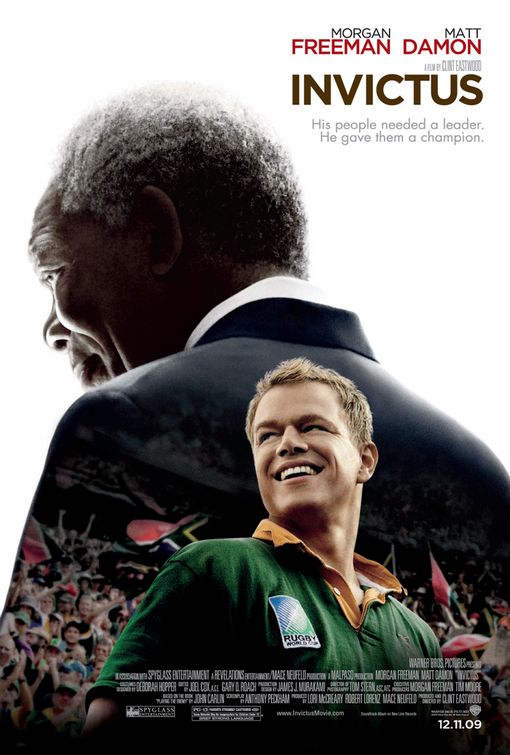
Invictus Movie Poster
Movie Poster for Invictus with Morgan Freeman and Matt Damon

Happy New Year!

I’ve been spending a lot of time at the movies lately. I’ve seen a sports movie set in post-apartheid South Africa, a Hindi movie that made me laugh, a film about loneliness in the so-called friendly skies, and stepped into a fantastical 3D world that provided much food for thought. So, for the next two weeks I’m going to look at these movies and try to pinpoint what they say about winners, finding your passion and epic, fantastic narratives that are really masks for the colonial past.

I know floating out there is the common adage that “history is written by the winners.” Which is true, to some extent. Winners are the one’s who seemingly get to dictate the terms for the narrative, those who survive to describe the victorious battles and the defeat of their foes on their own terms. In effect provide their interpretation for the events that brought them success.

Winning also brings forth a certain amount of pride, and in the case of sports team, a sense of identity with those the team represents. Over the holiday I saw the movie Invictus, which narrates the presidency of Nelson Mandela through his work to bring the South African rugby team (the Springboks) to victory in the 1995 World Cup. While I think Mandela’s role and his relationship with the Springbok’s has been dramatized for the film, his years long relationship with Captian Francois Pienaar (played by Matt Damon in the film) has not. Mandela’s hope was that this team could heal a nation trying to move past the legacy of Apartheid, and to bring unity between black and white South Africans.

I was thinking about this later in the week when my sister and I attended my first ever NFL game at FedEx Field in Washington, DC. As had become the norm this year the home team—the Redskins, were defeated by the Dallas Cowboys. But amidst the maroon and gold I could see that this team, like many in the NFL stirs such strong emotions in those who have been long time fans. We all know how loud and proud fans of the Boston Red Sox and the New York Yankees are—and that many stick by their teams in the good years and the bad—or more often than not, just during the good years. What is it about winning that makes the bond of local identity stronger? Does losing cause some erosion of faith in the city, making it a less enticing place to live and work?

Nelson Mandela and Springbok's captian Francois Pienaar in 1995
Nelson Mandela and Springbok's Captain Froncois Pienaar in 1995 after the Rugby World Cup.

In terms of looking to the past, if the movie is to be believed fully, Mandela saw the Springbok’s as an opportunity, a way to give both black and white in South Africa something to look forward to, a symbol that there was something both sides had in common. What does this say about the larger narrative—including things like the Olympics or other World Cup events where athletes are specifically chosen to represent their country at worldwide tournaments?  Are sports-as-unifiers merely temporary panacea’s to larger issues? Do they actually heal wounds, or just a temporary band-aid that keeps slipping open?

Below is the poem that Nelson Mandela held onto while he was being held in prison.

Invictus
William Ernest Henley

OUT of the night that covers me,
Black as the Pit from pole to pole,
I thank whatever gods may be
For my unconquerable soul.

In the fell clutch of circumstance
I have not winced nor cried aloud.
Under the bludgeonings of chance
My head is bloody, but unbowed.

Beyond this place of wrath and tears
Looms but the Horror of the shade,
And yet the menace of the years
Finds, and shall find, me unafraid.

It matters not how strait the gate,
How charged with punishments the scroll,
I am the master of my fate:
I am the captain of my soul.