Hodge Podge: On Vice, Designations, and Reviewing a Home

Happy Thanksgiving! As we head on into the long weekend I thought it would be nice to think about food and foodways as a lead in to an event I attended at Woodlawn, the importance of our latest National Monument at Fort Monroe, and a review of a book about the evolution of a particular hearth and home.

On Vice and Food
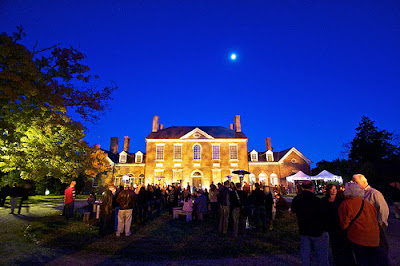
Woodlawn during the 2011 Vices that Made Virginia Event. Image from the Neighborhood Restaurant Group Flickr Page

When I was an undergraduate student I had the opportunity to take a course on foodways. We learned about the sugar and salt trade and their role in global economies while also examining objects from our kitchens to see and understand everyday life.

A few days ago I learned that my professor from this course, Barbara Carson, had passed away, and so I wanted to take a moment to reflect on what I learned from her.

Food can tell us a lot of things about the past. On one level we learn about diets—how our ancestors (or grandparents even) got their nutrition. We learn about how advances in canning and preservatives allowed food from California to be eaten in Vermont. And with more and more advances in transportation commodities like tea, sugar, salt, and spices became less of a luxury and more accessible—removing these items as limited only to the rich.

How this food was prepared gives us insight into familial roles—and the role of mealtimes in the cult of domesticity. We learned more about how that expectation changed, and the how advent of TV dinners moved families from the dinner table to the couch.

This was on my mind when I attended the second annual “Vices that Made Virginia” program at Woodlawn Plantation in Alexandria, VA. A National Trust property, this fund raiser was put on by Arcadia: Center for Sustainable Food and Agriculture —a non-profit organization bringing farming back to Woodlawn while educating children and adults on how food comes from the farm to the table.

The program itself was set up to highlight Virginia vices: cigars, bourbon, wine and of course the fresh produce, while introducing visitors to the farm and the historic site where it lay. It was, in one word, delicious.

Thinking about local food, and eating local harvests is a current trend in being sustainable not only economically but also in establishing a healthy lifestyle. It is a matter of looking back into our pasts and recognizing that sometimes the best things to eat is in your backyard.

Professor Carson’s course gave me a foundation to understand the shifts in thinking about how we eat, when we eat, and why we eat…what we eat. She also provided me with the essential underpinnings on how to look at material culture and find meaning. For that, I will be forever grateful.

Designating a National Monument

A few months ago I had the opportunity to sit in on a conversation at Lincoln’s Cottage in Washington, DC. This mini-conference was a brainstorming session, a place for attendees to envision a way to save a piece of history that is not often talked about: the history of the contraband.

In short, in May 1861, a little over a month following the shots at Fort Sumter a trio of slaves ran away to Union lines at Fort Monroe in Hampton, VA. When they arrived, the general, Benjamin Butler,chose to hold the runaways (Shepard Mallory, Frank Baker, and James Townsend) as “contraband” rather then honor the Fugitive Slave Law and return them to their owner in the Confederacy. By the end of the war half a million formerly enslaved people had looked for freedom in the same way. Their legacy, which included camps in and around Washington, DC hastened Abraham Lincoln’s decision to issue the Emancipation Proclamation and bring an end to slavery. [Learn more]

During the brainstorming session a key suggestion from those attending was to urge President Obama to use his powers under the 1906 Antiquities Act and designate Fort Monroe, or “Freedom’s Fortress”, a national monument.

And guess what. this past month, he did.

Political affiliations aside, this is a “win” for everyone. I know that we are in turmoil—that finding common ground between the left and the right is a place that our politicians can’t seem find. In designating Fort Monroe as a national monument, President Obama (in my opinion, of course) emphasized how important our cultural heritage is in our identity as Americans—not merely as liberals or conservatives, Democrats or Republicans. That is, finding common ground may involve taking a risk that will make our country stronger.

Forty years ago, historians came together to look at American history through different eyes: the eyes of women, immigrants, and African-Americans. Today, we are still working towards that goal—looking at “the forgotten” and telling their story. This National Monument at Fort Monroe is one more step in the right direction–recognizing the wide breath of stories in the American past

Reviewing At Home
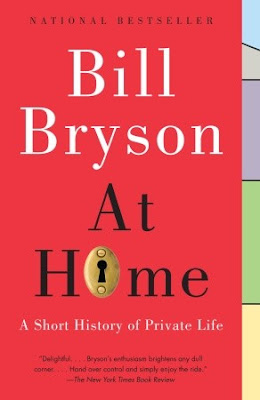
From http://www.randomhouse.com

Finally, I wanted to say a few words about Bill Bryson’s At Home. It’s a book that came out a few years ago that looks at a particular home, his home to be exact, and searches for the histories of particular rooms. I’ve read Bryson before (A Walk in the Woods), and have liked his meandering tales. However, this wasn’t quite what I expected.

It’s not that it wasn’t in the same style as his other books. He uses the house—an old rectory in England—as a touchstone in telling broader stories about social changes in European architecture, family life and industry. But I had hoped for something a little bit more….structured.

I know, I know. Having read Bryson before I should have known better—but it was a little disconcerting at times to go from talking about a bedroom or a kitchen to the history of bedbugs and then to a discussion on funerary arrangements and graveyards.

That minor disappointment aside, At Home is one example of how a broader story can be told through a particular structure. Certainly not the first to use this mechanism, however it provides insights into how rooms can spark interest in the unexpected.

~~~

And with that I would like to wish everyone a very happy Thanksgiving. Eat well, be merry, (shop local), and live large.
The Third Act: Stripped, Betrayed, and Rhymed

How does a play that rhymes
Keep us all in line
Is it the lovely dresses?
Or simply all the messes

The scrapes and schemes
With portents and themes
Bringing out death and love
Or all of the above

But in all the wonder of the stage
We are released from the worldly cage
To watch in awesome delight
As the story tries to set things right

In the last month I’ve had the opportunity to attend four different plays. The first I’ve reviewed before: a tale of witches, assumptions, and finding the truth.  Wicked with a first time watcher is always great, and this time I could geek out and sing along.

The other three plays were part of my usual love of Shakespeare. With the start of the 2011-2012 season I experienced my usual double header with Free For All and a newly translated French play that was all in rhyme (much better than my attempt above). However, before we talk about those shows I thought we could talk about another version of the Bard work that I saw in Staunton, VA.

Stripped Down Hamlet

A group of girlfriends and I spent the weekend in a main street town two hours west of DC. Staunton is one of those small towns that have eateries that embrace the local food movement, shops that are all about supporting local merchants, rehabbed local movie house, and a historic hotel. It also has one other thing: a recreation of the London Blackfriars Playhouse.

Blackfriars is the name of two different theatres that existed in London. The first was a children’s theatre replaced by an Elizabethan playhouse that became home to Shakespeare’s company. Both theatres were built on the grounds of Blackfriars monastery. In building this re-creation, The American Shakespeare Center (ASC)  intended to mimic Shakespeare’s “original staging conditions.”

I’ve been a season ticket holder of the Shakespeare Theatre in DC for three years now. With each show they put on I am amazed by what a theatre with a strong budget can do with creative staging. Seeing a show at Blackfriars is a completely different experience.

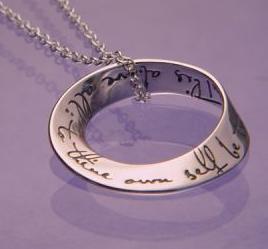
A Silver Infinity Necklace (which I own) with "This Above All: To Thine Own Self Be True" inscribed upon it.

To Thine own Self be True.  On this particular trip, we attended a production of Hamlet. In contrast to what I’ve usually seen, ASC presented the show with lights fully on, audience members on the stage, and intermission music that pulled from modern day tunes with the mood of the sixteenth century play. For Example: Letters to Cleo’s Cruel to be Kind, Simon and Garfunkle’s Sound of Silence.

Devoid of the trappings of set the show forced the audience to pay attention to the dialogue, and the language of Shakespeare. The lack of set also pushed the actors and through their delivery turned Hamlet’s insanity and subsequent tragedy into a comedy filled with dark black humor.

One last comment on the lighting: Usually when sitting in a darkened theatre the viewer feels disconnected from the story before them.  Part of the reason that this version of Hamlet worked so well is that we became a part of the conversation. With the ability to make direct eye contact during the show, I felt as if the story was being told to us, as active agents in Hamlet’s demise, rather than merely a passive presentation.

You can see Hamlet at the American Shakespeare Center in Staunton, VA through November 2011.

Et Tu Brute: Shakespeare’s Julius Caesar

The third show I saw last month was the first show of the 2011-2012 Shakespeare Theatre Company  (STC) season, which was also a part of  Free For All. This year’s free show was Julius Caesar, which while far from perfect (my group wasn’t a big fan of the actor playing Mark Antony), didn’t disappoint.

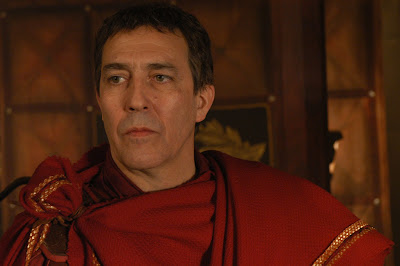
Ciarán Hinds as Gaius Julius Caeser in HBO's Rome

Presented with as much historical accuracy as possible (at one point Caesar is groomed using these scythe like scrapers called a strigil), the show evoked all the drama surrounding Caesar’s demise with gusto.

With some entertaining hand-to-hand combat and on stage blood, you really felt sucked into the fatal events on the Ides of March.

I walked away from the show wanting a refresher on the way historians describe Caeser’s death, since much of the popular depictions of his death are often drawn from Shakespeare’s play.  So much so that you expect familiar lines in other unrelated representations of the rise and fall of Gaius Julius Caeser.  I remember when watching the HBO show Rome (which tried to be gritty and realistic) that I expected “E Tu Brute” (click for an interesting conversation about the source of the quotation) to be uttered when Ciarán Hinds (Ceaser) met his end on the senate chamber floor.

There are many different ancient historians of Julius Caeser, and the two I am familiar with are Suetonius and Plutarch. While Suetonius is know for writing his histories by theme, Plutarch wrote about history in a more chronological fashion. I thought I would pull the section in Plutarch’s Lives of Caesar that describes how Caesar died.

Well, then, Antony, who was a friend of Caesar’s and a robust man, was detained outside by Brutus Albinus, who purposely engaged him in a lengthy conversation; but Caesar went in, and the senate rose in his honour. Some of the partisans of Brutus took their places round the back of Caesar’s chair, while others went to meet him, as though they would support the petition which Tullius Cimber presented to Caesar in behalf of his exiled brother, and they joined their entreaties to his and accompanied Caesar up to his chair.  But when, after taking his seat, Caesar continued to repulse their petitions, and, as they pressed upon him with greater importunity, began to show anger towards one and another of them, Tullius seized his toga with both hands and pulled it down from his neck. This was the signal for the assault. It was Casca who gave him the first blow with his dagger, in the neck, not a mortal wound, nor even a deep one, for which he was too much confused, as was natural at the beginning of a deed of great daring; so that Caesar turned about, grasped the knife, and held it fast. At almost the same instant both cried out, the smitten man in Latin: “Accursed Casca, what does thou?” and the smiter, in Greek, to his brother: “Brother, help!”

So the affair began, and those who were not privy to the plot were filled with consternation and horror at what was going on; they dared not fly, nor go to Caesar’s help, nay, nor even utter a word. But those who had prepared themselves for the murder bared each of them his dagger, and Caesar, hemmed in on all sides, whichever way he turned confronting blows of weapons aimed at his face and eyes, driven hither and thither like a wild beast, was entangled in the hands of all; for all had to take part in the sacrifice and taste of the slaughter. Therefore Brutus also gave him one blow in the groin. And it is said by some writers that although Caesar defended himself against the rest and darted this way and that and cried aloud, when he saw that Brutus had drawn his dagger, he pulled his toga down over his head and sank, either by chance or because pushed there by his murderers, against the pedestal on which the statue of Pompey stood. And the pedestal was drenched with his blood, so that one might have thought that Pompey himself was presiding over this vengeance upon his enemy, who now lay prostrate at his feet, quivering from a multitude of wounds. For it is said that he received twenty-three; and many of the conspirators were wounded by one another, as they struggled to plant all those blows in one body.

As I’ve talked about before, representations of history are often just as useful as historical truth. They reveal subtle cues regarding the time in which it was written, while also providing a glimpse into the lasting legacy of a particular piece of history.

Since this show is now closed, I leave you with Caesar’s final moments, Shakespeare style: Et tu, Brute! Then fall, Caesar.

Rhyme Time: The Heir Apparent

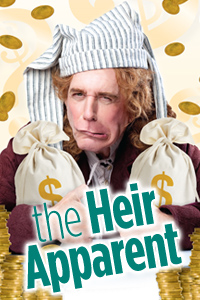
Just four days after seeing Julius Caesar I saw a new staging by the STC called The Heir Apparent, written by Jean-François Regnard in 1708.  For the first time in a long time I walked into the show not knowing what to expect, and about two hours later I walked out smiling. Presented entirely in rhyme, this translation by David Ives (who also did The Liar a few years back) was engaging and light-hearted.  By no means a serious play, it follows a young man Eraste who wants to marry, but can’t until his miserly uncle names him the heir apparent. Hijinks ensue, including some cross dressing and a surprise guest that even now we can’t stop talking about.

Ives even inserts, in that clever way that translators do, some more modern allusions bridging the gap between 18th century France and 21st century Washington, D.C. Sometimes this bothers me, but in this case not so much. Probably, in the end, because the jokes flowed seamlessly into the rhyme scheme and were so enigmatically delivered by the players on the stage.

Even the reviewers got into the fun, with Peter Marks of the Washington Post presenting his opinion the same rhyme scheme as the show.

I highly recommend seeing this show if you can, its run ends October 23. For more information visit www.shakespearetheatre.org

Outside the Box: Strong Female Characters and Moving Out

Quick post before I head out on vacation for the rest of the week. In the last month I’ve been busy working on two different blog posts. The first was personal about big life changes, while the second took a look at some of my interests outside history (namely my love of reading). So here are the two links. I’m working on a few more posts before I head out to the 2011 National Preservation Conference in Buffalo at the end of October.

My first blog was for the Smithsonian Homespun Project where I talked about the act of Moving Out.  Not an easy thing to do, but something that forces you to think about your past, present, and future. Check out You Can Take it With You  here.

In a slight departure from my normal blog writing I recently wrote a post for a blog called Fangirl.  In the post I try to look at what makes a up a strong female character. By no means a definitive recipe for success it was a great exercise in thinking about why I’m drawn to some books over others, and how dynamic and interesting female characters can be. Read my take on The Anatomy of a Strong Female Character on www.fangirlblog.com.

The Power of the Cover

At first glance it is the color that forces me to stop. Something about the way they play together—within shapes, images, old photographs. The different hues mash together into an emotion….

…as I read the words. The Bluest Eye, Cat’s Cradle, A Dance with Dragons.

Together the design serves as a teaser for the text that lies between—a teaser for the good, the bad, and the horribly disappointing.

This post is about the power of the Cover, and how sometimes the cover is the difference between reading the summary flap or just walking by without a second glance.

When I was in college I worked at a Barnes and Noble where one of our jobs was to go through the shelves and do face outs to make the shelves look full. This also served as a way to highlight a specific title. Often times when I walked through I tended to be influenced by what had read, or heard about from others,  and those were the books that got that extra attention. But sometimes the cover that I highlighted was one that was beautiful, intriguing, and expressive.  Because our store was a hub of tourist activity (it was in the middle of Merchant’s Square in Colonial Williamsburg) we tended to get a lot more browsers in addition to our regular customers and so making sure that those shelves were especially attractive was important.

Another part of my job involved working at the information desk. On more than one occasion I would have conversation that went like this:

Customer: Hi I’m looking for a particular book.

Me: Sure, can you tell me the title?

Customer: No.

Me: How about the author?

Customer: Nope.

Me:    

Customer: …but I do know that the book was redish orange, with a circle in the middle. And it was set in Scotland?

More seriously, this is where the power that lies within a cover came up. If it was a piece of popular fiction more often than not one of us would recognize it based on the cover description, and would be able to find the book for the customer.  It provides an element of identification, a marker for those looking to read it. In other cases if we could narrow down the genre just walking through the shelves sometimes produced results.

So let’s take a moment and look at the book cover as an object/a piece of material culture:

Observation: The cover serves a variety of purposes. As mentioned above it is an illustration of what exists with in the book. A symbolic summary of what we will learn, enjoy, and experience. It is also meant to be, perhaps first and foremost, a piece of information. What is this book called, who is its author. You know that when you pull the book off the shelf, the back cover will tell you either more about the title or provide titillating one sentence reviews of the book from similar authors, and newspapers. Thirdly, the cover is a marketing piece. It distinguishes this particular book from that particular book.  Sometimes the cover design distinguishes one publisher from another (my favorite? Vintage Classics).

According to this essay in the Guardian, illustrated book covers, particularly early dust jackets, did not come into vogue until the late 19th century. Until then the covers of books were served as protection or as a space for advertising what other books the publisher was producing rather than the specific title in hand. The article, as do many other sites around the web, also point out the importance of the book cover/dust jacket/book jacket in the mode of identification—something that I described in an earlier blog post “Prelude to the Power of the Cover.

Continued Analysis leads me to acknowledge that even over the years book covers change with time. If one were to trace the evolution of an older title one would find multiple versions of the book depending on who and when it was published. Even today it has become popular practice to publish new reprints of books in tandem with the movie adaptation, and despite liking said adaptation, these covers often invoke a sense of impurity. A sense that is especially frustrating when the movie adaptation is nothing like the words that you have grown to love.

Just for fun, open a new browser window and do a search under Google Images. Type in “Lord of the Rings Book Covers.” to see how many different versions pop up. The version I have (left below) is very different from the version my roommate (right below). I’m sure that somewhere out there are book cover collectors who can identify who the artist and the creator of each edition of their favorite book is by—and the availability of said edition determines worth. I know that when choosing a book to own and when presented with multiple cover options (all other things being equal)–I tend to lean towards the more aesthetically pleasing edition.

Interpreting covers is a larger conversation—and probably demands a lot more research that I have had time to give. However, each edition, each design, says something about the times in which we live (see above commentary on movie covers). And in an age of e-books the purpose of covers has changed—e-ink doesn’t allow for full color imaging, despite making the ability to read text easier on the eye. Additionally the art on the page is probably a reflection of imagination, but also cultural influences in that particular period of time.  More specifically I find myself thinking about how the widespread censorship in Nazi Germany dictated how books were designed and marketed–and what we can learn by looking at these different covers about the messages that the Nazi’s were propagating.

As a piece of every day life, a cover says a lot about what we as a country and as a society are reading. In an age of mass marketing, seeing the cover everywhere only stimulates the brain into wanting to know more, learn more, and experience it first hand.

The Guessing Game

I first started thinking about this blog post almost a year ago when CBS Sunday Morning put together this segment (watch it here). Narrated by Erin Moriarty the piece looks at book covers as an element of our visual landscape—that they are, in fact, pieces of art.  Art  provides a glimpse into how people are feeling about particular events in the outward world–and like the Mona Lisa, a Mark Rothko painting, or Monet’s Water Lilies covers are seared into our minds. So let’s play a little game:

Can you identify this book by its cover?

How about this one?

or this one?

This exercise made me think about the book cover as it moves into its next phase of existence, where (as both the Guardian and the Sunday Morning piece explain) the digital world is using the cover in entirely new ways that shift the function of the book into a new medium (after all you can’t see what someone is reading when they are on a Kindle or a Nook). In fact, when I start reading a book on my Kindle it starts on the first page, automatically bypassing the title/author acknowledgement/index.  In this way the cover is perhaps reduced to playing merely an informational role, without the vivid colors and design elements translating easily into e-ink.  I do acknowledge that on color e-readers you can see covers in much the same way as you see them off screen–but even then its a digitized form, without the texture of the physical copy.

Of course books aren’t completely gone from our physical landscape, and I very much doubt that they will ever be completely eradicated.  I also recognize that not everyone cares as much as I do about the face of a book–and look to word of mouth to find new titles. I do hope, however that we’ll still be able to see a book cover that is as with iconic as the covers for Catch-22, Jurassic Park, and The Great Gatsby.

Personal Inspiration

In preparing this post I thought it would be fun to look at some of my favorites. So here are a few book covers that I love:

Tana French’s book is startlingly creepy–the branches of the tree emblematic of the complexity of the mystery that lies within. This is my favorite cover of Little Dorrit partially because it juxtaposes the door of the Marshalsea with Amy’s form. The way her hand clutches her skirt indicates movement as she passes from her father’s walled prison into the chaos of London. I love this cover of Stardust primarily for its whimsy.

As I mentioned on this blog, a few weeks ago a dear friend passed away. Before she died we had talked about “the power of the cover” and she took the time to send a few of her favorites my way:

I also sent the request out over Twitter, and one of my followers pointed out these two covers. When I asked for an explanation @EttaHRichardson tweeted that the covers are attractive because of “the grandeur that the building maintains” for the first and “it’s the style, a bit Voo-doo & Cartoon but fresh and edgy” for the second.

I guess for me, the power of the cover is in its ability to inspire imagination. That the artwork, the layout, and the text all provides that initial jump into the unknown,  into a world that is filled with tales of heroic acts or dastardly deeds, a world filled with the enigmatic, the charismatic, the magical, and the ordinary, and a world filled with stories, and storytellers.  It is the power of the cover which starts us on this journey, one that begins  long before you even open the book in your hand.

Note: Just a note that for those of you that are in DC that you should visit the National Book Festival down on the National Mall. It will take place September 24-25, 2011.

Image Credits: Courtesy of Google Images, Amazon.com, WSJ.com

Prelude to The Power of the Cover: The Deathly Hallows

Eleven years ago July (ELEVEN years!). I’m on my way home from an internship, just a few weeks before I go to college. It is Pre-Twitter. Pre-Facebook. Pre-easy access to the internet.

Map of the blue line. We started off at Federal Triangle and continued straight on until Franconia Springfield.

I settled myself on a blue line train at Federal Triangle with a woman who is holding a pretty hefty book in her hand. It’s a green cover with a cartooney looking boy with horn rimmed glasses.

She ends up sitting across the train from me, but still within my line of vision, and as we travel I find myself without anything to occupy myself, choosing to look out the window instead….and people watch. We approach Crystal City. Stop. At this point I notice the woman looking up with the classic oh I missed my station expression on her face. She half stands, then sits back down, pulling out the book to read again.

She reads on, and we travel past Braddock Road, King Street, and Van Dorn Street easily 30 minutes past what must have been her original stop to the end of the line. She closes the book, finger firmly marking her place, exits out of my train and then renters the one waiting on the other side of the tracks to take her back to her destination.

As I move up the escalator I can see that she is lost to the outside world again, engrossed in whatever is written between the hard green covers.

It was the Summer of 2000, and the book was Harry Potter and the Goblet of Fire.

I want to say that I was drawn to the series because of the cover because even then you could see it in bookstores, coffee shops, and on the Metro. But I wasn’t. I was drawn to the texts ability to draw in the mind, and clearly the imagination.

But it was the cover that told me what to read.

Now, eleven years (ELEVEN!) later I spent the weekend watching the final chapter of the Harry Potter saga on the big screen. Nothing is more exhilarating than Midnight Madness for a movie of a book that changed how you look at fantasy and storytelling. Feeling slightly otherworldly, you find yourself playing Harry Potter twenty questions for two hours as a stream of kids roll by dressed up as the Hogwarts Express in a conga line. In my head I was thinking that this must be how those moviegoers felt when they sat for the first Star Wars movie in 1977—the feeling of wonder and surprise that a story of dragons, and quests, heroes and heroines opens your hearts and makes your imagination travel to new heights.

But while the on screen spectacle was arresting, it was another reminder of just how strong of an impression a book can make. I testify that this series made me smile and at times, cry. There were tears when Deathly Hallows book first came out, and again as the revelation that we had all misjudged a certain potions master played out across the screen. While this series grew up with its primary audience, I can say that it saw me through my twenties–through college, grad school, job uncertainty—essentially the start of my adulthood. And so while I was never in the same age range as the trio of friends, I recognize the impact the story had on my love of storytelling and writing.

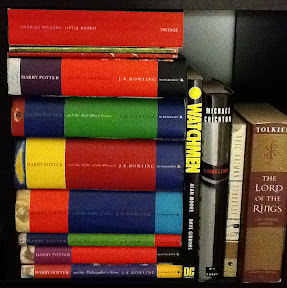
My Harry Potter Books, along with a few other of my favorite titles. PS: If you haven't read Little Dorrit I highly recommend it.

As for my physical copies of the books? I really did end up choosing them based on their covers. Even though I was curious after that initial metro ride, it wasn’t until a trip to India that I started collecting my personal copies. Each book has its own story: 1, 2, 3 & 4 I got in Mumbai during a family vacation (though at the time 1-3 were in paperback, my mom got me the hardcovers after someone donated them to her library). Book 5 (Order of the Phoenix) I bought in the States, until a fortuitous trip to visit a friend revealed that this was the only book where she had the British version, so we made a switch. Harry Potter and the Half Blood Prince made it to my shelves after a midnight purchase in 2005, another midnight trek to a bookstore in the London suburb of North Harrow.

For Harry Potter and the Deathly Hallows I was in New York City, moving my sister into her first apartment. I stood in line, by myself, at the Union Square Barnes & Noble, until someone told us (well past midnight) that there was another store a half a block away with no line and plenty of copies. I’ve never read a book faster in my life. (Once again playing switcheroo helped me complete my matching set as a friend visiting abroad made an exchange when she returned to the states.)

After seeing the movie this weekend, I wanted to write a piece in farewell. However, I realized I’m not quite ready to say goodbye, and probably never will be. Many articles this week have listed favorite parts, characters, objects—and have posited clever praises on Rowling’s femininity (or lack there of). Instead I thought I would leave you with a passage in the book that made me think—one that speaks to the power of imagination, but also of knowing your own self—and trusting what is in your own heart.

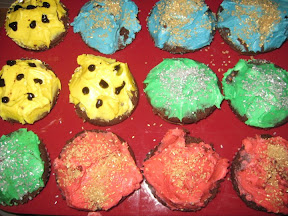
Cupcakes from Midnight Madness. Three for each of the Hogwarts Houses. Recipe for Cake and Buttercream from Real Simple Magazine (Click to view).

From Harry Potter and the Deathly Hallows (pp579)

“Tell me one last thing,’ said Harry. “Is this real? Or has this been happening inside my head?”

Dumbledore beamed at him, and his voice sounded loud and strong in Harry’s ears even though the bright mist was descending again, obscuring his figure.

“Of course it is happening inside your head, Harry, but why on earth should that mean that it is not real?”

The Sorting Hat Says Goodbye

When we first met he was very young
As, of course, were we
But as we grew, he found his place
To fight Voldemort and be Free

In our minds the wonder sparked
And imagination soared
Whimsical and fantastical
We were never bored

And then the end in published form
Came to say goodbye
But we all knew we’d still have
On the movies to rely

Soon there will be no more Harry Potter
To look forward to in time
No Hallows, Horcruxes, or Hogwarts
And I’ll have nothing left to rhyme

So join me on the 15 of July
As the stroke of midnight chimes
And we’ll say fare-the-well to the wizarding world
With a flick of our wands, our hearts and our minds

—P. Chhaya 6/21/2011

Note: More on The Power of the Cover will follow next week.

Hodge Podge: On Memory, Weddings, and Original Recipes

I have been working on this post for a few weeks, but alas the post-wedding catch up has taken over, plus every time I think I am done something else comes up that I want to add to it. But sometimes you just have to hit publish!

We will start with a quick word about weddings. Historically speaking weddings are the bringing together of two families and thus creating a new path of history. Two stories become one thus creating a new narrative.For those who love genealogy these events and the documentation of these events will one day let our great, great, great, great, grandchildren trace their own ancestry.

In addition to the immaterial the actual physical landscape of a marriage reveals heritage and culture, an opportunity to show the more recent past of the bride and groom. For my sister it was the trappings off India mixed in with with the quintessential American rituals (the first dance, cutting of the cake). My friends Mary and William embraced their inner Irish and love of fantasy for a ceremony filled with beauty and heart a week later.

For this hodge podge I’ll talk about This American Life episodes, a play on memory by Harold Pinter, a short conversation about fictionalizing the past through Geraldine Brooks’ work People of the Book and Year of Wonders, and finally a pop culture meets history link.

This American Life

There are actually three episodes that I wanted to talk about here. The first was an episode about Kid Politics. Where reporter Starlee Kine describes a program at the Reagan Library which asks kids to reenact the invasion of Grenada. While the show looks to see if kids make better decisions than adults, I found myself reacting to the subtle cues the library educators used to emphasize that the presidents decision was the “right one”. The kids who spent some time learning about Grenada before arrival are divided into three groups “the president and his cabinet”, “the military”, and “the press.” Than whenever the student makes a decision that Reagan did not make a light flashes along with a loud buzzer and a red light. On one level it is one way to indicate that the President made a different decision, but I think that by painting other options as wrong or right pushes kids away from critical thinking/analyzing presidential history as a series of decisions rather than because it happened this was the only course we could have taken.

The second episode had a segment that examined a television show, “This Is Your Life.” The premise interviewing individuals, and then surprising them with a carefully constructed vision of their life. Two separate episodes brought on a Holocaust survivor and a Japanese man who survived the atomic bomb-introducing these very sensitive subjects to the American audience in a way that they had never been discussed before. Each person also had a “surprise” guest–in the case of the Holocaust survivor it was a fellow camp mate, while the Japanese man (who was in the United States getting operations for girls who had been disfigured from the blast) was presented with one of the pilots of the Enola Gay. “This is your Life” seems almost like a modern day reality show. In both cases described above the individual being profiled used the show to bring awareness to what had happened to them, despite the shows structure feeling a little intrusive and voyeuristic.

And finally, for a light-hearted turn. Ira Glass believes he found the original recipe of Coke. While it is possible that it is a version of the drink we all know and love, this episode is a testament to the power of the document. Of finding things in boxes years from now that can tell a missing story. Above all else this episode showed that history is fun…especially when it involves an element of food ways and a little history of an American industry, regulation history and pop culture all at once.

Shakespeare Theatre: Old Times

The second to last show of the 2010-2011 season wasn’t a traditional tale by the bard but rather a reflection on memory written by Harold Pinter. The two leads are a married couple Kate and Deeley (played by Stephen Culp, of West Wing Fame, and the Tracy Lynn Middendorf who played Bonnie in LOST), who are expecting an old friend of Kate’s named Anna. In the course of the show, the play becomes less about a visit, and more a battle of remembrances between husband and guest. It is stark full of imagery that asks the audience to question, what is real what is true, did that really happen. It’s at times funny, yet equally gloomy as tension rises. Yet the woman at the center of each memory, Kate demands no attention. She seems content to live merely as an object of this memory, trapped in her own thoughts, often letting her husband’s former friend memorialize her as if she does not exist. The show ends in a bizarre parody leaving us to wonder about what memory really is.

I know that we see things one way in the moment, and that with time that vision shifts and is colored by the receding years. Collective memory works the same way. This play fiddles with the past, and illustrates in an evocative way about how even what we believe to be true can change in an instant. Old Times is playing at the Shakespeare Theatre in DC through July 3.

Of the Book: Two Titles by Geraldine Brooks

I’ve been doing a lot of reading, as usual. From fantasy, to catching up on my Public Historian, I find reading to be incredibly cathartic. Occasionally you come across a text so engaging that you feel inspired. This is so with books by Geraldine Brooks. Best known for winning the Pulitzer Prize for March which follows the father in Little Women through his wartime journey, I picked up People of the Book and Year of Wonders. Both books use history as the backdrop for remarkable examples of storytelling. Year of Wonders is the story of a town hit by the plague, and how it voluntarily closes its boarders to keep those outside safe. People of the Book follows a book conservator and narrates her story and that of the object she is trying to save–it is the Sarajevo Haggadah, a real book with a really engaging past. It is an amazing piece of writing–in that as we step back in time with the book’s history we see fragments of the world, of Europe during times of intense upheaval before being brought back to our guide’s life. For anyone who is not convinced that material culture tells us more about the past than anything else–I would pick up People of the Book immediately.

.…and finally

I took a moment for fun and went to see the latest X-Men movie. It was fairly well plotted and takes place during a particular part of the cold war (1962 to be exact). However, like most movies–it gets some things wrong. Ta-Nehisi Coates went to see the movie with his son and tells us about it in “You Left Out the Part About….“. A good opening for a discussion….so tell me what you think in the comments.

Pushing Language Towards the Joyful

I am maxed out.

For the last twenty days the Kennedy Center in Washington DC has put on a vision of India. A vision filled with art, music, politics, literature–a vision filled with noise and texture and soul. Maximum India looked to grasp an idea of Indian culture and bring it to the United States. On Friday I attended my last event (though the last of the festival will be a free performance by Panjabi MC) a literature panel with Salman Rushdie and Nayantara Sahgal.  The first is the author of Midnight’s Children (an RPSNE book club book) and is known for his incredible use of the English language, while Sahgal, an author in her own right, is known for setting her books against the backdrop of change in the South Asian subcontinent–in addition to being the niece of India’s first prime minister Jawaharlal Nehru. Ahdaf Soueif, a political and cultural commentator, moderated the panel.

So the discussion kicked off with a question to each of the panelists about why their work in literature is suffused with discussions of politics. The short answer? Writing is a form of resistance. That the written word proves that identity is not a collection of stereotypes, but rather what you want it to be. Each looked to their generation, Saghal of the revolutionary, and Rushdie from a transitional India, and found separating what happened around them from what happened at home was unfathomable. For both writing involved an element of the public and the private –and that the only way to make sense of change, to reconcile that change with the vision of India the republic, one had to integrate narratives from the personal and political.

Sometimes dealing with current events, sometimes a lively exercise in humor this lecture touched upon some serious ideas. I was drawn to, as I usually am, to the conversation about language. Rushdie, after being complimented on his lack of “respect” for the English language and his ability to embrace its malleability, spoke of how this malleability makes writing about India in English possible. That he had to find a way to break down the “cool, quiet, formal” English of the British Raj to be compatible with the “hot, noisy cacophony” of languages from India. He said that he wanted to “take English away from the English.”

He wants to push language towards the joyful. Hear. Hear.

This thought, amidst the many other topics from this lecture, inspires me. The way we speak to one another, the way we articulate reactions and actions on the familial, local, regional, national and global stage says much about who you are, who we are, who I am.  That politics and literature define these identities and often are linked together to tell the stories that official history neglects to tell.

Naturally, this part of the conversation led to the question re: who owns the narrative? Who owns the past? What perspective is the most valid? A subject near and dear to every historians heart–and it is acknowledged that the closer you are to the event/situation the harder it is to see beyond your blinders. Writing in the moment has some value, but taking a step back (that is an act of time mores so than a physical taking a step back) can bring details into focus that you wouldn’t see otherwise.

An obvious assertion, one that I’ve heard a few times in a few different places. Distance and time bring truths closer to the one reality. For literature that is deeply rooted in the larger public narrative of the place in which it is set, that distance and time makes a story stronger, more reliable, more resonant….

More Joyful.

A Thousand Paper Cranes

When I was a little girl one of the first books I read told a story of another little girl,  Sadako who had been diagnosed with leukemia after the United States dropped atomic bombs on Hiroshima and Nagasaki.  In the story she started folding, shaping, and manipulating paper into the shape of paper cranes, because an old Japanese saying states that a thousand paper cranes will grant the maker a wish. For Sadako that wish was survival.

While the cranes have become a symbol of peace and for the abolition of nuclear weapons,  I plan on folding one or two tonight as I think and pray for those in Japan in the aftermath of the 8.9 earthquake and resulting tsunami in Japan.

Note: For those of you who might not know the story, Sadako was only able to finish folding over 600 cranes before she passed away. Her family and friends (amongst others) completed the task. Today, there is a memorial in her honor at the peace park in Hiroshima where you can often see hundreds of  paper cranes that have been folded by others.

Telling the Whole Story

I am a sucker for a good book, especially stories that are steeped in their own…history. There is one part of me that lives firmly ensconced in reality where I constantly think about our own past and its public component, but then there’s this other half that becomes engrossed at made-up worlds and marvels at how writers are able to create complete visions filled with music, art, and culture all through the written word. And when that vision integrates a mythology with heroes and morals like our Greek/Roman/Etruscan/Hindu myths it is all the more fantastic.

When those books end up on the big screen, I find myself thinking about how the director’s imagination measures up (of course, no movie is ever quite as satisfying as a book for me). That being said when the first part of Harry Potter and the Deathly Hallows came out I was floored.

I’m not the most critical movie watcher.  Generally, I’ll always try to find a reason to justify sitting in the theater for 2.5 hours (Though Avatar, the 3D is the only thing that saved you.) Anyway…when I saw Harry Potter 7 (Part 1) a few weeks ago I realized that the strength in the narrative came from J.K. Rowling’s ability to create a wholly believable world. When reading the books the reader is bombarded with the tools of the historical trade to tell the story–and each step hearkens back to something that had been prophesied not only when Harry Potter was a young boy, but even further back through the veil of mythology.

What are some of the key primary sources we use in writing about the past? Objects, written sources, art, music.  Material culture includes things like jewelery, funerary objects, items from everyday life that ultimately create meaning for an individual, a community and a nation. In terms of the written word we look to the text in the form of diaries, newspapers, and books for contextual clues.

So in order to understand the wizarding world of Harry Potter we are pulling from the stories told in the last six books, but Rowling also pulled together tools of historiography to tell her story.

In terms of material culture we have the standard trappings of the witch or wizard, but more specifically there are the Horcruxes–magical objects that hold individual pieces of Voldemort’s soul, objects that hold an overarching meaning for him due to their connection with his own mangled past with Hogwarts.  Then we have pieces from Harry’s own past–a golden snitch which holds his key to survival, the diary of Tom Riddle, and the three Deathly Hallows.

Of course this final chapter of the Harry Potter saga is not bereft of textual sources.  Dumbledore’s last will and testament plays a role in setting the three on their journey, not to mention the actual gift to Hermione–The Tales of the Beedle the Bard which adds yet another rich layer to the world. Then we have the book written by Rita Skeeter, which uses (albeit doctored) oral history from Bathilda Bagshot to put together Dumbledore’s past connections to Grindlewald a history that is also told by Elphias Doge. Competing sources of the past, both with kernels of information that are hidden by the other individuals bias. To some extent the last Harry Potter book finds Harry, Ron and Hermione playing the historian and try to suss out the means to destroy Voldemort in the end.

I think one of the additional strengths of the story, and why it resonates with some many, is how it emphasizes the importance of place and that subsequent connection to a community, family, and a people. I know that the sadness I felt (both in the book and the film version) of going back to Godric’s Hollow is directly related to knowing the ‘historical’  moment that happened there. I loved how in the book at the home of Harry’s birth there is a monument to the sacrifice–and how those pilgrims have written of their connection to the events that occurred there.  This isn’t all that different to the writings at Abby Road near the Beatles studio, or the guest books at any major historical site around the world. Good fiction, often makes connections to reality. (As an aside, I also love how cemetery markers provided Hermione with a clue re: the Hallows. As a primary source, gravestones can tell you a lot about the people who lived there).

As I mentioned, part of the reason my blogging has been slow the last few months is because of my participation  in National Novel Writing Month.  I tried to integrate some of my favorite things about history (material culture, landscape analysis, and mythology) with a kernel of a story.  While I’m not sure about how successful I ended up being (while I hit 50k words, the book isn’t done) I did gain a new appreciation for J.R.R. Tolkien, Robert Jordan, George R.R. Martin, Orson Scott Card, and of course J.K. Rowling. I definitely recognized that history isn’t just about revealing fragments of the past, but about trying to engage with and embrace the whole story–in the fictional and non-fictional realm.

~~~

On a side note, here is my work blog post from PreservationNation.org. If you didn’t know already the Historic American Landscape Survey turned ten this year. I also took a trip to Baltimore to learn more about preservation efforts by Baltimore Heritage, Inc.

A Layered Past, An Immortal Life

Henrietta Lacks

Let’s take a moment and think about her name. Henrietta. Lacks. Our names serve as an identifying marker–the gateway into our personalities, our history, our lives. Henrietta had two names, the one that she died with, and HeLa, the name that made her immortal.

For the RPSNE book club this month we decided to read The Immortal Life of Henrietta Lacks, a non-fiction book that tells the story of the life, death–and life of a poor African American woman from Baltimore, Maryland.  In short, in the 1950’s Henrietta Lacks died of cervical cancer at Johns Hopkins University. During treatment and upon her death, her cells were taken for research–and were found to be the first cells grown in culture–cells that to this day could encircle the Earth hundreds, upon hundreds, of times. As the book states, her death allowed for scientists to develop the polio vaccine, and investigate the causes for cancer, major virus’, and the effect of an atom bomb on the human cellular structure.

But that is the story of HeLa–not Henrietta Lacks. Her story is one of growing up in rural Virginia, of going to school, and almost dropping out after becoming pregnant–if not for her sister-in-law, and of raising five kids in a segregated Baltimore city. Her story is also the story of her death, and the very real experiences of someone dying of cancer. And it is the story of her five children, of her youngest daughter Deborah who never really knew her mother–and how the knowledge of HeLa cells changed her life.

History is often told along a distinct timeline. We have a birth, we have a death–and the story is best told in chronological order.

Henrietta’s story (soon to be a TV movie by Alan Ball, Oprah and  HBO) is a layered story, and Rebecca Skloot does an incredible job of weaving the scientific history/the history of the HeLa cells, the Lacks’ family history, and Henrietta’s own personal history.

I don’t want to spoil the book for those interested in reading it, but I did want to point out a few details about this very public history. First, methodology. Rebecca Skloot is nothing if not meticulous in her writing. She is very clear in laying out the various controversies in the field, pulling together public perception on cell culture with current discussions on privacy and the human genome project. She makes it easy for someone who is not a scientist to understand the role that HeLa played in scientific discoveries for the last sixty years.

Second, narrative. I found that this story was as much of a memoir on Skloot’s perseverance and connection with the Lacks’ family….and the development of trust. In putting the pieces together Skloot is honest, fair, and open in describing the faults and flaws no one is described in a vacuum or prettied up for the sake of the publication.  Taking place against the the backdrop of  The Civil Rights movement, Nixon’s War on Cancer, 9/11 she weaves together scientific discourse, american history, the Lacks’ history, and her personal history all together to create a distinct, interdisciplinary image that you can’t help but relate to and understand.

Third, implications. Many history books of a popular bent tell a story rooted only in the past. They look back and say, “hey, isn’t it nice that things aren’t that bad anymore?” Not so with this book–which really emphasizes the new frontier for scientific (and ultimately our own) history. What will Henrietta’s cells do next? What diseases will HeLa help to cure? A few year’s back when the new federal medical privacy laws went into effect (HIPAA, in 1996) I didn’t think anything of it–but I think that this book has helped me to become more aware and educated.

Of course the strength of this narrative is that an ordinary woman unknowingly and without giving permission, has made an impact on the world. The fact that none of us knew about her until recently does not matter. Without Henrietta Lacks our lives would not be the same.

~*~*~

The Immmortal Life of Henrietta Lacks, by Rebecca Skloot

Doctors took her cells without asking. Those cells never died. They launched a medical revolution and a multimillion-dollar industry. More than twenty years later, her children found out. Their lives would never be the same. Learn more here. You can also learn more about Henrietta Lacks through NPR’s Radio Lab segment here.