Closing it Out (and a bit about Nashville Food)

I know it has been a few weeks since the end of the National Preservation Conference, but I wanted to make sure to provide a closing post. On Friday after dispatching the last of the field sessions those remaining in town made our way over to BB Kings for the Final Fling which included a live auction and music from Last Train Home.
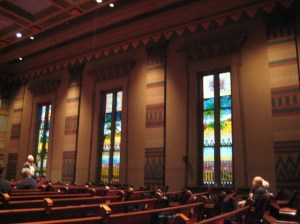
Interior of the Downtown Pres. ChurchBut there was more to come. Saturday dawned bright and early for us with the Closing Plenary in the Downtown Presbyterian Church, an example of Egyptian Revival architecture. We were about to be treated to a talk by Chief Justice of Indiana Randall Shepard and Congressman and Civil Rights Leader John Lewis of Georgia.
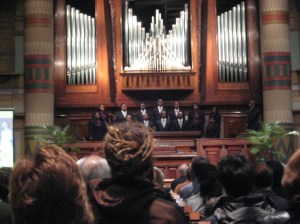
Fisk Jubilee SingersBefore we talk about them let me say a few words about the Fisk Jubilee Singers. First started in 1876 as a means to raise money for Fisk University (the first American University to offer a liberal arts education without any stipulations as to race) the group is now known for preserving one of America’s greatest treasures—that which the website refers to as the negro spiritual. Let me say from first hand experiences that those voices rose in perfect harmony, bouncing off the walls with a clarity and resonance so vivid and vital that I got chills.

As for the talks-despite coming from two tangentially different directions (preservation and law/preservation and civil rights/politics)-Chief Justice Shepard and Congressman Lewis had ultimately one message for preservationists. The Chief Justice surmised our mission in one eloquent sentence, that “we stand up for livability, for a sense of place and architecture that lifts up the soul rather than deadens it.” His words were followed quickly by a call for continued agitation by Congressman Lewis who proclaimed that “If we do not fight for these places then history wont be kind to us.” In both speeches there was a rallying call that said, to borrow a popular phrase from the National Trust at this conference, what we do matters. That preserving buildings, music, and the spectacular architecture that Nashville has to offer effects how people live and breathe and connect with the world around them.

This dialogue intermingled with my thoughts on the music, the lights and the life in Tennessee and led me to ponder the following question: Where do we go from here?
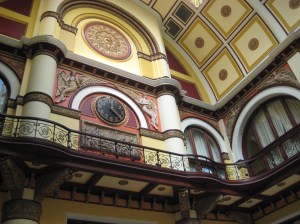
Union Station Hotel in Nashville

All right. Maybe not. But it does allow me to segue into the final event of the conference (for me at least) which was the Forum Lunch, and I urge everyone who is interested on where Preservation should be and could be going in the next fifty years to take a look at Don Rypkema’s talk here. Particularly intriguing for me was his assertion that as historic preservationists we should work (at least in urban areas) to manage change over time and not necessarily a point fixed in time. At the heart of his talk he is asking us about how we remain relevant in a world that incorrectly sees history and historic preservation as a luxury, as something that will not create jobs, will not help the economy, and is not important enough to consider a priority at every level of living. He says that we are evolving–(for those not familiar with it, This Place Matters is a program of the National Trust that asks citizens to look at the world around them and identify the places that matter to them.)

Here is my test – look at what made the list of the National Trust’s “This Place Matters” program. Virtually none of the finalists met the test of either being an architectural masterpiece or of particular significance to our national history. Those places were nominated because they mattered to the local community and in many cases not on architectural grounds. I for one think that is a wonderful way for historic preservation to have evolved.

Stained Glass at Union Station Hotel

I say that this is exceedingly clear when we think about the evolution of historical thought in the last few decades. We have moved from looking only at the big men of history to understanding the everyday—the people on the streets, the forgotten and the silenced. Social history has done amazing things for democratizing what we know about our pasts and our future—we can now step inside museums and watch on television stories that make connections on a more visceral level than before. It is the same way with Historic Preservation whose history may have began with the rich and the elite but has long since moved to a movement that seeks to preserve the places we live in, the character of neighborhoods, the places that, in essence, make the world unique and diverse in every sense of the word.

So I think my one takeaway from this conference is that we have to be open to expanding our definitions and boundaries, looking to new horizons to let the past and present stand the test into the future.
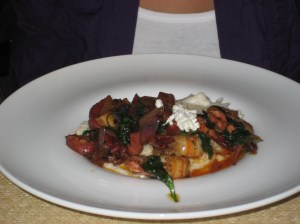
Shrimp & Grits from Prime 108Whew. Did you think I was going to forget to talk about the food?

This is one of those towns where being a Vegetarian is really difficult—luckily I eat chicken, and boy did I eat a lot of it.

Here are my recommendations:

  1. The Fried Chicken at BB Kings
  2. While the Mac n’ Cheese I had at Robert Hicks’ house was to die for, I’ll just say that Nashvillians know how to make a mean mac n’ cheese.Mike's Ice Cream Fountain-Ceiling detail
  3. Make sure to check out Mike’s on Broadway by the River where you can get some of the most delicious ice cream cones out there.
  4. For brunch—go fancy and hit up the Wyndham Union Station (Prime 108) where I had some delicious French Toast, and my friend had some true southern grits with shrimp. While we waited for food we ogled the stained glass windows.

Don’t forget to Check out the pictures on Picasa!

National Preservation Conference in Nashville

Nashville: My Place Matters, Opening Plenary

It has been a wild few days. I meant to post this earlier but was struck down with a crazy head cold.  Sad that I missed the partner’s reception but the early bedtime put me in a much better position to enjoy yesterday’s events.

First though–I wanted to say a few things about an event I worked on Tuesday. Charlotte Bonini (Senior Education Planner for the National Trust for Historic Preservation), Kimberly Nyberg (director of the Tennessee Main Street Program), Andrea Blackman (Director of Special Collections at the Nashville Public Library), and Kathryn Bennett (Librarian at Hillwood High School) put together a program for a group of fifth graders from Rose Park Magnet School. Called My Place Matters the goal of the program was to introduce kids to the role of historic places in their lives and get them thinking about why places matter on many levels. It was inspirational and I have to say those kids were some of the smartest kids I have ever had the opportunity to speak to.

The first half of the program took place in the Nashville Public Library. The first stop was the Young Adult Room where the kids showed us pictures of places that matter to them why they matter to them. It didn’t take long for them to make the connections between why their places matter and why historic buildings are important to preserve. The second room was the Special Collections room where the kids had an introduction to some of the very cool features offered by the Nashville Public Library everything from lesson plans, oral histories and videos.

The third part of the library the kids stopped at was the Civil Rights Room where a quotation from Martin Luther King Jr. sums up the story of Civil Rights in this city: “I came to Nashville not to bring inspiration but to gain inspiration from the Great Movement that has taken place in this community.” The Nashville Public Library stands where many of the events during the Civil War occurred. The room is dotted with images of the marches, sit ins and boycotts from this era. The students were treated with lectures from two of the participants from the demonstrations–Rip Patton and Frankie Henry. Rip talked to the kids about the  non-violence doctrine and at one point a little girl looked at him and said–“You keep saying we did this…were you a part of the demonstrations?” When he said yes, the resulting awe revealed just how much the kids had internalized what had happened.  They were most shocked by the stories from Frankie which revealed just how strong you had to be in the face of resistance.  She explained how at the age of 19 she had sat at a lunch counter and had been deliberately burned by a cigarette, and despite wanting to fight back the rules of non-violence meant she just had to take it.  In talking with my group afterward I was surprised by how much they recognized the importance of that moment–that the movement was too important and too big to fight back. That non-violence was key to accomplishing their goals.

The second part of the program involved a walking tour around Nashville where the kids took a look around at the buildings that make up this neighborhood, focusing on details with a Zoomer (a rolled up piece of paper that served as a telescopic focusing device) and sketching in their My Place Matters sketchpad. It was a great exercise in revealing the connections between space, place, history and the past and I know the teachers and students involved all walked away excited and energized.

So that was Tuesday. Yesterday, I attended the Opening Plenary where Dame Fiona Reynolds and Bill McKibben served as keynote speakers. It kicked off with some great music by singer/songwriter Dave Berg. I live twittered through the entire thing so you can check out some of my thoughts on my Twitter Feed @pc_presnation. For the purpose of this post I want to talk about how both Dame Fiona Reynolds and Bill McKibben underscored the theme for this year’s conference–which is Sustaining the Future in Harmony with our Pasts. Dame Reynolds spoke about how we’re moving past seeing preservation as a luxury, something we should think about only when we have money. She described how the UK National Trust has started up a bunch of programs involving sustainability but has tailored those programs to be simple, useful and meaningful. The one that Dame Reynolds highlighted dealt with the idea of growing produce seasonally and how they are cultivating sections of of their land for gardens that will be used in their various restaurants across the country.

The second keynote speaker, Bill McKibben talked about his cause 350.org which is what scientists say is the safe upper limit for carbon dioxide in the atmosphere and how the Copenhagen talks in December on climate change may very well be the most important meeting of our lifetime. For us historians, I think his point was driven home when he talked about our sense of place and space and how climate change relates to that. He says that how we relate to these places won’t be the same anymore.  One of the best examples he gave involved Robert Frost’s home in Vermont.  How will we, as human beings, contextualize his poems that talk about the snowy wood when there is no snow in Vermont?  So much of what we do as public historians (and preservationists) depends on the materiality of the past and making those physical connections between what we know of the world around us and what we know existed in the past.  Just as those kids in the My Space Matters program were asked to take something familiar and extrapolate out to understand how places matter, McKibben is saying unless we do something about carbon emissions we won’t have those familiar links that define our very identities.

Something to think about.

Pictures to come later.

I’m on Twitter!

This coming week I will be attending the National Preservation Conference in Nashville, Tennessee. As part of the efforts I’m part of a group of staff who are tweeting from the conference. My general “tweet beat” is Genral History and you can follow me @pc_presnation.  If you’re going to be at the conference and are tweeting make sure the hash tag #PresConf.

Otherwise, if you’re interested in checking out some of the events and sessions at the conference check out the virtual attendee page where we’ll be blogging, webcasting, webchatting, uploading images to Flickr, posting on Facebook  and of course tweeting. Not convinced? Check out this awesome video with Sarah and Jason!

I’ll also be posting a blog or two right here on …and this is what comes next.

See you in Nashville!

One Man’s Trash….

My latest post from blogs.nationaltrust.org/PreservationNation.

Mostly be just musing on how things are valued differently, with a little bit of commentary on what just happened in Orange County regarding the building of a Walmart near/on (depending on who you ask) Wilderness Battlefield.

Preserving our Present

I think I was in a mood when I wrote this. All these icons were passing away and it made me think about how we would be remembered. Would it be things connected to popular cultlure like our obsession with reality television (ugh), or will it be the politicial reality we now live in. Which naturally led me to think about how this new media would be saved and documented for us to remember it.

Preserving our Present

South Asian History in America: When Does Our Story Begin?

This posting is from May 2009 during Asian Pacific American Month. What started as a search for information on the wave of Indian immigrants that came here in the 1960’s and 1970’s turned into a realization that our American story was not what I had expected.

South Asian History in America: When Does Our Story Begin?

Individual Stories, Shared Histories

A little bit about myself during Asian Pacific American Month at the National Trust for Historic Preservation.

Individual Stories, Shared Histories

127 Years & Still Counting: Barcelona’s Beautiful Work In Progress

A blog post about my summer 2009 trip to London and Spain where I saw remarkable things in cities full of history & art.

127 Years & Still Counting: Barcelona’s Beautiful Work In Progress