When In the Course of Human Events

Another Fourth of July has passed. Gone are the sparkling fireworks while the BBQ’s-hallmarks of summer–have been consumed by the hazy heat of the morning after. My Fourth began with a cup of tea with my parents–while Regis and Kelly asked America about the first seven words of the Declaration of Independence.  Heavy stuff  is what they said when the words (the title of this post) were read out loud, and found myself (spurred on by the patriotic Facebook status messages filled with uncommon quotations) digging out my pocket sized Constitution (which also had the text of the Declaration) so that I could think about the complexity of this 235th birthday of the United States of America.

On this day I honored not merely the ideal of America, or the date in which a document (a piece of our civic scripture–to borrow from Pauline Maier) was signed. Rather I chose to recognize the struggle-the one that re-examined our self evident thruths. The struggle that redefined “men” to include race and gender, and molded the meaning of life, liberty, and the pursuit of happiness.

Ironically, my Fourth of July did no include a BBQ or Fireworks. Instead, I went to see “Midnight in Paris”, a film which turned out to be a perfect backdrop for reflection on Independence Day.  In short, the film follows a Hollywood script writer turned aspiring novelist as he is magically transported to 1920s Paris. It is during these “suspension of reality” moments where Gil encounters idols of film, literature, art and culture. As a Woody Allen film, the movie mocks pretentiousness, while also being slightly pretentious–and also in a less than subtle fashion drives full force into the commentary on nostalgia (even to the extent that Gil’s novel is set in a nostalgia shop). The man is caught between his fiance and her friends who don’t understand the magic of Paris, and a slow realization that his forays into the past are really ventures into fantasy.  This mystical Paris in the 20’s pulls those who reminisce away from the demands (or as one character states the “dullness”) of the present and leaves them disconnected–unable to see the realities of the time that they fill with the veneer of romance. As one of my fellow movie viewers pointed out, the past became a way for the writer to feel affirmation and confidence rather than genuinely earning it through his actual actions.

At the same time that Gil is realizing the imperfectness of remaining in the past, he is also acknowledging the beauty of the urban. His walks through the city provided him with vision–and make him, in his mind, a better writer. For  Gil the lure of Paris is in its character both in its modern and historical sense–though even then he uses rain as a way of hiding reality (for Paris is at its most beautiful when it is raining).  It is the city–the power of place–that brings inspiration.

Fourth of July Fireworks (NYC 2011, Thermal view) Taken by T. Chhaya

I thought this was a great way to think about America on it’s birthday. That though the day is filled with nostalgia–summer days with a slightly romantic sheen, our Founding Fathers fighting for our rights against a tyrannical king–we all recognize the reality of the day–the sacrifice and yes, the struggle to get where we are. That the power of our place– our country –is not just in the sites we like to visit, but also in our people who make history with every vote, every breath, and every step.

O! say does that star-spangled banner yet wave. 

O’er the Land of the Free, and the Home of the Brave. 
A is For Arizona

I can’t believe that April is nearly at an end.  In a month that saw prep work for THE BIG EVENT in less than three weeks, and the NCPH conference in Pensacola I also had a quick, mini-vacation in Scottsdale, Arizona.  While we spent a good amount of time by the pool enjoying the warmth (it was still very chilly in DC, something that is no longer the case) there was an opportunity for some good eats, hiking, and a moment to take in a historic house tour.

I’ll be honest and say that this trip had an agenda–it was my sisters bachelorette party–and the goal was relax, relax, relax. So while we did take a lovely hike up Camelback mountain (you can see me in the slideshow sporting my PreservationNation.org shirt) the rest of the time pretty much just involved….

Food

Mohitos!

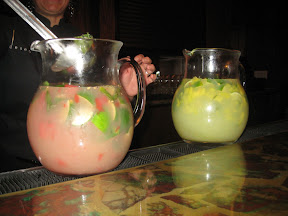
While in Scottsdale we ate at a lot of places. I did want to take a second to mention that as great as the food at Deseo was , the private mixology class where we learned how to make three different types of mohitos was fascinating–historically speaking of course. The instructor gave us a brief history of the drink and explained the different variations of rum and how they are developed. From some of the courses I took on foodways I remember thinking about the different regions of the world that make the liquor and how the histories of those nations were affected and transformed by production.  Specifically the history of sugar and the slave trade. If you want a really good book about the subject check out Sydney Mintz’s work Sweetness and Power: The Place of Sugar in Modern History.

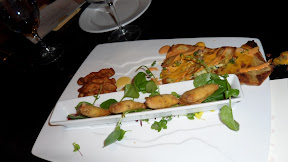
Food at Deseo

We also ate at…

Old Town Tortilla Factory

In addition to perfect weather, this restaurant had amazing southwestern/Mexican cuisine.  Built from a 75 year old Adobe, diners at the Old Town Tortilla Factory sit in the open air.  I would recommend getting the green enchiladas.

Hotel Valley Ho–Cafe Zu Zu

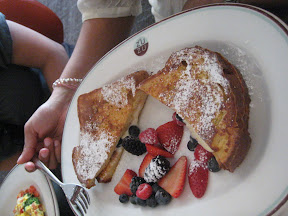
French Toast at Cafe Zu Zu

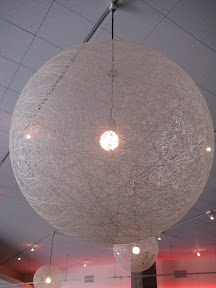
Brunch at Cafe Zu Zu was the perfect way to start our leisure filled Saturday. It also gave me an excuse to visit a very chic modernist hotel (part of the Historic Hotels of America collection). With awesome chandeliers, and a pretty trendy lobby–I thoroughly enjoyed my french toast.  If you love mid-century modernist hotels I recommend visiting the Valley Ho–or just read about its past.


Olive and Ivy

Our first stop when we landed was getting some food at Olive and Ivy. Despite it being the hottest day of the year (so far) in the area, we decided to sit outside. While we tried a lot of different food–the Sweet Corn and Tomato Flatbread was (to me at least) the star of the meal.

And Now for the History: Taliesin West

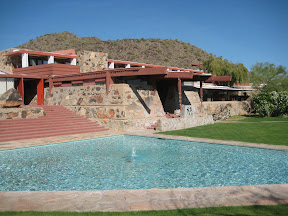
View from the front of Taliesin West

Earlier this week I posted this post over at PreservationNation about the perfect house tour. It stemmed from my general dissatisfaction of a tour I had received at Taliesin West. I wanted to elaborate on this a little. For me the typical house tour is symbolic of a time when great men dominated our history lessons. So while many tours work very hard to look “downstairs” or interpret slave quarters occasionally you get to a tour that hasn’t quite made the leap.

Now of course, the difference with Taliesin West is its connection to Frank Lloyd Wright and his influence on American architecture–but the same principals apply. Instead of trying so hard to convince the captive audience of his greatness, the tour may have been better if his concepts and ideas were relayed narratively, using the house and the school to illustrate the points.  Instead, as an audience member, the conversation felt a little condescending. Rather than talk about the school in a way that talked curriculum and how it uses Wright”s vision to train new architects, we got discussions of accreditation and how many students are accepted. It felt, at times, much like an advertisement for applicants rather than a  story of Wright’s legacy–continuing on beyond his lifetime.  I am willing to concede, as I mention in the post above, that the temperature may have contributed to the ineffectiveness of our guide–or that it was a particular off day–but when you feel like the hour long tour could have been concluded in half the time, there is a problem.

Detail of a statue at Taliesin West

The tour aside, if you do have a  chance to visit this masterpiece do so. Every angle produces a new vision — of sky, water, stone against Arizona’s natural landscape. A is for Arizona–which means it was absolutely amazing.

Note: Speaking of historic moments. While we were in AZ, some of the party attendees stayed up all night to watch the final cricket match of the cricket world cup between India and Sri Lanka. At this moment the Indian team was playing against a team that had dominated the series, while they had fought tooth and nail to make it to the end. It was a team that had not made the finals since the year I was born (1982). While very much an important part of Indian culture, I found myself unexpectedly caught up in witnessing the exciting win–and felt like I was a part of a nationwide moment of joy. So I say Bravo India!

View the full album of pictures.

A House Tour – Just Like a Building – Should be Greater than the Sum of its Parts

This blog has been re-posted from the PreservationNation blog.

Chris Madrid French’s recent blog post on Phoenix modernism on Preservation Nation reminded me of a recent weekend jaunt I took just a few miles east in Scottsdale, Arizona.

While there I did what any self respecting historian/preservationist would do and dragged my two cousins and my sister to see a Frank Lloyd Wright masterpiece, Taliesin West. I’m going to start off by admitting that I do not know much more about Frank Lloyd Wright and his architecture style than his overarching building ethic of having structures that are “in tune with nature.” I love the way they mirror the landscape, providing an almost abstract art-like vision, modernist masterpieces that are close to the earth. They remind me that the soul of a building is much more than the sums of its parts—as Taliesin West exhibited with its tilted roofline, low ceilings, and sunset colored walls.

As magnificent as the building was, I found myself contemplating another art form—the art of a house tour. Being an interpreter is a tough job. No tour is alike—as I well know from giving historic house tours when I was in college. A guide has to be on his/her toes ready to pull from the reams of knowledge they have amassed. My experience—both in giving and attending—tells me that moving a house tour from good to great also involves the following:

  • Know your audience—at the start of the tour it is fine to ask your group about where they are from—but delve deeper. Find out how much the group knows about the site and why they’ve come to visit. And then ADAPT.
  • Show—don’t tell. Obviously there is a reason that this home/structure/architectural wonder has been preserved. However, a repeated exclamation stating that it is wonderful is not instructive when the evidence is right in front of us.
  • Time. I’ve often found that one of the biggest problems with house tours is the need to fill a specific time frame. It is important to recognize when you don’t have enough material—so as to prevent repetition. It is better to produce a tight program, rather than one that rambles and is repetitive over the course of an hour.
  • Tell us a story. This is a personal preference of mine. The house tours I tend to gravitate to make the broader connections between the architect, the place, and those who lived there. It is that interconnectedness that makes a space come alive and makes those past lives tangible.
Taliesin West

Maybe the early morning 95 degree heat in late March may have had something to do with it, but the last point is why I found the tour at Taliesin West slightly unfulfilling. We had the building, we had the great story of an architect whose work dots the American landscape in many forms, but we also had this amazing living history of a school—and the students who lived (and continue to live) there. However, as we moved around the main area, each of these pieces remained disconnected from one another; each existing as a part of their own separate sphere, ultimately lacking the organic, natural flow emphasized by the teachings of Wright.

As our guide stated—entering a Frank Lloyd Wright house is like listening to music. Each element blends seamlessly with the other—low entryways opening up into a robust chorale of space—with its own volume and tone leading to a symphony of nature in something that is man-made. This is how a great house tour should be: elements building upon one another, sifting through the potential cacophony of information creating seamless (with occasional improvisation) orchestration.

See pictures from Taliesin West.

Learn more about my trip to Arizona.