Teaching American History Project Director’s Conference

In December I participated in the Teaching American History Project Director’s Conference in Washington DC.  I’ve been waiting for the video’s for the “lessons learned” part of the session, which should be available any day now, but I wanted to share the video of the keynote speech today. This way you can here the full presentation which included the description of Jim Percoco’s Applied History class, and the testimonial from another one of his students.

You can read the text of my part of the speech here.

THATCamp: Digital Storytelling, Local History, Social Media

What is an un-conference? It is a participant-driven gathering based on a particular theme or purpose. On the weekend of May 22nd I attended THATCamp, an un-conference at the Center for History and New Media in Fairfax, VA.

THATCamp (The Humanities and Technology Camp) is a gathering of individuals who work in the humanities to talk about the issues, concerns, challenges, and products in the realm of digital humanities.  While much of our conversations happened in person, they continued with the group writ large on Twitter all weekend long (#thatcamp). I thought I would take this opportunity to post about three of the sessions I attended.

Digital Storytelling

History is in essence a story. A narrative of the past compiled from documents, objects, and visualizations. It is text, it is verbal, and it is a very integral part of human identity whether it be your personal history or history on the multi-national level. During this session a group of us talked about the nature of digital storytelling and its role in education (though of course I was thinking about how it can be used in the public arena as well).

In a nutshell digital storytelling is the practice of telling a narrative using using technology and web tools. Sometimes this involves film (moving or, pictures put to sound), other times it is just a story told sans words with just digital photography. In our discussions we talked about how DS is narrative (that is a story told in a constructive format), non-narrative (something that is more formal), it can be linear or non-linear, interactive or a mash-up of many different mediums.

In the realm of education digital storytelling can be a means to teach the technology, but also a way to re-examine the past.  At the same time its a way to emphasize the value of textual, material, and visual sources in recognizing a complete picture of the past.

Some Digital Storytelling Links (Resources, Examples and Tools):

Local  History

The great thing about THATCamp was the opportunity to meet with preservationists/historians/humanities practitioners on the local level. At work, we (at the National Trust for Historic Preservation) are often looking at the big picture, and trying to provide resources to the local preservation organizations on the ground. So this session was about digital media on the local level–and what their needs were, and how to make the case to their boards and communities that digital technology and preservation are beneficial to where they live.

During this discussion we ended up talking broadly about the challenges and opportunities for local historical organizations, and aside from the ever present problem of funding we talked about the importance of collaboration and working with free, open-source products to branch out how we tell history on the ground level.  How can we, as digital historians, help our local historic societies reach a broader community not only through the framework of history that they tell, but also through the far reaching capabilities of the internet?

At the end of the session we talked about producing one of three “products” for use at the local level.

At the conclusion of the session we discussed a few possible next steps including,

  • A group blog written by local digital historians in the Mid-Atlantic region
  • A collection of how-to guides for implementing digital projects
  • White-papers or reports with detailed case studies on existing projects, e.g. PhillyHistory.org

Social  Media and the History Non-Profit

This was the session I proposed, which was to get an idea of what was going on at other organizations regarding the use of various social media tools. We started out by looking at some of the ways the National Trust for Historic Preservation has been using social media in its advocacy:

  • The 2009 National Preservation Conference, “Virtual Attendee” page. Using live chat (Cover it Live), Facebook, Flickr, YouTube and Twitter to get information about the conference out to the preservation community.  In particular the web team looked at ways in which Twitter could be used by multiple people to tell the multiple stories from the conference–and as a result a team was deployed that consisted of each individual Twitter account having its own “beat”. For example, my handle @pc_presnation was tasked with giving a general history point of view for the conference, and I ended up actually tweeting the National Preservation Award ceremony as if it were the Oscars. To prep our members we released this video.
  • The Save America’s Treasures campaign. In brief, in the 2011 budget the monies for the Save America’s Treasures, Preserve America and Heritage Area’s programs were either completely zeroed out or drastically reduced.  In order to mobilize our members and remind Congress of the importance of preservation  it was decided that social media would a) put materials out there that people could use, and b)serve as direct marketing for the cause.  The text messages, the Facebook status messages, and the materials posted on YouTube and Flickr were divided between the emotional and the factual. For examples check out our   Tweet for  Our Treasures page.

The conversation ended up with a discussion about how to integrate social media into existing workloads–and we came up with the following strategy list:

  • Adding Social Media to your work plans
  • Creating a policy to deal with criticisms
  • Developing metrics for assessing how our social media projects are reaching potential audiences
  • In order to get the word out it is useful to have canned messaging for your members to use to get the word out themselves

All that being said, we were left with a few questions. How do you reach people digitally outside of Facebook, Twitter etc., and how do you deal with the issues that come from non-profits that work on an international level? Also–aside from another portal to distribute information from Twitter and Facebook how are non-profits taking advantage of the tools on LinkedIn?

THATCamp

The nice thing about The Humanities and Technology Camp is that it appeals to individuals of all levels of tech ability–and unlike most conferences the discussions are informal, and collaborative, ensuring a continuation of the discussion beyond the four walls of the actual lecture room.  With each of these sessions we developed actual goals and ideas that could be implemented in our day-to-day work days.

LOST…..and Found

Note: Below are spoilers for the entire series of LOST. Specifically the Series Finale “The End.”

Dharma: Performing one’s duty, or the path to enlightenment.


At the end of tonight’s episode there was a window, a fragment of stained glass each with a series of symbols, the iconography/visual culture of spirituality. The icons of faith.

Inside this church, inside the building that, in the real world, housed the Lamppost, waited a Shepherd, Christian who watched for his son so that he could reveal the truth. So that their love could bring, finally, some enlightenment, some answers….that death comes to us all, and with it the ability to move on.

He said:

The most important part of your life was the time you spent with these people. Nobody does it alone. You needed all of them and they needed you.

Which I think is, in the end the ultimate message of the series. That the murder, the anger, the decisions, the choices, the manipulations were real. That evil was evil, but that it had made a choice to be evil, and that choice had consequences. When Desmond finally looked at Jack and said, “Nothing matters,” our consummate man of Science reached out to remind Desmond with newfound faith that “No. All of this matters.” That you have a duty to the people that surround you, that your actions and reactions are all a part of your personal history. Everything is real, and yes ““No shortcuts, no do-overs, what happened, happened.”

Here is what LOST meant to me.

Breaking Barriers

When LOST first started six years ago one of the best things included how it took the time to step beyond the archetypes. We had a murderer, a thief, a conman, an addict, the abusive Asian man, the submissive Asian woman, the terrorist, the spoiled brat, the handsome leading man doctor, the priest,and comedic fat man. You name it, LOST had it.

Of course over the course of the series, those archetypes fell away—sometimes creating new ones, but other time creating competing viewpoints and actions that stretched the imagination. We learned through shared experience that Sun and Jin had once been in love, that their history had pulled them apart after they fought so much to stay together. We read a letter by a little boy to the man who destroyed his life and watched as he shot that man dead, and stood by as our comedic man who never seemed to lose weight became a leader in his own right.

Most of all what this final episode shows is that sometimes what we see is not what we get. That every individual comes with a shared history, and that sometimes we cannot understand how to fix that history until we pass on into another existence….which is all the more reason why we should take care with the time we are given.

Another science fiction show that ended this year claimed, that “everything has happened before, and everything will happen again.” It looked at the flaws of humanity and claimed that the lessons will be learned eventually, but that we live in a continual cycle until that end point is achieved, if ever.

LOST, saw “the end” as a fixed point. That what intrigued us for six years was the story of Jack, Kate, Sawyer, Jin, Sun, Hurley, Miles, Lapidus, Claire, Charlie, Mr. Eko, Rose, Bernard, Desmond, Penny, Libby, Hurley, Ana Lucia, Michael, Walt, John Locke, Benjamin Linus and of course Vincent—and that for them those experiences were about trying to make a fresh start, that when faced with an inescapable situation some were able to believe in themselves and break free, while others consciously had to take the bomb and save those who he had come to love in order to find redemption.

While I don’t believe that the sideways world or the island were purgatory per-se, I do see them as weigh stations, one in life and one in death that allowed our castaways to finally be true to themselves and yes….move on.

On Mysteries, Hatches, Whispers and Ghosts

I think out of everything that happened in the 2.5 hour finale, the mysteries are what got short-shrift. We learned about the whispers, we learned about the island, but in the end we, as an audience, were expected to take those solutions on faith. To not ask answers to questions that can only be answered with more questions. While many of our characters were scientists, they lived within a world of coincidences and miracles—each a number on a compass, possible guides to the future of the island.

This is probably what is going to anger many viewers, but I think that I can live without these answers. That a series of events led each of these passengers on Oceanic 815 to the island so that they could remake themselves and pass “through the looking glass,” and into the light.

This confluence of science and science-fiction, faith and religion is, to some extent, a reflection of our actual reality. That we live in a world full of contradictions and hypocrisies. That we can have faith, but be faithless—or believe in the existence of God and Evolution at the same time. That the search for answers to miracles and mysteries can be obstacles to actually looking yourself in the mirror and changing your life.

We saw this with Jack and Locke, time and time again as they became obsessed with pushing a button, hunting down the others, searching for water, food, or some method off the island. In each case these hatches and mysteries which were all pieces of investigation for the Dharma Initiative, were also steps in each heroes journey (to pull from Joseph Campbell) to achieving dharma the path to enlightenment.

Good versus Evil

In all good science fiction and fantasy there is a struggle between dark and light, good and evil. Up until this season good has been personified by our castaways, with ultimate evil coming in the shape of one Henry Gale/Benjamin Linus. I’m going to miss Ben Linus—and while I’m glad that in the end he found his own sort of peace and happiness it is difficult to actually forgive a man so heinous with his actions (don’t forget he in essence committed genocide on the Dharma Initiative). That being said I think he is the key figure in the overall LOST conversation about redemption. That in the end, he chose to wait outside, to wait to atone a little bit longer speaks volumes for Benjamin Linus’ changes over the length of the series.

Of course in the last three seasons that duality was replaced with that of the Man in Black and Jacob, and the island itself—sitting on a well of darkness that if destroyed would let forth all the evil into the universe. Take it, or leave it, but this idea that someone had to protect the island, that someone had to in the end sacrifice their off-island destiny was ultimately “the point” of the entire LOST experience didn’t feel real until Jack leaped towards Flocke on the top of the mountain to finally kill the Man in Black. I keep coming back to other science-fiction tropes that at one point the hero has to descend into the well of darkness to find his way out again. That some come out forever changed, while others become that darkness, they become Darth Vader or even Gollum whose need and greed for the “one ring to rule them all” pushed him over the edge and into Mount Doom. That being said like all mythical “good” figures mistakes were made along the way—and I am convinced that Jacob was a figure of malevolence in his own right. That we had to know his story so that we could understand Jack’s is clear—but I think that Ben stated it quite clearly in “The End” when he told Hurley that in effect they did not have to play by Jacob’s rules any more. They could chart their own destiny their own fate.

This show had it all, it had the overarching evils, mixed in with more personal, realistic choices between right and wrong, good and bad (or in some cases bad-ass). After the darkness follows the light and that’s what we got with the sideways world—which in the end was ultimately about humanity.

Science Fiction: Faith in the Narrative

I am an apologist. Which means I am willing to accept contradictions and things that just don’t seem to make sense (sometimes finding ways to get them to make it work as Tim Gunn likes to say). So it probably won’t surprise many of you that the most important part of this series was the story—that the world building and the emotional joyride we’ve been on for six years was made all the more stronger by the other-worldly environment. That a show about a group of castaways wouldn’t have worked in this day and age without the mysterious, science fiction elements. Now I’m not going to give everything a pass, since there were points where we seemed to veer off course (the temple, which I suppose in hindsight was an integral part of Sayid’s journey to self-realization.) but this story could not have been this story without the polar bears, the hatches, the fantastical methods to push us to look beyond the fabric of reality and see that unexpected things can occur to ordinary people. In doing so the narrative gave us something that I’ve never gotten in any other television series to date—a window into a truer reality one where love, faith and reason trumped death, loss and tragedy. That we could, despite never finding it on Earth find peace together. That we did not have to “live together, and die alone,” because in death we are with those that make us whole.

Reflecting Outward, On History

A few final thoughts, since this is—first and foremost, a history oriented blog. One of the key elements that makes history matter is its relevance to the reader. While we can write large tomes and detailed analysis of actions during a war, or a place in time it is up to the reader, the public writ large, to internalize that piece of the past into their identity. For some history doesn’t mean anything, and bears little relevance to our personal pasts, but for others it is an integral part of who we are and why we exist.

I brought all of you here because I made a mistake. A mistake I made a long time ago.” –Jacob

I didn’t pluck any of out of a happy existence. You were all flawed.” –Jacob

LOST, to some extent did just that. It put us in a place with a group of people who were trying to escape their pasts—to remake their histories so that they could attain a “good” life. Instead of starting a-new in LA they were brought to the island by someone else who was trying to escape his own mistakes, and found “in the place they all made together so they could find each other,” that their histories were more than just the actions they took, but also the people they loved.

Memorable Quotations:

  • I’m real, you’re real. Everything that has ever happened to you is real, all those people in the church are real.
  • Everybody dies sometime. There is no now, here.
  • To remember, and to let go.
  • Hurley to Sayid: “You can’t let others tell you what you are. You have to decide for yourself.”
  • I have a bad feeling about this”
  • He’s worse than Yoda.”

Don’t agree? Comment below!

Please Vote for History and Preservation!

Top five reasons to vote for the National Trust for Historic Preservation in the American Express’ Take Part Member’s Project.

1. Protection of Historic Places. Yesterday the National Trust announced the 2010 11 Most Endangered  Historic Places list.

2.  Preservation= sustainability

3.  Preservation=Jobs

4. What other organization works to preserve buildings, landscapes, main street America, and tries to save itself from a Peep invasion on a regular basis?

5.  Because the past matters, and if we don’t take care to preserve it, who will?

What is the American Express Take Part Member Challenge?

The National Trust for Historic Preservation is one of nine non-profit organizations vying to win $200,000 in the first round of American Express’ latest Members Project endeavors, TakePart. We are now on the last week of the first round of voting and are tied for first.

Click here to vote!

Songs of the Preservationist

Latest post from PreservationNation.org, based on a discussion from the email list I help run.

They paved paradise
And put up a parking lot
With a pink hotel, a boutique
And a swinging hot spot
Don’t it always seem to go
That you don’t know what you’ve got
Till it’s gone
They paved paradise
And put up a parking lot

Big Yellow Taxi, Joni Mitchell

Music — a bunch of lyrics, poetry put together to a rhythm and a collection of notes that riot our emotions, pull at our heart strings, or soothe the soul. For a preservationist a song can remind us of a place, or a building; an architect or a time long past. They are sounds and words that remind us of home, a nostalgic look back that often isn’t completely rose-colored.

A few weeks ago the preservationists on Forum-L compiled a list of songs that seem to “speak” to the field. In the end, I had a list of more than 200 songs, some with obvious preservation connections, others that are more like “save our building” anthems.

Click here to read more and listen to some of the songs.

Taking a Walk Through Washington DC: Monumentalism and Mass Transit the Nation’s Capital

This post can also be read on the PreservationNation.org blog.

A few weeks ago I took a long walk through our Nation’s Capital. I started off at McPherson Square Metro Station and walked across to Chinatown for lunch. My friends and I then walked down 7th Street to the National Mall, and crossed over to the base of the Washington Monument to watch the National Cherry Blossom Festival performances. After a brief respite we meandered over to the Jefferson Memorial where I left them to travel diagonally past the World War II memorial to the Lincoln Memorial and 23rd Street. From there I walked up through Washington Circle and Foggy Bottom to make my way into Georgetown. I took a brief break, but after grabbing some time to read and some chai, I wandered along the pathway next to the C& O Canal until I could cross the Key Bridge into Rosslyn to catch a train home. Every single step was punctuated by amazing views and beautiful clear skies.

When I’m away from home I say am from DC, which is not wholly accurate and therefore is infuriating to some DC residents, but it suffices for outsiders. I am, in fact, from Northern Virginia – or more specifically from Springfield, the land of the mixing bowl (where Interstates 395, 95 and 495 meet). I am, however, an ardent defender of DC to those from who find it boring, staid, and devoid of diversity, and I recognize that there is more to this city than what tourists see. Washington is a place with running trails and hiking in the woods of Rock Creek Park, museums that aren’t all affiliated with the Smithsonian, individually unique neighborhoods, concert venues and theatres (I’m partial to the Shakespeare Theatre/Harmon Center for the Arts), and ice rinks in the winter.

Of course, there’s also my favorite thing to do when I come downtown: Walking directly into the middle of the National Mall (between the Natural History Museum and the Smithsonian Arts and Industries Building) and to look first left at the Washington Monument and then right at the iconic dome of the Capitol Building. For some reason I can’t explain exactly, it’s a vista that is exhilarating and energizing.

Which is why, when I started reading the various articles floating around about the DC streetcar system that I paid attention—especially since one of the arguments against the planned version involved the wires cluttering up the grand vistas of what is often referred to as the “monumental core” of the city. Some preservationists are opposed to this, while others – as discussed in this Washington Post op-ed – disagree. In this piece Adam Irish states that, “the monumentalist vision of Washington has choked nearly all urban life from the Mall and its environs. It has fashioned large sections of our city into pleasing vistas for tourists but has given the rest of us lifeless wastelands …”

Now I suppose I should be clear. I don’t see the wires as an impediment to the current landscaping of the National Mall; in fact I think that you won’t really notice them. I also agree that the streetcar system will be a benefit for the city, especially in the parts that Metro can’t really reach. While I do take a measure of notice to the argument that the National Mall and the monumental core are only for tourists, I also agree with David Alpert’s assertion in his post on Greater Greater Washington. He argues that there are better ways to make use of the public space, that being a 21st Century city that is an example for sustainability and planning, and a city that thinks strategically about preservation (of those very sightlines that bring visitors from all around the world) are not mutually exclusive. I don’t think we have to choose one or the other. Streetcars and sustainable design can live hand in hand with the Lincoln Memorial and the White House.

I know that Alpert’s assertion that the National Mall is “unpleasantly sun-baked, too spread out, and largely devoid of convenient transportation or food, “ is not a feeling shared by him alone, but if there was one thing that I learned from my walk that gorgeous spring day was that a modern city does not need to be one of towering buildings punctuated by greenery like much of New York City, where the insanity of choices begs for an oasis like Central Park. Rather, I think that the very expansiveness and openness of that monumental core can inspire planners, residents and preservationists alike to find a compromise that everyone can enjoy.

Click here to view my pics

Anne Frank Revisited

Recently PBS aired a new version of The Diary of Anne Frank the story of a young girl, hiding with her family in an attic during World War II. I remember the original production from grade school, and found myself engrossed not only by the heartbreaking events of the Holocaust but by also witnessing the first person account of a young girl growing up in the shadow of war and unimaginable horror.

Despite knowing how the story would end, I found myself hoping and wishing for an alternate account, punctuated all the more by knowing that with the recent death of Miep Gies (one of the individuals responsible for hiding the Franks) that there is probably no one else left alive who was involved in those last years of Anne and her family’s life. She was an individual who witnessed their trials, their arguments, and their world–providing a lifeline and buying almost all of them a few more years before discovery.

After shedding a few tears (how could you not?), I began thinking about how this story, and the role of the diary in telling this particular piece of history, underscores the importance of primary documentation. These were Anne’s private thoughts, but they were a glimpse into her heart, and reveal much about what it was like to live in a time so fraught with danger. Her words give the Holocaust, at least for the younger generation, texture–and a personal face. Just knowing the statistics for who died at a particular concentration camp isn’t enough. While there are other books that serve similar puposes (I’m thinking of Lois Lowry’s Number the Stars) Anne’s diary is a story of a real person and gives credence to the adage that we should use history to learn from mistakes.

Note: Sorry for the delay in posting. I’m the maid of honor in a wedding on May 1 and have had limited time for writing. Look for more from me in May.

Eating My Way Through New York City, Portland, and Miami

In the last two months I have done a lot of traveling and eating. I’ve been up the east coast to New York City, then across the country to Portland, Oregon followed by a quick vacation in Miami. Each of these trips was for an entirely different reason but in the end the food made me smile.

In New York City we went to…..

I have nothing but good things to say about the Rocking Horse Cafe. Suggested to me by a co-worker we landed there more than 40 minutes late for our reservation (we were essentially traveling the Friday after the crazy snow storm in DC so our sure fire travel plans landed us in the city a full half day later than expected) and had to get out of the restaurant within the hour to see Wicked. They got us in and out with fifteen minutes to spare, and while we inhaled our food I know each and every one of us will go back next time we are in the City.  Want to know why? Check out these images of delicious Chicken Enchiladas with pomegranate sauce.

We also ate at  Elmo’s (for one dinner and brunch). The decor and music were great, and my food was delicious. I had the latin american chicken tacos and the creme brulee (can I help it if I like Mexican food?). During brunch I had the baked french toast with grand mariner and baked apples.

The last place in New York City we ate at was a Otto’s Enoteca Pizzeria. While the Pizza was naturally really, really good–I loved how knowledgeable our server was and the great variety of cheese we had to pick from.

In Portland, Oregon….

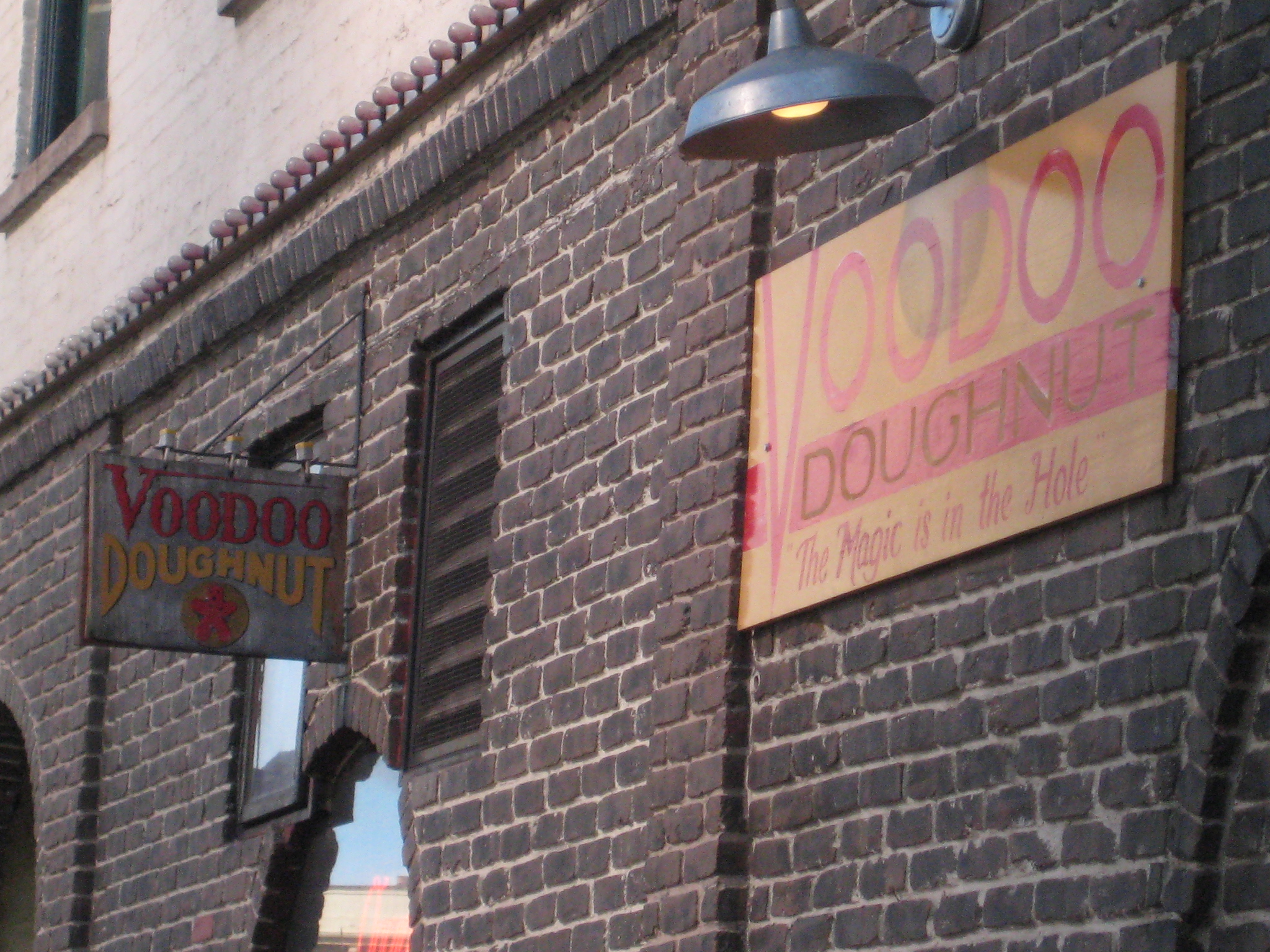
All places I would suggest you try? The Flying Elephant Cafe for lunch, if you want a variety of different bar food try a McMenamins bar (I tried the Ringler’s Annex next to the Crystal Ballroom). The Cajun tater tots were delicious. I also was picked up by a friend and driven out of the main part of the city to the Hawthorne District (I think?!). Where I ate a great meal at Savoy Tavern (I guess the website is coming soon). Here I ate a great salad, sauteed mushrooms that were a little garlicky and a really good onion soup. This meal was quickly followed by dessert at Pix Patisserie where we got individual desserts whose names escape me. I think I was charmed by the toy monkey’s hanging from the ceiling.  Of course, let’s not forget about the incredible doughnuts from Voodoo Doughnut for breakfast.  Really good, quirky and enough to give you a great sugar high for hours.  Also, if you’re in Portland you have to get lunch from one of the carts. I had a great Kabob Sandwich that made me smile.

As for Miami

I’m just going to write you a short list. I ate at Opa’s Tavern on Ocean Drive. The food was good, very filling. They had great entertainment that was maybe a mite too loud for dinner unless you are prepared to dance on your table while you are eating. We picked up sandwiches along the boardwalk and some so-so Cuban food at a place whose name I sadly can’t remember. That being said if you are in Miami make sure you eat at Big Pink’s, but I would recommend sharing unless you have an appetite for four people.

So…that’s the food run. Are you hungry yet? I know I am.

The Story of US Through Save America’s Treasures and Other National Trust Reads

I have a new blog post on PreservationNation.org. Sort of an homage to the variety of sites supported by Save America’s Treasures.

Before we were Americans we lived off the land, within the cliffs and earth. We were Cherokee, Iroquois, Cheyenne; we were the Sinagua, ancestors of the Hopi, who lived here at Honanki (AD1100-1300).
I also wanted to point out this well written blog posting on Cape Wind by Roberta Lane. Its an issue that I actually have only paid a little bit of attention to as the issues have progressed. I found this to be a very well reasoned, well thought out discussion about dealing with cultural resources while we are also trying to save our planet.

Lastly, if you like Chicago Architecture here’s a great interview with Chicago’s First Lady of Modernism by Arnold Berke.

Stepping Out in Portland

Portland, Oregon is a beautiful city. It’s not too enormous or too small in its harmonious setting between the Columbia and Willamette Rivers, which are flanked (on a clear day) by the snowy peak of Mount Saint Helens reaching into a beautiful blue sky.

That’s what Saturday was like at the National Council on Public History Conference, revealing to me just what a walkable, bike-friendly city looks like. I spent one of my breaks eating at Voodoo Doughnut and at various food carts, all while meandering through street fairs and Powell’s Bookstore (their architecture and history sections are like time warps – prepare to lose four hours in a flash). All in all, a good ending to a fantastic four days.

That being said, let’s take stock on the last two days of the conference. Friday morning I moderated a panel with David Brown (the National Trust for Historic Preservation’s executive vice president), Ian Fawcett (deputy executive director of the Land Conservancy of British Columbia), and Liz Dunn (consulting director of the Preservation Green Lab). The session explored the work of the International National Trusts Organization (INTO) and how climate change is being thought about by their member organizations across the globe. In putting together this panel, I wanted to spread the great information from the INTO conference in Dublin this past year. You can read one attendee’s reaction here.

Following this, I boarded a bus out to Dundee Hills to visit the Sokol Blosser Winery, an organic sustainable winery that is home to the first LEED certified silver wine cellar. The owners of Sokol Blosser understand the need for sustainable farming and viticulture and have adopted it wholeheartedly, managing to convince the vineyards surrounding them to work with them to accomplish their goals. More on that in a bit.

So, what does all this have to do with preservation?

On the one hand, the story of the vineyard speaks to what historians can accomplish (the founders of the vineyard were both history majors in the 1970’s), but it also attempts to answer a question we struggled with earlier in the week – how do we reach the public and show them that sustainability is a part of our future, and more specifically that historic preservation and sustainability go hand in hand within that future?

When I first started at the National Trust almost four years ago, I knew almost nothing about how the environmental movement was linked with old buildings (aside, of course, from the role of Teddy Roosevelt and John Muir in the creation of the National Park System). It took time reading and listening for me to understand why this is an integral part of what we do.

As a public historian/preservationist, it is important to recognize all the ways that history and the past connect with the public, even when this connection reflects highly volatile and controversial current issues like global warming and sustainability. We always throw around the fact that history is relevant in the here and now – that it is an important part of daily life and is ingrained in community character. The acknowledgement of this link between the public at the grassroots level and our role as historians/preservationists/public historians at the professional level needs to happen in sync with the work we do on policy and other legislation.

Let’s take a step back to the vineyard. The owners of Sokol Blosser knew they wanted to have a vineyard that was organic and sustainable, but they knew they couldn’t do it by themselves. So they reached out to their neighbors, trained their employees, and created a mindset within their own community about the importance of being green. Similarly, we recognize that the work we do on this issue is about more than just saving historic places; it is about preserving ecosystems and landscapes that are a part of historic view sheds, and consequently a way of life. We work within our organizations to communicate this belief and to spread the word to our memberships. We are ambassadors that are helping to usher forth an engaged, knowledgeable, and determined public.

Yes, this is a slow process, but it will continue to be advanced by gathering at conferences like the 2010 National Council on Public History/Environmental Historian Conference, where we all stepped out of our disciplinary silo’s and talked to one another.

Also cross posted on the PreservationNation.org Blog and the NCPH2010 Blog.