Teaching With American History: The Five Senses

Last week I had the opportunity to speak at the Teaching with American History Grant Directors Conference. It was a short 3 minute talk, a testimonial of sorts to the course that started me on my journey to being a historian. I was going to wait until the videos became available (filmed by George Mason’s Center for History and New Media), but decided to post the text of the talk now instead.

Essentially the main speaker was my high school history teacher, Jim Percoco who outlined the basic tenants of the class called Applied History. The first half of the year is spent going on field trips, looking at films and books and really making students into teenage historians. The second half of the year involved sending us out into the world to work at historic sites first hand. As a supplement to his talk, Jim asked me and one other student to provide information about how we were effected by Applied History.

Good Morning,

If I had to summarize my experiences in Applied History I would do so by thinking about our five senses

Sight: Applied History taught me how to see beyond the words in the textbook. To walk upon the battlefields and see the ridges, to trace the road that Paul Revere took on his flight before the opening shot of the Revolutionary War, to recognize that these things really happened, that the evidence is everywhere we look.

The class taught me to touch (of course with gloves on): As the second half of the year involved a semester long internship, I was able to gather first hand knowledge about material culture, and consequently understand the role a simple basket, painting, or shoe played in every day life of ordinary and extraordinary people.

Applied History taught me to hear, to listen: Every line in a history text book is really a summary of a thousand different stories. That the movies we watch, the objects we touch, the sites we see are all part of a grander narrative. That even listening to my parents tell their stories, informs who I am, and who we are.

Taste: After Jim’s class I ended up at the College of William Mary where I took a course on foodways. Without the foundation I got in high school, I don’t think I would ever have been able to see the part that food plays in our very identities and culture.

As for the sense of smell: how many of us have walked into an archive and taken a deep breath. Imagine being a 17 year old student walking in and realizing what these documents and objects could tell you about the past.

Perhaps I can go on to say that the course opened up a sixth sense, you know, the one that allows us to see dead people and make them live again. This is the sense that lets us see the past as something tangible and worthwhile, something with meaning, and worth saving. Something with relevance not only to pass a test or to have random facts in our heads, but really to understand why we live the way we live. That the past really defines our present.

Lastly, I do have to say that this course gave me a passion—one that is reflected not only in my Masters degree at American University in Public History, but also in the work I do at the National Trust for Historic Preservation.

Going Green, (Not) Eating Animals, and Finding New Stories

This post was adapted for a New Year’s Resolution Post on the PreservationNation Blog.

What happens when you decided to make a decision that involves dramatically changing your eating habits. Imagine avoiding processed food, or deciding to stop eating meat—and learning how these decisions impact not only your own health but also your sense of community and place.

One of the keynote speakers in Nashville (at the National Preservation Conference) was Bill McKibben who gave a talk that involved thinking about the environment in terms of our historic built environment (you can take a look at what he said here on Mother Jones). I finally got around to finishing his book Deep Economy and became very interested in the one chapter that describes his year of eating locally. Now, admittedly this is something that is a lot easier to do in Vermont then here in the middle of DC but it seemed like an exercise that would essentially lead (by the end of the year) to food that was boring (I mean how many times can you eat a salad made of ingredients you froze?).

He started in September (harvest time) and buys up as much fresh vegetables, fruits and produce that he can manage, freezing, brining and apparently also Cryovacing things to maintain their usage for a longer period of time. By the time he gets to February and March his menu has changed to eggs, soup and cheese sandwiches. As for his meat he goes local there as well, making his way over to local community farms.

But what does this all mean? I’m still not sure I buy the fact that its not that expensive to buy local as we think it is (once again, think Vermont), but I do believe that the food is better for you in every way. I also get McKibben’s central argument that we need to make a change in the way we live in order to help ourselves and help the environment. That being said, his strongest argument is when he points out that he has had to “think about every meal, instead of wandering through the world on autopilot, ingesting random calories” (Deep Economy, 94). Furthermore he’s “gotten to eat with my brain as well as my tongue: every meal comes with a story. The geography of the valley now means something much more real to me, I’ve met dozens of people I wouldn’t have otherwise have known“( Deep Economy, 94).

Which leads me to the idea of (not) eating animals. Last week, I was given an extra ticket to listen to Jonathan Safran Foer talk about his latest book Eating Animals, a book that describes his path to vegetarianism. While I have yet to read the book, he started off his talk telling us about how our eating habits are always connected to “stories we are told, tell ourselves, and stories that are impressed on us.” That the food we are trained to eat at a very young age is connected to what our parents fed us—in his case what his grandmother fed him.

The majority of the conversation dealt with looking at where our food comes—and pretty much like the narrative on a recent episode of Bones about the horror of large scale meat farming. But like Bill Mckibben he offers a solution, describing the importance of being able to see where your meat comes from.

Of course it all comes back to the story, at the start of his talk Foer told us about his grandmother, who spent all of his childhood feeding him—impressing upon him the importance of having food. He then described a moment when his grandmother was scavenging for food during the Holocaust. She came upon a Russian Farmer who offered her some ham. She then made a decision that I don’t know if I could have made. She said no. When Foer asked his grandmother why she chose continued starvation over some sustenance (because the meat was not kosher) she said the following, “if nothing matters, there is nothing to save.”

This phrase takes on an even broader meaning when you think about McKibben’s thoughts after his year of eating locally—that the “good taste was satisfaction. The time I spent getting the food and preparing it was not, in the end, a cost at all. In the end it was a benefit, the benefit. In my role as eater, I was part of something larger than myself that made sense to me—a community. I felt grounded, connected“ (Deep Economy, 94).

Everything we do has meaning. Where we live, who we interact with, the choices we make—and, as it turns out, what we eat. While I’m not sure what changes I’ll make in my eating habits, I know that I’m now looking at what I eat and why I eat with a more critical eye. I know that the Indian food my mother has made me from birth invokes a sense of homecoming, and that mint chocolate chip ice cream makes me think of my older sister. I know that every time I eat Italian food I’m going to think of the best tiramisu I’ve ever had (randomly at Canary Wharf in London)–which brings up memories of the summer I lived there and traveled around Great Britain.

So something to think about this holiday season as we embark upon our traditional fruit cakes, gingerbread cookies and other Christmas food traditions. Of course this is something that can be seen from a variety of perspectives, so I wanted to bring in another perspective. After that, take a look at some pictures from my all vegetarian Thanksgiving dinner.

Being Vegetarian
By Guest Blogger: Sarah F.

As a somewhat recent vegetarian, I’m often discouraged by the flak meat eaters give vegetarians—and vice versa—in my own experience, in the food blogs I read, and even on my favorite shows (hello, Top Chef! Please stop treating us like second-class culinary citizens!). I enjoyed Jonathan Safran Foer’s talk because he mentioned that the issue of factory farming doesn’t have to pit meat eaters versus vegetarians; it’s an issue of extending our moral consideration to include animals and the environment, which anyone can do. He even argued that the term “vegetarian” has done a disservice by making dietary choices seem like one extreme or the other (also, I know I often feel like I am not living up to some imaginary vegetarian ideal).

That people get so impassioned over eating meat or not shows the extent to which food is tied in to our culture and our identities. The food you eat can help define you as health-consious, socially or environmentally conscious, “real” or “elitist,” a manly burger eater or a dainty salad bar eater. Perhaps we’ve been wrong to think of it in such binary terms.

While I try to think critically about what I eat, it is hard not to get discouraged. Eating locally seems too expensive and too time-consuming. Processing all the labels at the grocery store can be overwhelming, especially when certain terms (organic, free range) seem to have lost all meaning. I haven’t read McKibben’s book yet, but from Priya’s description it sounds like following his example would be a tall order. I’ll be keeping in mind Foer’s point that eating responsibly doesn’t necessarily have to be an extreme or some impossible state of dietary perfection, but a goal to keep striving towards.

~~~~~

Some pictures from all veggie Thanksgiving.

The Menu:

Stuffed Shells (with shredded zucchini, mozzarella cheese and potato)
Eggplant Parmesan
Butternut Squash Puree (with sweet apples and orange zest)
Mushroom, Spinach, Pine Nuts in Phyllo (Note: The recipe includes bacon and is a lot fancier, we kept it simple)
Traditional Green Bean Casserole (with Campbell Cream of Mushroom Soup)
Melted Brie with cranberries and walnuts
A soup that my mom made which is I guess her own special recipe.
Potato Pave

Desert (aside from apple pie): Caramelized Pineapple, Apples, and Craisans in Phyllo (Note: We did not use dried cherries, and instead of rum put in Apple Juice, also didn’t do the ice cream mixture).

23,110

Civil War cannon and luminaries at Antietam Battlefield by Keith Snyder

This post can also be found on the PreservationNation.org Blog.

I know that Thanksgiving is normally when the holiday lights go up twinkling, bright and cheery. They give you that warm wintry feeling that many associate with both the commercial and religious aspects of the season. However, those lights always remind me that the first week of December is near—and with it the annual Antietam National Battlefield Memorial Illumination.  On this day, thousands of people drive through the National Park grounds to view the luminaries, one for every single solider who was killed, wounded, or missing on September 17, 1862 — 23,110 in total.

My first experience walking this hallowed ground was in 2000. As a senior in high school I helped to set up the white bags with candles, working with rope to outline a perfect gird. I can’t remember how many I lay down, but I do know what happened at dusk, when each candle sprang to life. From every angle the candles stood at attention, with honor in perfect lines. I guess you can say that they danced, the peaceful glow of the beams a far cry from the violence of those 12 hours–the bloodiest in the entire Civil War.

It has been nine years since I attended the ceremony, but I still spend that first weekend looking for articles, pictures and testimonials. This year I will be in Sharpsburg, Maryland with 20,000 others ready to look out over the field of lights and remember.

The Annual Antietam National Battlefield Memorial Illumination will take place this year on December 5, 2009 (rain/snow date December 12). More information can be found on the Antietam National Battlefield website.

Illumination is only one way that we remember the past, just as Antietam is not the only battlefield or site that remembers the fallen in this manner. I’d like to hear about some others, so please comment and share.

Finding Relevance

Just a heads up:
Today is November 20. Due to unforeseen circumstances I am sadly 10k words behind on my National Novel Writing Month challenge. This is going to be a fun ten days!

Below is the text of a blog posting that went up today on the PreservationNation Blog. You can read it there. Or just scroll down.

Coffeehouses, Storytelling, and Relevance

This could be the story of Starbucks, Saxby’s, or Caribou Coffee. This could be the story of hundreds of independent coffee houses that dot the American landscape. Almost 240 years ago, a Williamsburg wigmaker named Richard Charlton opened up a coffeehouse. A few feet from the capitol building; this coffeehouse served as a space where colonists would gather to talk, socialize, debate, and gossip.

However, in 1776, amidst revolutionary turmoil, that coffeehouse became the scene of a clash between the tyranny of the stamp act and revolutionary fever. Today, Colonial Williamsburg (CW) is reopening the coffeehouse to the public, and like much of the interpretation it will tell a familiar piece of the larger story about American independence. I read about this yesterday in the Washington Post in an article that talks about how CW’s shift to active storytelling is a part of their broader plan to make history relevant.

This, I suppose, is the watchword for the historical profession: We are always trying to find ways of maintaining relevance, finding relevance, or being relevant. It is a battle that we have been fighting for a long time—and one linked to the mass media craze, where entertainment comes in the form of cell phone applications and video games. We are constantly afraid that those we want to educate, to inform, will pass us by without the right presentation, the right hook. We are afraid that the children of tomorrow won’t recognize how we got the Declaration of Independence, or why we fought in World War II—and instead be consumed by the latest in the world of pop culture. That one day, history may become irrelevant.

But isn’t that what doing history is all about? Making those connections to the present and acknowledging that with every generation relevance shifts according to what is that generation sees in the mirror? That meaning, and acknowledgment of that meaning is integral to the broader need for identity ?

Those of us who listened to Donovan Rykema’s speech at the National Preservation Conference know that this is something that historic preservationists deal with regularly. While some of us may agree or disagree with Rypkema, relevance hovers just above the horizon. Maybe finding relevance is not so much a watchword or a fire bell in the night for the historical profession but our modus operendi and is something we should all be proud of.

Hodge Podge: Books that Changed A Life

One of the reasons I started this blog has to do with my love of a particular NPR podcast/radio show known as This American Life. Every week I would listen to Ira Glass and think about how much I wanted to talk to someone about what happened or I wanted to put pen to paper and write about a particular episode that moved me in some remarkable way. A lot of people I know listen to this and we’re always asking each other—did you see the one where the woman got rabies and couldn’t find vaccine (I can’t for the life of me remember the episode name)? Or in Switched at Birth where those girls are switched at birth and the mother who knew didn’t do anything about it (we always get angry when we think about this one). One of my favorites is the story of the Iranian couple who divorced and then two years later, found each other again (Reunited (and it feels good)). Don’t even get me started on the awesomeness that is The Ghost of Bobby Dunbar.

Anyway I’m a few weeks behind and finally heard an episode that originally aired on August 20, 1999. and was re-aired on October 2nd. This episode was called The Book That Changed Your Life. Made up of four acts this episode took a look at the ways in which a particular book touched and of course changed lives. I think the episode is best summed up by a quotation in Act 1 which looks at how playwright Alexa Junge used a book from her grandfather’s library to feel closer to him. She says that

“When you read a book and something speaks to you and you feel understood and it makes the world a less lonely place.” Books can be powerful things and I’ll be first to admit that sometimes we read things that aren’t quite so intellectual or highbrow because they make us feel comfortable and at peace. Others challenge you to look beyond your normal scope of inquiry to see worlds beyond your wildest imagination.

It is to their credit that the power of the written world sometimes trumps other storytelling mediums (one example from the last decade would be the translation of the Harry Potter series to the big screen.) There is also something about books that reflect on the simplicity of expression. In Act III we learn about Roger a construction manager who becomes obsessed with collecting every book about Lewis & Clark known to man. At first he doesn’t read the texts, but once has the final piece (I believe it is a copy of the two volume first official printing of their journals) he opens up and begins learning as much as he can about these two people he has spent years of his life on. The magic is in his voice as he describes reading about the moment when Lewis and Clark reach the ocean, and how he would have been screaming and dancing but for Lewis and Clark their excitement is summed up in the simple text “ocean in view. Oh the joy.”

So it got me thinking about the fiction books that have changed my life. If I included nonfiction this could be a very long list, since there are many, many non-fiction books that inspired me. To some extent these five books are the ones that made me think about the construction of a story, but also made me think about the choices characters are forced to make and how powerful those choices can be as a reflection of reality.

  1. The Giver by Lois Lowry
  2. A Tale of Two Cities by Charles Dickens
  3. The Lord of the Rings (fine three books not one but I’m counting it as one) by J.R.R. Tolkien
  4. Pride & Prejudice by Jane Austin
  5. Atonement Ian McEwan

The Giver, the story of a boy living in a colorless world was perhaps my first introduction to the idea that maybe not everyone can see the world the way I do. What could I live without? A Tale of Two Cities is perhaps one of Dickens most quoted books and while not necessarily his best (I may say that Bleak House might be that) his ability to take his many story strands from incoherency and then pull them back together is just one of the reasons why I love this. It might be the vivid picture of the dirt, the gritty grime of his London/Paris that says it all. As for Tolkien it is the classic hero’s journey, and one which has parallels from all parts of life. Pride & Prejudice has more to do with Jane Austen and what she could do in the middle of 18th century England, but also the way she uses the story to provide a glimpse into all walks of English society. Lastly, Atonement…..really its because Ian McEwan has created a character who is both morally ambiguous and for whom I can never decide whether I would like to feel sorry for or just hate.

As always though as I put together this list other books started popping out at me so instead of me talking about myself—tell me about what books you guys love.

A few related notes:

  1. Claude Levi-Strauss: Levi-Strauss was a French structuralist anthropologist, who formulated theories on how and why so many myths from around the world seem to have similar structures and ideas. He died at the age of 100 last week and his writings were one of the first to push my mind beyond looking at things in one particular way. Levi-Strauss also had a big role in the creation of UNESCO race policy. Learn about his work at UNESCO here.
  2. A few weeks ago during one of Gene Weingarten (a columnist for the Washington Post) humor chats he asked us to take a look at a newly surfaced video that provides a single three second glimpse of Anne Frank prior to when her family went into hiding. He wanted us to decide if it was powerful and to explain why—so I’m asking you. Is it just a video of a girl watching her neighbors go off on their honeymoon, or is it powerful (as I found it) to finally catch a glimpse of someone whose words symbolize some of the acute horrors of the Holocaust.
  3. You might not get another long blog post from me until after November. I’ve decided to write for National Novel Writing Month (50k words in 30 days.) For more information visit www.nanowrimo.com.

Closing it Out (and a bit about Nashville Food)

I know it has been a few weeks since the end of the National Preservation Conference, but I wanted to make sure to provide a closing post. On Friday after dispatching the last of the field sessions those remaining in town made our way over to BB Kings for the Final Fling which included a live auction and music from Last Train Home.

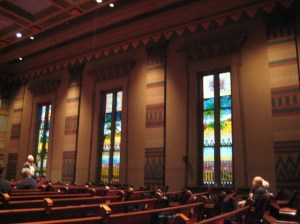
Interior of the Downtown Pres. ChurchBut there was more to come. Saturday dawned bright and early for us with the Closing Plenary in the Downtown Presbyterian Church, an example of Egyptian Revival architecture. We were about to be treated to a talk by Chief Justice of Indiana Randall Shepard and Congressman and Civil Rights Leader John Lewis of Georgia.
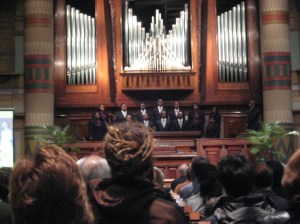
Fisk Jubilee SingersBefore we talk about them let me say a few words about the Fisk Jubilee Singers. First started in 1876 as a means to raise money for Fisk University (the first American University to offer a liberal arts education without any stipulations as to race) the group is now known for preserving one of America’s greatest treasures—that which the website refers to as the negro spiritual. Let me say from first hand experiences that those voices rose in perfect harmony, bouncing off the walls with a clarity and resonance so vivid and vital that I got chills.
As for the talks-despite coming from two tangentially different directions (preservation and law/preservation and civil rights/politics)-Chief Justice Shepard and Congressman Lewis had ultimately one message for preservationists. The Chief Justice surmised our mission in one eloquent sentence, that “we stand up for livability, for a sense of place and architecture that lifts up the soul rather than deadens it.” His words were followed quickly by a call for continued agitation by Congressman Lewis who proclaimed that “If we do not fight for these places then history wont be kind to us.” In both speeches there was a rallying call that said, to borrow a popular phrase from the National Trust at this conference, what we do matters. That preserving buildings, music, and the spectacular architecture that Nashville has to offer effects how people live and breathe and connect with the world around them.

This dialogue intermingled with my thoughts on the music, the lights and the life in Tennessee and led me to ponder the following question: Where do we go from here?

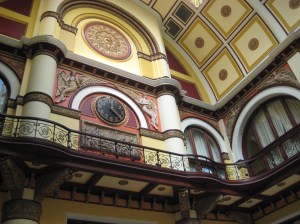
Union Station Hotel in Nashville

All right. Maybe not. But it does allow me to segue into the final event of the conference (for me at least) which was the Forum Lunch, and I urge everyone who is interested on where Preservation should be and could be going in the next fifty years to take a look at Don Rypkema’s talk here. Particularly intriguing for me was his assertion that as historic preservationists we should work (at least in urban areas) to manage change over time and not necessarily a point fixed in time. At the heart of his talk he is asking us about how we remain relevant in a world that incorrectly sees history and historic preservation as a luxury, as something that will not create jobs, will not help the economy, and is not important enough to consider a priority at every level of living. He says that we are evolving–(for those not familiar with it, This Place Matters is a program of the National Trust that asks citizens to look at the world around them and identify the places that matter to them.)

Here is my test – look at what made the list of the National Trust’s “This Place Matters” program. Virtually none of the finalists met the test of either being an architectural masterpiece or of particular significance to our national history. Those places were nominated because they mattered to the local community and in many cases not on architectural grounds. I for one think that is a wonderful way for historic preservation to have evolved.

Stained Glass at Union Station Hotel

I say that this is exceedingly clear when we think about the evolution of historical thought in the last few decades. We have moved from looking only at the big men of history to understanding the everyday—the people on the streets, the forgotten and the silenced. Social history has done amazing things for democratizing what we know about our pasts and our future—we can now step inside museums and watch on television stories that make connections on a more visceral level than before. It is the same way with Historic Preservation whose history may have began with the rich and the elite but has long since moved to a movement that seeks to preserve the places we live in, the character of neighborhoods, the places that, in essence, make the world unique and diverse in every sense of the word.

So I think my one takeaway from this conference is that we have to be open to expanding our definitions and boundaries, looking to new horizons to let the past and present stand the test into the future.

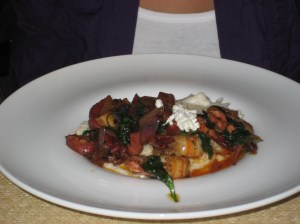
Shrimp & Grits from Prime 108Whew. Did you think I was going to forget to talk about the food?

This is one of those towns where being a Vegetarian is really difficult—luckily I eat chicken, and boy did I eat a lot of it.

Here are my recommendations:

  1. The Fried Chicken at BB Kings
  2. While the Mac n’ Cheese I had at Robert Hicks’ house was to die for, I’ll just say that Nashvillians know how to make a mean mac n’ cheese.Mike's Ice Cream Fountain-Ceiling detail
  3. Make sure to check out Mike’s on Broadway by the River where you can get some of the most delicious ice cream cones out there.
  4. For brunch—go fancy and hit up the Wyndham Union Station (Prime 108) where I had some delicious French Toast, and my friend had some true southern grits with shrimp. While we waited for food we ogled the stained glass windows.

Don’t forget to Check out the pictures on Picasa!

National Preservation Conference in Nashville

Nashville: My Place Matters, Opening Plenary

It has been a wild few days. I meant to post this earlier but was struck down with a crazy head cold.  Sad that I missed the partner’s reception but the early bedtime put me in a much better position to enjoy yesterday’s events.

First though–I wanted to say a few things about an event I worked on Tuesday. Charlotte Bonini (Senior Education Planner for the National Trust for Historic Preservation), Kimberly Nyberg (director of the Tennessee Main Street Program), Andrea Blackman (Director of Special Collections at the Nashville Public Library), and Kathryn Bennett (Librarian at Hillwood High School) put together a program for a group of fifth graders from Rose Park Magnet School. Called My Place Matters the goal of the program was to introduce kids to the role of historic places in their lives and get them thinking about why places matter on many levels. It was inspirational and I have to say those kids were some of the smartest kids I have ever had the opportunity to speak to.

The first half of the program took place in the Nashville Public Library. The first stop was the Young Adult Room where the kids showed us pictures of places that matter to them why they matter to them. It didn’t take long for them to make the connections between why their places matter and why historic buildings are important to preserve. The second room was the Special Collections room where the kids had an introduction to some of the very cool features offered by the Nashville Public Library everything from lesson plans, oral histories and videos.

The third part of the library the kids stopped at was the Civil Rights Room where a quotation from Martin Luther King Jr. sums up the story of Civil Rights in this city: “I came to Nashville not to bring inspiration but to gain inspiration from the Great Movement that has taken place in this community.” The Nashville Public Library stands where many of the events during the Civil War occurred. The room is dotted with images of the marches, sit ins and boycotts from this era. The students were treated with lectures from two of the participants from the demonstrations–Rip Patton and Frankie Henry. Rip talked to the kids about the  non-violence doctrine and at one point a little girl looked at him and said–“You keep saying we did this…were you a part of the demonstrations?” When he said yes, the resulting awe revealed just how much the kids had internalized what had happened.  They were most shocked by the stories from Frankie which revealed just how strong you had to be in the face of resistance.  She explained how at the age of 19 she had sat at a lunch counter and had been deliberately burned by a cigarette, and despite wanting to fight back the rules of non-violence meant she just had to take it.  In talking with my group afterward I was surprised by how much they recognized the importance of that moment–that the movement was too important and too big to fight back. That non-violence was key to accomplishing their goals.

The second part of the program involved a walking tour around Nashville where the kids took a look around at the buildings that make up this neighborhood, focusing on details with a Zoomer (a rolled up piece of paper that served as a telescopic focusing device) and sketching in their My Place Matters sketchpad. It was a great exercise in revealing the connections between space, place, history and the past and I know the teachers and students involved all walked away excited and energized.

So that was Tuesday. Yesterday, I attended the Opening Plenary where Dame Fiona Reynolds and Bill McKibben served as keynote speakers. It kicked off with some great music by singer/songwriter Dave Berg. I live twittered through the entire thing so you can check out some of my thoughts on my Twitter Feed @pc_presnation. For the purpose of this post I want to talk about how both Dame Fiona Reynolds and Bill McKibben underscored the theme for this year’s conference–which is Sustaining the Future in Harmony with our Pasts. Dame Reynolds spoke about how we’re moving past seeing preservation as a luxury, something we should think about only when we have money. She described how the UK National Trust has started up a bunch of programs involving sustainability but has tailored those programs to be simple, useful and meaningful. The one that Dame Reynolds highlighted dealt with the idea of growing produce seasonally and how they are cultivating sections of of their land for gardens that will be used in their various restaurants across the country.

The second keynote speaker, Bill McKibben talked about his cause 350.org which is what scientists say is the safe upper limit for carbon dioxide in the atmosphere and how the Copenhagen talks in December on climate change may very well be the most important meeting of our lifetime. For us historians, I think his point was driven home when he talked about our sense of place and space and how climate change relates to that. He says that how we relate to these places won’t be the same anymore.  One of the best examples he gave involved Robert Frost’s home in Vermont.  How will we, as human beings, contextualize his poems that talk about the snowy wood when there is no snow in Vermont?  So much of what we do as public historians (and preservationists) depends on the materiality of the past and making those physical connections between what we know of the world around us and what we know existed in the past.  Just as those kids in the My Space Matters program were asked to take something familiar and extrapolate out to understand how places matter, McKibben is saying unless we do something about carbon emissions we won’t have those familiar links that define our very identities.

Something to think about.

Pictures to come later.

The Battle for Franklin: Visiting the Widow of the South

Yesterday was the first actual work day for the National Preservation Conference. As with every year the day ends with a special treat for staff which often includes a tour that explains why the city we are in is ideal for preservationists. This year, of course, was no different.

Barely an hour before the meeting I finished Robert Hicks’ Widow of the South a book which tells the story of Carrie McGavock, a woman who despite the recent loss of three children steps up and makes a time that was so terrible mean something. During the Battle for Franklin, which is essentially the death knell for the Confederate Army, Carrie’s house, Carnton Plantation, was chosen to be the best place for a field hospital. What  makes this story so remarkable, aside from the heroic measures Carrie McGavock took that day to save young Confederate lives, is what happened two years later.

1500 soldiers from the battle had been buried where they had fallen. When faced with a landowner who wanted to plow under the land to turn it back into cotton and other commodities, Carrie fought and successfully re-interred all of the boys to her home creating a large private cemetery in her backyard. For five years she wrote to the families, and when the families came to take their boys home, four ended up leaving them there after seeing Carrie’s strength of character.

During our tour we heard from Robert Hicks himself (who is a speaker this coming Friday here in Nashville–something that will be web cast on our virtual attendee page) who described those bloody five hours at Carter House, and later the aftermath at Carnton. We saw the bloodstains that had seeped through the carpet and imagined the upper porch (the columns apparently a bright yellow) lined with a hundred injured souls.

He told us a story of one such Union officer who amidst the fog and the darkening night shot a young Confederate soldier dead. As he turned around he found himself impaled through with a sword, realizing that it was the sword of the young man he thought he had killed.  The duel continued with knives, and perhaps fists, until the Union officer lay injured with nine wounds that by all means should have been fatal.

Twenty years later he marries and has a son. That son is Douglas MacArthur.

Back at Carnton, despite not being able to see the cemetery I think we could imagine what things had been like. Having seen this house described in his novel, I could see the history come to life, but perhaps what is more powerful and more telling is the power we have as individuals to do what is right and to make a change.

Earlier in the day we had been going through the conference schedule and I had been asked to say a few things about Congressman Lewis–and perhaps these are the same words I can say about Carrie McGavock. There are individuals out there who step up and fight for what is right,  regardless of what that means for their personal safety and daily lives.

Congressman Lewis threw himself into the cause of Civil Rights in the 1960’s, Carrie McGavock spent the rest of her life documenting those dead soldiers and made sure that they were remembered, even though the cause had been lost.

Note: While Widow of the South is a fictionalized narrative it is based on real people and a real battle. Visit Carnton’s website here.

View my pictures from Nashville on my Picasa page.

National Preservation Conference in Nashville

I’m on Twitter!

This coming week I will be attending the National Preservation Conference in Nashville, Tennessee. As part of the efforts I’m part of a group of staff who are tweeting from the conference. My general “tweet beat” is Genral History and you can follow me @pc_presnation.  If you’re going to be at the conference and are tweeting make sure the hash tag #PresConf.

Otherwise, if you’re interested in checking out some of the events and sessions at the conference check out the virtual attendee page where we’ll be blogging, webcasting, webchatting, uploading images to Flickr, posting on Facebook  and of course tweeting. Not convinced? Check out this awesome video with Sarah and Jason!

I’ll also be posting a blog or two right here on …and this is what comes next.

See you in Nashville!

Quickly Turning Pages

Four Book Reviews in One
For  a review of the following books with a history/preservation slant click here.

In the Woods
The Likeness

By: Tana French

Dublin, Ireland. In her first two novels, Tana French writes a story that is hauntingly engrossing and equal parts frustrating. The first tells the story of a murder. A young girl is found at an archaeological dig and her case seems connected to a cold case, one where three children go into the woods, and only one comes out–his shoes filled with blood.

That child, now grown, is Detective Rob Ryan who along with his partner Cassie Maddox are in charge of investigating the death of Katy Devlin. This first book, narrated by Ryan, is about more than solving the murder/disappearances. Its about making decisions, breaking the rules and crossing ethical boundaries that end up changing the course of your life. I found myself pulled into Rob’s past and watching his every move with interest—not knowing that there is more to the story than what French gives us. While Operation Vestal (Katy Devlin’s murder) is trying in its own right, it is Rob’s story that hooked me. I’m hoping that we will see more of him in French’s future work, since my only disappointment with the book is a lack of resolution to what actually happened In the Woods. Then again, maybe that was the point. Not knowing defines the story, and the speculation and results of the two disappearances provide the contours to understanding Rob, his relationship with Cassie and how Operation Vestal finally plays out.

The Likeness takes place six months after In the Woods, and this time Cassie is our narrator. While some say you can read them in any order, I think understanding the events surrounding Operation Vestal gives you insight into Cassie Maddox’s state of mind. This book is also about the death of a young girl: Alexandra Madison. Not only does she have Cassie’s face, but the name is a fake identity created by Cassie and her former handler when she worked in undercover.

So Cassie who had once been Alexandra Madison a drug dealing student, becomes Lexie Madison—a dead, English doctoral student murdered and left alone in a ruined cottage. Just like with In the Woods Cassie makes choices that blur the lines of ethics, choices that force her to confront her own demons.

So two books and hopefully a series that I highly recommend.

Book of Air & Shadows
by Michael Gruber

This book is my choice for book club (the Royal Pinkerton Society for Novellic Exploration). I had high hopes. The plot in a nutshell? Someone discovers evidence indicating that somewhere out there is a missing Shakespeare manuscript, written in his own hand—and there are many out there that would kill to get it. The narrator of the story is Jake Mishkin who is writing the events out as he sits alone in a cabin waiting for people to kill him.

While I’m still not a hundred percent sure what happened at the end of the book I can say the best parts  involved reading the letters that speak of the missing manuscript. I appreciated seeing the actual text rather than having the characters repeat the text for us. That being said, unnecessary tangents and detail pulled me out of the actual drama surrounding the search for the book, making getting through it a bit distracting. Also, I’m not entirely sure that Gruber was successful in weaving the plots within plots, not to mention the fact that I guessed who the puppet master was long before the I hit the final confrontation. So—what’s the verdict? Could have been better, Could have been worse.

The Lost Symbol
by Dan Brown

The final book I wanted to mention in this review is by Dan Brown. I will go into this review with one caveat. I have read Angels & Demons and The Da Vinci Code, both were entertaining, but Brown’s writing style kept pulling me out of the story. I tried to go into this one with an open mind, but since it was set in DC I knew that the inevitable inaccuracies would drive me crazy.

I’m only going to mention two here, just to give you an example. At 10pm at night, it is not possible to get from Federal Triangle to King Street in 15 minutes via metro. As I often make the trip it takes more like 45 minutes. My second point, as you’re driving over Memorial Bridge with the Lincoln Memorial in front of you, its not possible to see the Tidal Basin.

I know, that’s being incredibly nit-picky. Here are some more specifics—if it were possible for me to hate Robert Langdon I would. What’s even worse is that Dan Brown chooses to use Langdon’s inner monologues to tell us every single piece of research he’s done for this book. Instead of weaving it into the story he decides to tell us everything rather than showing it to us. Also, for only taking place over the course of 4-5 hours the story moves really, really slow. Too many twists, and the identity of the big-bad guy is fairly obvious from the first 20 pages.

And then the ending. While I suppose Brown’s intention was to be awe-inspiring finding out what the title meant only made me groan (though I will admit the imagery of watching the sun rise over the Washington Monument from the top of the Capitol was nice, since that view of the mall is one of my favorites.) Maybe the final conflict intense, but the Return of the King like ending (you know, how the movie had 12 different “final scenes”) made the conclusion fairly tedious.

Last thing that bugged me? There is one point where there are five lines that make up a single chapter. That’s it. A one paragraph chapter. Also the events in question during that paragraph, though explained later, read more like Brown is trying to break out of his genre, and I feel could have been dealt with in another way.

Read it if you feel like it, but I was not impressed. Maybe you should just wait for the movie.