Hamilton & Public History: Who Lives, Who Dies, Who Tells Your Story

Second in a series of three posts about the musical Hamilton. Read the first here.

In starting an essay on Hamilton it might be best to state my bias upfront. A work of genius, Hamilton soars for a variety of reasons including the hip hop allusions, the allegory to modern life, and the purposeful diverse casting, all of which have already been covered extensively elsewhere. But while I yet to have the privilege of seeing it in person there is one very large reason why I think the musical is fantastic:

Hamilton is an almost perfect example of public history.*

Public history is about meaning. It’s not always 100% accurate and is rooted in how various publics perceive their own past. Hamilton the musical plays with that idea while engaging with the very real themes of legacy and memory.

But it’s about more than that. A few weeks ago, at the PastForward conference Bryan Stevenson of the Equal Justice Initiative spoke eloquently about the need to open up the narrative of our history to achieve social justice, he states “I believe that the opposite of poverty is not wealth….I believe that the opposite of poverty is justice. And we do an injustice when we tell stories about our space, our history, our identity that are incomplete.”

While Hamilton isn’t exactly an active agent in social justice, it does, in just over two hours, show how the narrative of a Founding Father is also the African-American story, the immigrant story, the story of women, and a story of the impoverished. As with most artistic interpretations there is an element of anachronism, as this American Historical Association piece mentions, but the musical’s ability to engage the public on the importance of history in all its forms is worth its weight in gold.

For me it all comes down to resonance and relevance.

The Two R’s

Resonance is an emotional reaction. In history it is the ability to relate to the past in a way that feeds your identity. In my case it was clear almost immediately that the lyrics and narrative of Hamilton would feed my history-loving, poetry-inspired soul and really hit home in making some abstract subjects real.

This is perhaps best illustrated through “Satisfied“, sung by Angelica Schuyler at her sister’s wedding to Alexander Hamilton.

I’m a girl in a world in which
My only job is to marry rich
My father has no sons so I’m the one
Who has to social climb for one
So I’m the oldest and the wittiest and the gossip in
New York City is insidious
And Alexander is penniless
Ha! That doesn’t mean I want him any less.

In one song we learn more about the social standing of women in 18th century America in a way that is ridiculously catchy and human. We hear Angelica’s conflicting feelingsbetween what she wants and what society expects–and really feel her plight. While intellectually I saw this as a vehicle for showing the way class and gender determined pathways in early America, emotionally I felt Angelica’s conflict.

Then there is relevance. A lot of the issues we grapple with as a country are rooted in a very real awareness that while “we hold these truths to be self-evident, that all men are created equal.” huge segments of the country were left behind. (Angelica: And when I meet Thomas Jefferson, I’m ‘a compel him to include women in the sequel!). And so one of the biggest reasons this show is a great example of public history is its ability to be relevant to the here and now.

But sometimes you can’t think about resonance and relevance as separate entities. I found that I was emotionally drawn to songs that subtly link to the practice of history. Specifically how Miranda is able to explain why we know some things and not others i.e. “no one else was in the room where it happened,” “I’m taking myself out of the narrative.” As a result Hamilton feels not only historically accurate (within reason), but also authentic. During the Smithsonian interview, Miranda mentioned that for the purposes of the art, some level of suspension of belief had to happen. I believe that in sacrificing some accuracy for the spirit of the past, Hamilton accomplishes something that is uniquely powerful.

As a public historian I walk around the world knowing that our present is influenced by what came before. We grow and change based on how we take those experiences in our own lives. The strength of Hamilton is the way it is able to take a very traditional narrative of the past and create tethers to our current existence. I see this in these two oft-repeated phrases “look around, look around, how lucky we are to be alive right now” coupled with the reminder “Look at where you are. Look at where you started. The fact that you’re alive is a miracle.” Both are reminder to us, the audience, that to create a better future we need to pause and recognize how far we’ve come. That it is worth taking a breath as we continue to fight the social ills of our own age.

Who Lives. Who Dies. Who Tells Your Story

During the Q&A last at the Smithsonian, an audience member asked Lin Manuel Miranda what he wanted his legacy to be. He said (paraphrasing) that Hamilton touches upon the notion that there is not a lot of time in this world (Why do you write like you’re running out of time, running out of time.) and so “I want to leave behind as much as possible. I know that’s selfish, but there is so much in my brain that when I go I want it all out, I want to always throw rocks in the pond.”

And that is the final reason why Hamilton an almost perfect piece of public history. We only have one life to live and it’s fitting that it is Eliza’s (Hamilton’s wife) words at the end of the show are what left me energized and in tears all at the same time. In the final song she sings of her own legacy, telling not only Hamilton’s story, but also her own, adding another layer to an already rich story. Perhaps, more importantly the show’s ultimate message is that it’s not about finding someone to tell your story, but rather to “put yourself back in the narrative” and tell it yourself. After all, the greatest impact of history can have on the public is to inspire — and Hamilton the musical does that in spades.

*Why is this not perfect? It comes down to accessibility. Right now, while grants have been given to allow school children to see it, the show is cost prohibitive for most people (unless you win the ticket lottery). But I suspect this will change with time — and hopefully a feature film?
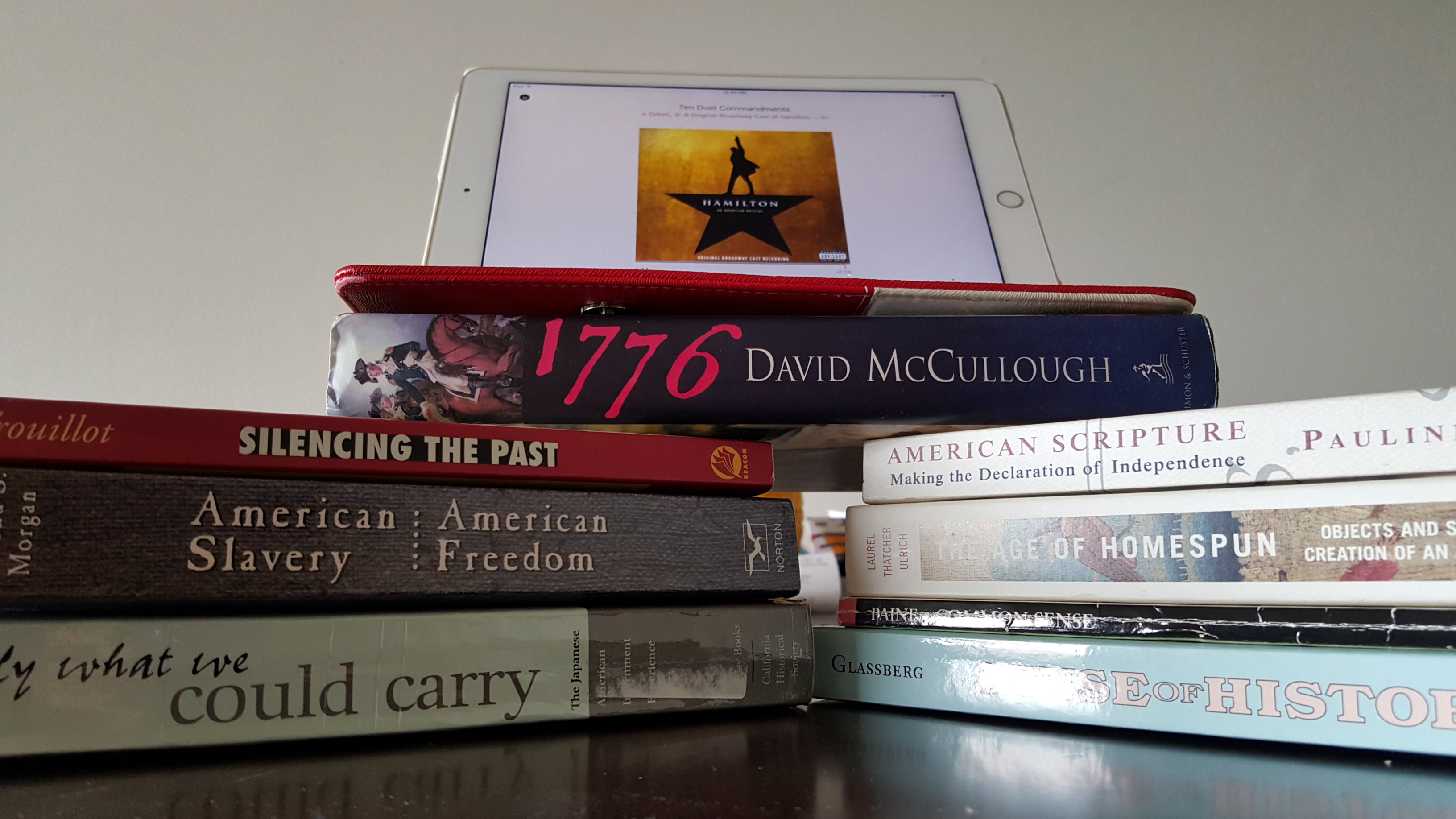
Ten Ham Commandments

20151122_124332

While in the process of trying to pull together a reflective piece on Hamilton as public history, my friend Sarah H. had a dream where she saw me rewriting the lyrics to “Ten Duel Commandments.”

Challenge accepted.

What follows is the first of three completely different posts on the musical. You should be aware I wrote “Ten Ham Commandments” on a five-hour bus ride between DC and Newark, and in doing so I now have a reinforced appreciation for Lin Manuel Miranda’s skills. Seven was ridiculously hard to re-write (internal rhymes!), and refers to a response Miranda gave during his recent interview at the National Museum of American History about what he wanted his own legacy to be. You can listen and read the original lyrics here – with annotations. Thanks to Sarah H. for helping me edit. In the end this parody is really about how much Hamilton connects with a more inclusive view of the past. Continue reading “Ten Ham Commandments”

Fundamental Truths: Forty-Six Days Until The Force Awakens

A day after the trailer for The Force Awakens aired I realized three fundamental truths at the exact same time.

  1. It was possible to feel 17 again.
  2. That in the absence of any real sense of story its possible to sway my opinion with a good score.
  3. That I am teetering on the edge of cautiously optimistic to sure thing.

Continue reading “Fundamental Truths: Forty-Six Days Until The Force Awakens”

Talking Honestly About the Past

It’s been over a week and I’m still thinking about the Slate Academy symposium “How Do We Get Americans to Talk Honestly about Slavery.” Why? It’s not just because the subject matter resonates with a lot of current events on race and class. It’s not just because the panel mimicked how I think about public history i.e. through a broader lens of objects, oral histories, literature, and popular culture. Rather, it is because the conversation presented to us represents a lesson on how to talk honestly about the entire past, period.

A culmination of a podcasting series for Slate Academy the live symposium brought together experiential historians, museum professionals, divers, authors, critics, and a pop culture icon to investigate the process of myth-making surrounding slavery. The strength of the symposium lay in participants ability to delve beneath the surface of history to identify ways to encourage a dialogue in the face of resistance. To investigate, as culinary historian Michael Twitty says, how “slavery is not a blip, but a chronic condition.”
Continue reading “Talking Honestly About the Past”

Lightbulbs

I love the lightbulbs strung across the patio. Yellow against a deepening blue.

Feet. Stepping. Twirling. Is this what getting older feels like? A sense that even in the moment time is speeding up.

Or maybe I should just blame the jet lag. Continue reading “Lightbulbs”

Authority at “History on the Edge”

1785Who owns the past? Who controls it and shapes the way it is told? What happens when intentional and unintentional omissions support one version of the past at the expense of another?

As one of the essential underpinnings of the historical profession we are taught to think through issues of authority at all levels. We are trained to recognize the role and nature of power not only in the creation of historical narrative, but also in our own interpretations.

At “History on the Edge,” the 2015 annual meeting of the National Council on Public History I heard attendees directly and indirectly discuss various forms of historical authority. I offer three statements to summarize the discussions:

  • Avenues for historical authority continue to expand.
  • We need to become better communicators about our profession (in effect to re-gain the historical authority we seem to be losing).
  • That complex issues of authority still exist as we continue to work to create a more inclusive historical narrative.

I attended five different panels. Continue reading “Authority at “History on the Edge””

What Would Dolly Do? Public History in Music City

Gate at the Hatch Show Print shop and workspace. | Credit: Priya Chhaya

This past April I was in a small exhibit space at the Country Music Hall of Fame learning the history of country music through the years. There were CMA awards and costumes, record covers and photographs. In front of me was a screen cycling through the songs of the featured artist. As it shifted to a new song first my foot began to tap, then my head began to bob, and though I was dutifully avoiding eye contact with anyone else in the room I knew I wasn’t the only one.

And then we just started to sing:

You’ve got to know when to hold ’em
Know when to fold ’em
Know when to walk away
Know when to run
You never count your money
When you’re sittin’ at the table
There’ll be time enough for countin’
When the dealin’s done

Because when The Gambler comes on, you can’t help but surrender and smile.  Likewise coming to Nashville means settling in and embracing the music. Continue reading “What Would Dolly Do? Public History in Music City”

Change is Gonna Come

Oh my, my, my. What a difference a day makes.

Reverend Pinckney once said, “Across the south, we have a deep appreciation of history. We haven’t always had a deep appreciation of each other’s history.”

Rainbows in New York City. #LoveWins (Instagram Filter) | Credit: Priya Chhaya
  

Twenty-four hours ago while, on a bus to New York City, I wrote a blog post which I probably will never share beyond my family. Incredibly pessimistic, the post reflected on heritage, hate, and deflection born out of frustration and my own anger at another tragic series of deaths.

Then today happened. Not only did we see that #lovewins, but we heard President Obama, in his eulogy to Reverend Pinckney, proclaim:

Continue reading “Change is Gonna Come”

The Cutest Droid In the Universe

I am trying to write shorter blog posts so here is my quick, fifteen-second, breakdown of the new The Force Awakens trailer. Hell. Yes.

ONE. Sand. Sand. Sand. BOOM. That buried star destroyer made me think of the Lusankya buried beneath the city of Coruscant — what happens to the detritus of these massive spaceships after battle? I guess they don’t all burn up in the atmosphere. Relics of a time gone past? Really, what a spectacular visual.

TWO.  The voiceover. “The Force is strong in my family. My father has it… I have it… my sister has it… you have that power, too.” Again we are seeing the blackened helmet of a father who fell so far before gaining redemption.

THREE. A passing of the torch. Rey the scavenger. Finn the stormtrooper. Poe the X-Wing pilot. Continue reading “The Cutest Droid In the Universe”

A Twinge of Loss. The Aftermath of the Star Wars Expanded Universe

This post originally appeared on FANgirl.

Han shot first. A toy in a prime television viewing spot at a friends house.

In eighth grade science class my friend Tracy slid me a folded piece of notebook paper. Scrawled across the top were the words “Star Wars Expanded Universe and Ratings” or something like that. On this paper she had painstakingly written out the name of each of the books marking each in turn with a series of stars. One for Children of the Jedi. Five for The Last Command. A blueprint for a newly inducted fan.

Soon I found myself devouring each book as it came along. Wanting to stay current, and let’s be honest, to know everything. In 1995, the internet was in its infancy, and my sphere of conversation on this topic was limited. But, boy, did I read.

I read regularly until the end of the New Jedi Order. Then things took a turn towards darkness. bugs, strange adventures, twisted Solo children. So I moved on, returning occasionally for a book by Timothy Zahn and to read about Mara’s demise firsthand. I felt like I owed it to her to read about her death, to pay my last respects.

Despite all this the internet kept me informed and it was enough. A single toe in a larger pond.

Enter Disney.

Let’s get this out of the way: I am hopeful. Cautiously optimistic. Filled with anticipation. Even thrilled now that we have three films in three years.

Seriously all — ROGUE ONE. Even if it isn’t linked to Michael Stackpole/Aaron Allston, the idea alone… Whew.

Then there was a notice about the new books, including a blurb about Star Wars: Aftermath, and there it was: an unexpected twinge next to my heart, a sudden moment of loss.

WHAT HAPPENED AFTER ENDOR? FIND OUT IN STAR WARS: AFTERMATH Continue reading “A Twinge of Loss. The Aftermath of the Star Wars Expanded Universe”