Anne Frank Revisited

Recently PBS aired a new version of The Diary of Anne Frank the story of a young girl, hiding with her family in an attic during World War II. I remember the original production from grade school, and found myself engrossed not only by the heartbreaking events of the Holocaust but by also witnessing the first person account of a young girl growing up in the shadow of war and unimaginable horror.

Despite knowing how the story would end, I found myself hoping and wishing for an alternate account, punctuated all the more by knowing that with the recent death of Miep Gies (one of the individuals responsible for hiding the Franks) that there is probably no one else left alive who was involved in those last years of Anne and her family’s life. She was an individual who witnessed their trials, their arguments, and their world–providing a lifeline and buying almost all of them a few more years before discovery.

After shedding a few tears (how could you not?), I began thinking about how this story, and the role of the diary in telling this particular piece of history, underscores the importance of primary documentation. These were Anne’s private thoughts, but they were a glimpse into her heart, and reveal much about what it was like to live in a time so fraught with danger. Her words give the Holocaust, at least for the younger generation, texture–and a personal face. Just knowing the statistics for who died at a particular concentration camp isn’t enough. While there are other books that serve similar puposes (I’m thinking of Lois Lowry’s Number the Stars) Anne’s diary is a story of a real person and gives credence to the adage that we should use history to learn from mistakes.

Note: Sorry for the delay in posting. I’m the maid of honor in a wedding on May 1 and have had limited time for writing. Look for more from me in May.

Stepping Out in Portland

Portland, Oregon is a beautiful city. It’s not too enormous or too small in its harmonious setting between the Columbia and Willamette Rivers, which are flanked (on a clear day) by the snowy peak of Mount Saint Helens reaching into a beautiful blue sky.

That’s what Saturday was like at the National Council on Public History Conference, revealing to me just what a walkable, bike-friendly city looks like. I spent one of my breaks eating at Voodoo Doughnut and at various food carts, all while meandering through street fairs and Powell’s Bookstore (their architecture and history sections are like time warps – prepare to lose four hours in a flash). All in all, a good ending to a fantastic four days.

That being said, let’s take stock on the last two days of the conference. Friday morning I moderated a panel with David Brown (the National Trust for Historic Preservation’s executive vice president), Ian Fawcett (deputy executive director of the Land Conservancy of British Columbia), and Liz Dunn (consulting director of the Preservation Green Lab). The session explored the work of the International National Trusts Organization (INTO) and how climate change is being thought about by their member organizations across the globe. In putting together this panel, I wanted to spread the great information from the INTO conference in Dublin this past year. You can read one attendee’s reaction here.

Following this, I boarded a bus out to Dundee Hills to visit the Sokol Blosser Winery, an organic sustainable winery that is home to the first LEED certified silver wine cellar. The owners of Sokol Blosser understand the need for sustainable farming and viticulture and have adopted it wholeheartedly, managing to convince the vineyards surrounding them to work with them to accomplish their goals. More on that in a bit.

So, what does all this have to do with preservation?

On the one hand, the story of the vineyard speaks to what historians can accomplish (the founders of the vineyard were both history majors in the 1970’s), but it also attempts to answer a question we struggled with earlier in the week – how do we reach the public and show them that sustainability is a part of our future, and more specifically that historic preservation and sustainability go hand in hand within that future?

When I first started at the National Trust almost four years ago, I knew almost nothing about how the environmental movement was linked with old buildings (aside, of course, from the role of Teddy Roosevelt and John Muir in the creation of the National Park System). It took time reading and listening for me to understand why this is an integral part of what we do.

As a public historian/preservationist, it is important to recognize all the ways that history and the past connect with the public, even when this connection reflects highly volatile and controversial current issues like global warming and sustainability. We always throw around the fact that history is relevant in the here and now – that it is an important part of daily life and is ingrained in community character. The acknowledgement of this link between the public at the grassroots level and our role as historians/preservationists/public historians at the professional level needs to happen in sync with the work we do on policy and other legislation.

Let’s take a step back to the vineyard. The owners of Sokol Blosser knew they wanted to have a vineyard that was organic and sustainable, but they knew they couldn’t do it by themselves. So they reached out to their neighbors, trained their employees, and created a mindset within their own community about the importance of being green. Similarly, we recognize that the work we do on this issue is about more than just saving historic places; it is about preserving ecosystems and landscapes that are a part of historic view sheds, and consequently a way of life. We work within our organizations to communicate this belief and to spread the word to our memberships. We are ambassadors that are helping to usher forth an engaged, knowledgeable, and determined public.

Yes, this is a slow process, but it will continue to be advanced by gathering at conferences like the 2010 National Council on Public History/Environmental Historian Conference, where we all stepped out of our disciplinary silo’s and talked to one another.

Also cross posted on the PreservationNation.org Blog and the NCPH2010 Blog.

For the Love of the Game

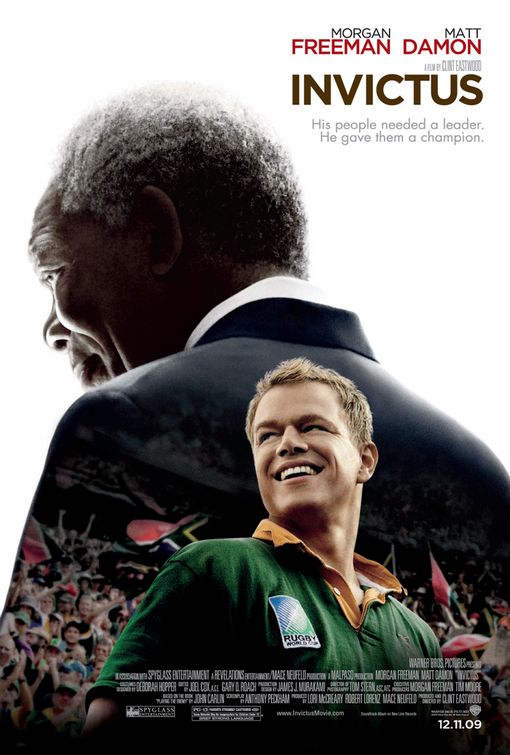
Invictus Movie Poster
Movie Poster for Invictus with Morgan Freeman and Matt Damon

Happy New Year!

I’ve been spending a lot of time at the movies lately. I’ve seen a sports movie set in post-apartheid South Africa, a Hindi movie that made me laugh, a film about loneliness in the so-called friendly skies, and stepped into a fantastical 3D world that provided much food for thought. So, for the next two weeks I’m going to look at these movies and try to pinpoint what they say about winners, finding your passion and epic, fantastic narratives that are really masks for the colonial past.

I know floating out there is the common adage that “history is written by the winners.” Which is true, to some extent. Winners are the one’s who seemingly get to dictate the terms for the narrative, those who survive to describe the victorious battles and the defeat of their foes on their own terms. In effect provide their interpretation for the events that brought them success.

Winning also brings forth a certain amount of pride, and in the case of sports team, a sense of identity with those the team represents. Over the holiday I saw the movie Invictus, which narrates the presidency of Nelson Mandela through his work to bring the South African rugby team (the Springboks) to victory in the 1995 World Cup. While I think Mandela’s role and his relationship with the Springbok’s has been dramatized for the film, his years long relationship with Captian Francois Pienaar (played by Matt Damon in the film) has not. Mandela’s hope was that this team could heal a nation trying to move past the legacy of Apartheid, and to bring unity between black and white South Africans.

I was thinking about this later in the week when my sister and I attended my first ever NFL game at FedEx Field in Washington, DC. As had become the norm this year the home team—the Redskins, were defeated by the Dallas Cowboys. But amidst the maroon and gold I could see that this team, like many in the NFL stirs such strong emotions in those who have been long time fans. We all know how loud and proud fans of the Boston Red Sox and the New York Yankees are—and that many stick by their teams in the good years and the bad—or more often than not, just during the good years. What is it about winning that makes the bond of local identity stronger? Does losing cause some erosion of faith in the city, making it a less enticing place to live and work?

Nelson Mandela and Springbok's captian Francois Pienaar in 1995
Nelson Mandela and Springbok's Captain Froncois Pienaar in 1995 after the Rugby World Cup.

In terms of looking to the past, if the movie is to be believed fully, Mandela saw the Springbok’s as an opportunity, a way to give both black and white in South Africa something to look forward to, a symbol that there was something both sides had in common. What does this say about the larger narrative—including things like the Olympics or other World Cup events where athletes are specifically chosen to represent their country at worldwide tournaments?  Are sports-as-unifiers merely temporary panacea’s to larger issues? Do they actually heal wounds, or just a temporary band-aid that keeps slipping open?

Below is the poem that Nelson Mandela held onto while he was being held in prison.

Invictus
William Ernest Henley

OUT of the night that covers me,
Black as the Pit from pole to pole,
I thank whatever gods may be
For my unconquerable soul.

In the fell clutch of circumstance
I have not winced nor cried aloud.
Under the bludgeonings of chance
My head is bloody, but unbowed.

Beyond this place of wrath and tears
Looms but the Horror of the shade,
And yet the menace of the years
Finds, and shall find, me unafraid.

It matters not how strait the gate,
How charged with punishments the scroll,
I am the master of my fate:
I am the captain of my soul.

Going Green, (Not) Eating Animals, and Finding New Stories

This post was adapted for a New Year’s Resolution Post on the PreservationNation Blog.

What happens when you decided to make a decision that involves dramatically changing your eating habits. Imagine avoiding processed food, or deciding to stop eating meat—and learning how these decisions impact not only your own health but also your sense of community and place.

One of the keynote speakers in Nashville (at the National Preservation Conference) was Bill McKibben who gave a talk that involved thinking about the environment in terms of our historic built environment (you can take a look at what he said here on Mother Jones). I finally got around to finishing his book Deep Economy and became very interested in the one chapter that describes his year of eating locally. Now, admittedly this is something that is a lot easier to do in Vermont then here in the middle of DC but it seemed like an exercise that would essentially lead (by the end of the year) to food that was boring (I mean how many times can you eat a salad made of ingredients you froze?).

He started in September (harvest time) and buys up as much fresh vegetables, fruits and produce that he can manage, freezing, brining and apparently also Cryovacing things to maintain their usage for a longer period of time. By the time he gets to February and March his menu has changed to eggs, soup and cheese sandwiches. As for his meat he goes local there as well, making his way over to local community farms.

But what does this all mean? I’m still not sure I buy the fact that its not that expensive to buy local as we think it is (once again, think Vermont), but I do believe that the food is better for you in every way. I also get McKibben’s central argument that we need to make a change in the way we live in order to help ourselves and help the environment. That being said, his strongest argument is when he points out that he has had to “think about every meal, instead of wandering through the world on autopilot, ingesting random calories” (Deep Economy, 94). Furthermore he’s “gotten to eat with my brain as well as my tongue: every meal comes with a story. The geography of the valley now means something much more real to me, I’ve met dozens of people I wouldn’t have otherwise have known“( Deep Economy, 94).

Which leads me to the idea of (not) eating animals. Last week, I was given an extra ticket to listen to Jonathan Safran Foer talk about his latest book Eating Animals, a book that describes his path to vegetarianism. While I have yet to read the book, he started off his talk telling us about how our eating habits are always connected to “stories we are told, tell ourselves, and stories that are impressed on us.” That the food we are trained to eat at a very young age is connected to what our parents fed us—in his case what his grandmother fed him.

The majority of the conversation dealt with looking at where our food comes—and pretty much like the narrative on a recent episode of Bones about the horror of large scale meat farming. But like Bill Mckibben he offers a solution, describing the importance of being able to see where your meat comes from.

Of course it all comes back to the story, at the start of his talk Foer told us about his grandmother, who spent all of his childhood feeding him—impressing upon him the importance of having food. He then described a moment when his grandmother was scavenging for food during the Holocaust. She came upon a Russian Farmer who offered her some ham. She then made a decision that I don’t know if I could have made. She said no. When Foer asked his grandmother why she chose continued starvation over some sustenance (because the meat was not kosher) she said the following, “if nothing matters, there is nothing to save.”

This phrase takes on an even broader meaning when you think about McKibben’s thoughts after his year of eating locally—that the “good taste was satisfaction. The time I spent getting the food and preparing it was not, in the end, a cost at all. In the end it was a benefit, the benefit. In my role as eater, I was part of something larger than myself that made sense to me—a community. I felt grounded, connected“ (Deep Economy, 94).

Everything we do has meaning. Where we live, who we interact with, the choices we make—and, as it turns out, what we eat. While I’m not sure what changes I’ll make in my eating habits, I know that I’m now looking at what I eat and why I eat with a more critical eye. I know that the Indian food my mother has made me from birth invokes a sense of homecoming, and that mint chocolate chip ice cream makes me think of my older sister. I know that every time I eat Italian food I’m going to think of the best tiramisu I’ve ever had (randomly at Canary Wharf in London)–which brings up memories of the summer I lived there and traveled around Great Britain.

So something to think about this holiday season as we embark upon our traditional fruit cakes, gingerbread cookies and other Christmas food traditions. Of course this is something that can be seen from a variety of perspectives, so I wanted to bring in another perspective. After that, take a look at some pictures from my all vegetarian Thanksgiving dinner.

Being Vegetarian
By Guest Blogger: Sarah F.

As a somewhat recent vegetarian, I’m often discouraged by the flak meat eaters give vegetarians—and vice versa—in my own experience, in the food blogs I read, and even on my favorite shows (hello, Top Chef! Please stop treating us like second-class culinary citizens!). I enjoyed Jonathan Safran Foer’s talk because he mentioned that the issue of factory farming doesn’t have to pit meat eaters versus vegetarians; it’s an issue of extending our moral consideration to include animals and the environment, which anyone can do. He even argued that the term “vegetarian” has done a disservice by making dietary choices seem like one extreme or the other (also, I know I often feel like I am not living up to some imaginary vegetarian ideal).

That people get so impassioned over eating meat or not shows the extent to which food is tied in to our culture and our identities. The food you eat can help define you as health-consious, socially or environmentally conscious, “real” or “elitist,” a manly burger eater or a dainty salad bar eater. Perhaps we’ve been wrong to think of it in such binary terms.

While I try to think critically about what I eat, it is hard not to get discouraged. Eating locally seems too expensive and too time-consuming. Processing all the labels at the grocery store can be overwhelming, especially when certain terms (organic, free range) seem to have lost all meaning. I haven’t read McKibben’s book yet, but from Priya’s description it sounds like following his example would be a tall order. I’ll be keeping in mind Foer’s point that eating responsibly doesn’t necessarily have to be an extreme or some impossible state of dietary perfection, but a goal to keep striving towards.

~~~~~

Some pictures from all veggie Thanksgiving.

The Menu:

Stuffed Shells (with shredded zucchini, mozzarella cheese and potato)
Eggplant Parmesan
Butternut Squash Puree (with sweet apples and orange zest)
Mushroom, Spinach, Pine Nuts in Phyllo (Note: The recipe includes bacon and is a lot fancier, we kept it simple)
Traditional Green Bean Casserole (with Campbell Cream of Mushroom Soup)
Melted Brie with cranberries and walnuts
A soup that my mom made which is I guess her own special recipe.
Potato Pave

Desert (aside from apple pie): Caramelized Pineapple, Apples, and Craisans in Phyllo (Note: We did not use dried cherries, and instead of rum put in Apple Juice, also didn’t do the ice cream mixture).
Hodge Podge: Books that Changed A Life

One of the reasons I started this blog has to do with my love of a particular NPR podcast/radio show known as This American Life. Every week I would listen to Ira Glass and think about how much I wanted to talk to someone about what happened or I wanted to put pen to paper and write about a particular episode that moved me in some remarkable way. A lot of people I know listen to this and we’re always asking each other—did you see the one where the woman got rabies and couldn’t find vaccine (I can’t for the life of me remember the episode name)? Or in Switched at Birth where those girls are switched at birth and the mother who knew didn’t do anything about it (we always get angry when we think about this one). One of my favorites is the story of the Iranian couple who divorced and then two years later, found each other again (Reunited (and it feels good)). Don’t even get me started on the awesomeness that is The Ghost of Bobby Dunbar.

Anyway I’m a few weeks behind and finally heard an episode that originally aired on August 20, 1999. and was re-aired on October 2nd. This episode was called The Book That Changed Your Life. Made up of four acts this episode took a look at the ways in which a particular book touched and of course changed lives. I think the episode is best summed up by a quotation in Act 1 which looks at how playwright Alexa Junge used a book from her grandfather’s library to feel closer to him. She says that

“When you read a book and something speaks to you and you feel understood and it makes the world a less lonely place.” Books can be powerful things and I’ll be first to admit that sometimes we read things that aren’t quite so intellectual or highbrow because they make us feel comfortable and at peace. Others challenge you to look beyond your normal scope of inquiry to see worlds beyond your wildest imagination.

It is to their credit that the power of the written world sometimes trumps other storytelling mediums (one example from the last decade would be the translation of the Harry Potter series to the big screen.) There is also something about books that reflect on the simplicity of expression. In Act III we learn about Roger a construction manager who becomes obsessed with collecting every book about Lewis & Clark known to man. At first he doesn’t read the texts, but once has the final piece (I believe it is a copy of the two volume first official printing of their journals) he opens up and begins learning as much as he can about these two people he has spent years of his life on. The magic is in his voice as he describes reading about the moment when Lewis and Clark reach the ocean, and how he would have been screaming and dancing but for Lewis and Clark their excitement is summed up in the simple text “ocean in view. Oh the joy.”

So it got me thinking about the fiction books that have changed my life. If I included nonfiction this could be a very long list, since there are many, many non-fiction books that inspired me. To some extent these five books are the ones that made me think about the construction of a story, but also made me think about the choices characters are forced to make and how powerful those choices can be as a reflection of reality.

  1. The Giver by Lois Lowry
  2. A Tale of Two Cities by Charles Dickens
  3. The Lord of the Rings (fine three books not one but I’m counting it as one) by J.R.R. Tolkien
  4. Pride & Prejudice by Jane Austin
  5. Atonement Ian McEwan

The Giver, the story of a boy living in a colorless world was perhaps my first introduction to the idea that maybe not everyone can see the world the way I do. What could I live without? A Tale of Two Cities is perhaps one of Dickens most quoted books and while not necessarily his best (I may say that Bleak House might be that) his ability to take his many story strands from incoherency and then pull them back together is just one of the reasons why I love this. It might be the vivid picture of the dirt, the gritty grime of his London/Paris that says it all. As for Tolkien it is the classic hero’s journey, and one which has parallels from all parts of life. Pride & Prejudice has more to do with Jane Austen and what she could do in the middle of 18th century England, but also the way she uses the story to provide a glimpse into all walks of English society. Lastly, Atonement…..really its because Ian McEwan has created a character who is both morally ambiguous and for whom I can never decide whether I would like to feel sorry for or just hate.

As always though as I put together this list other books started popping out at me so instead of me talking about myself—tell me about what books you guys love.

A few related notes:

  1. Claude Levi-Strauss: Levi-Strauss was a French structuralist anthropologist, who formulated theories on how and why so many myths from around the world seem to have similar structures and ideas. He died at the age of 100 last week and his writings were one of the first to push my mind beyond looking at things in one particular way. Levi-Strauss also had a big role in the creation of UNESCO race policy. Learn about his work at UNESCO here.
  2. A few weeks ago during one of Gene Weingarten (a columnist for the Washington Post) humor chats he asked us to take a look at a newly surfaced video that provides a single three second glimpse of Anne Frank prior to when her family went into hiding. He wanted us to decide if it was powerful and to explain why—so I’m asking you. Is it just a video of a girl watching her neighbors go off on their honeymoon, or is it powerful (as I found it) to finally catch a glimpse of someone whose words symbolize some of the acute horrors of the Holocaust.
  3. You might not get another long blog post from me until after November. I’ve decided to write for National Novel Writing Month (50k words in 30 days.) For more information visit www.nanowrimo.com.

Quickly Turning Pages

Four Book Reviews in One
For  a review of the following books with a history/preservation slant click here.

In the Woods
The Likeness

By: Tana French

Dublin, Ireland. In her first two novels, Tana French writes a story that is hauntingly engrossing and equal parts frustrating. The first tells the story of a murder. A young girl is found at an archaeological dig and her case seems connected to a cold case, one where three children go into the woods, and only one comes out–his shoes filled with blood.

That child, now grown, is Detective Rob Ryan who along with his partner Cassie Maddox are in charge of investigating the death of Katy Devlin. This first book, narrated by Ryan, is about more than solving the murder/disappearances. Its about making decisions, breaking the rules and crossing ethical boundaries that end up changing the course of your life. I found myself pulled into Rob’s past and watching his every move with interest—not knowing that there is more to the story than what French gives us. While Operation Vestal (Katy Devlin’s murder) is trying in its own right, it is Rob’s story that hooked me. I’m hoping that we will see more of him in French’s future work, since my only disappointment with the book is a lack of resolution to what actually happened In the Woods. Then again, maybe that was the point. Not knowing defines the story, and the speculation and results of the two disappearances provide the contours to understanding Rob, his relationship with Cassie and how Operation Vestal finally plays out.

The Likeness takes place six months after In the Woods, and this time Cassie is our narrator. While some say you can read them in any order, I think understanding the events surrounding Operation Vestal gives you insight into Cassie Maddox’s state of mind. This book is also about the death of a young girl: Alexandra Madison. Not only does she have Cassie’s face, but the name is a fake identity created by Cassie and her former handler when she worked in undercover.

So Cassie who had once been Alexandra Madison a drug dealing student, becomes Lexie Madison—a dead, English doctoral student murdered and left alone in a ruined cottage. Just like with In the Woods Cassie makes choices that blur the lines of ethics, choices that force her to confront her own demons.

So two books and hopefully a series that I highly recommend.

Book of Air & Shadows
by Michael Gruber

This book is my choice for book club (the Royal Pinkerton Society for Novellic Exploration). I had high hopes. The plot in a nutshell? Someone discovers evidence indicating that somewhere out there is a missing Shakespeare manuscript, written in his own hand—and there are many out there that would kill to get it. The narrator of the story is Jake Mishkin who is writing the events out as he sits alone in a cabin waiting for people to kill him.

While I’m still not a hundred percent sure what happened at the end of the book I can say the best parts  involved reading the letters that speak of the missing manuscript. I appreciated seeing the actual text rather than having the characters repeat the text for us. That being said, unnecessary tangents and detail pulled me out of the actual drama surrounding the search for the book, making getting through it a bit distracting. Also, I’m not entirely sure that Gruber was successful in weaving the plots within plots, not to mention the fact that I guessed who the puppet master was long before the I hit the final confrontation. So—what’s the verdict? Could have been better, Could have been worse.

The Lost Symbol
by Dan Brown

The final book I wanted to mention in this review is by Dan Brown. I will go into this review with one caveat. I have read Angels & Demons and The Da Vinci Code, both were entertaining, but Brown’s writing style kept pulling me out of the story. I tried to go into this one with an open mind, but since it was set in DC I knew that the inevitable inaccuracies would drive me crazy.

I’m only going to mention two here, just to give you an example. At 10pm at night, it is not possible to get from Federal Triangle to King Street in 15 minutes via metro. As I often make the trip it takes more like 45 minutes. My second point, as you’re driving over Memorial Bridge with the Lincoln Memorial in front of you, its not possible to see the Tidal Basin.

I know, that’s being incredibly nit-picky. Here are some more specifics—if it were possible for me to hate Robert Langdon I would. What’s even worse is that Dan Brown chooses to use Langdon’s inner monologues to tell us every single piece of research he’s done for this book. Instead of weaving it into the story he decides to tell us everything rather than showing it to us. Also, for only taking place over the course of 4-5 hours the story moves really, really slow. Too many twists, and the identity of the big-bad guy is fairly obvious from the first 20 pages.

And then the ending. While I suppose Brown’s intention was to be awe-inspiring finding out what the title meant only made me groan (though I will admit the imagery of watching the sun rise over the Washington Monument from the top of the Capitol was nice, since that view of the mall is one of my favorites.) Maybe the final conflict intense, but the Return of the King like ending (you know, how the movie had 12 different “final scenes”) made the conclusion fairly tedious.

Last thing that bugged me? There is one point where there are five lines that make up a single chapter. That’s it. A one paragraph chapter. Also the events in question during that paragraph, though explained later, read more like Brown is trying to break out of his genre, and I feel could have been dealt with in another way.

Read it if you feel like it, but I was not impressed. Maybe you should just wait for the movie.