Eating My Way Through New York City, Portland, and Miami

In the last two months I have done a lot of traveling and eating. I’ve been up the east coast to New York City, then across the country to Portland, Oregon followed by a quick vacation in Miami. Each of these trips was for an entirely different reason but in the end the food made me smile.

In New York City we went to…..

I have nothing but good things to say about the Rocking Horse Cafe. Suggested to me by a co-worker we landed there more than 40 minutes late for our reservation (we were essentially traveling the Friday after the crazy snow storm in DC so our sure fire travel plans landed us in the city a full half day later than expected) and had to get out of the restaurant within the hour to see Wicked. They got us in and out with fifteen minutes to spare, and while we inhaled our food I know each and every one of us will go back next time we are in the City.  Want to know why? Check out these images of delicious Chicken Enchiladas with pomegranate sauce.

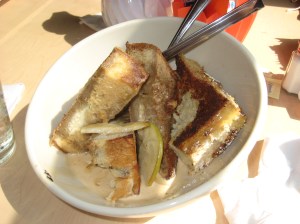
We also ate at  Elmo’s (for one dinner and brunch). The decor and music were great, and my food was delicious. I had the latin american chicken tacos and the creme brulee (can I help it if I like Mexican food?). During brunch I had the baked french toast with grand mariner and baked apples.

The last place in New York City we ate at was a Otto’s Enoteca Pizzeria. While the Pizza was naturally really, really good–I loved how knowledgeable our server was and the great variety of cheese we had to pick from.

In Portland, Oregon….

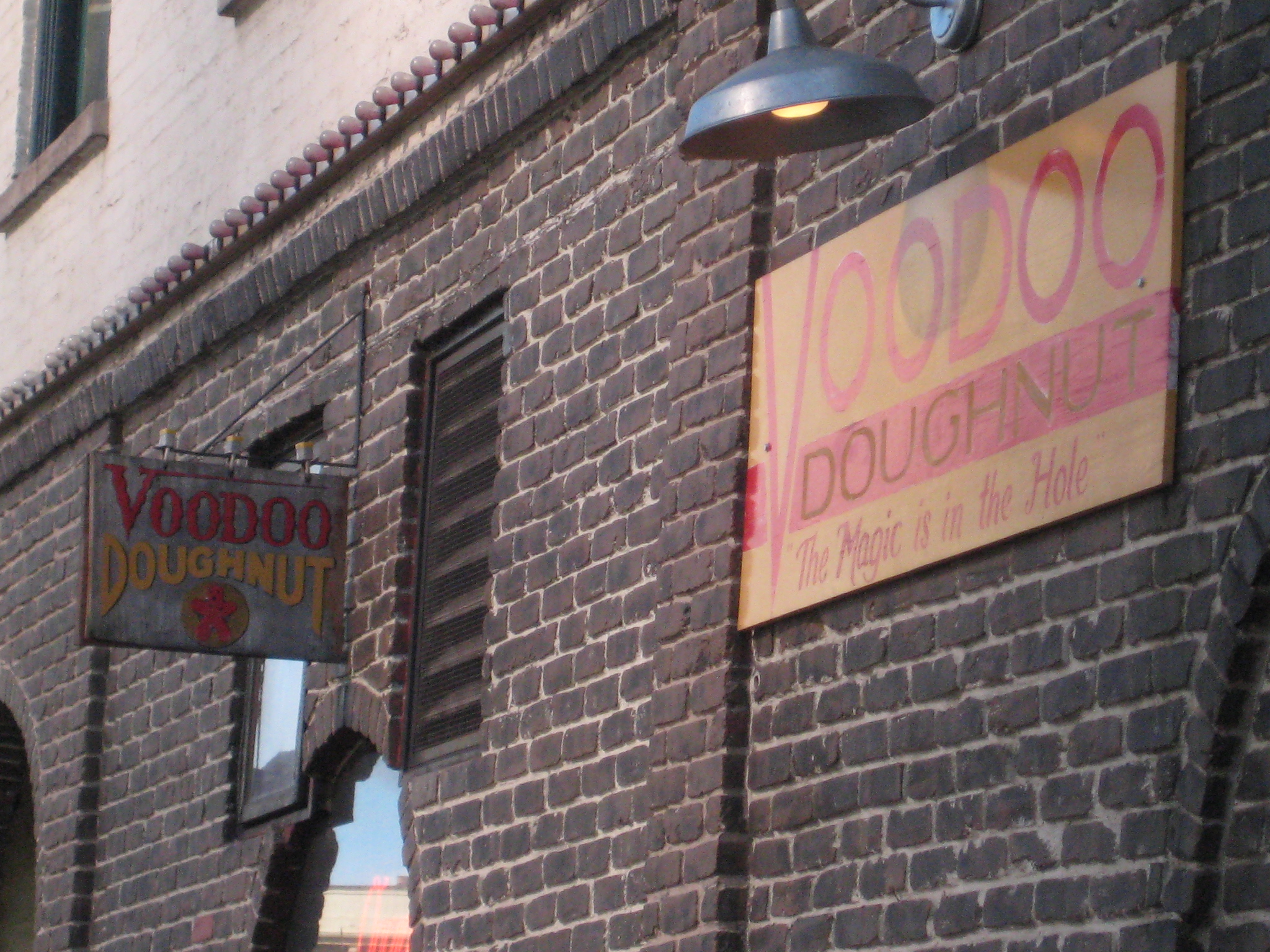
All places I would suggest you try? The Flying Elephant Cafe for lunch, if you want a variety of different bar food try a McMenamins bar (I tried the Ringler’s Annex next to the Crystal Ballroom). The Cajun tater tots were delicious. I also was picked up by a friend and driven out of the main part of the city to the Hawthorne District (I think?!). Where I ate a great meal at Savoy Tavern (I guess the website is coming soon). Here I ate a great salad, sauteed mushrooms that were a little garlicky and a really good onion soup. This meal was quickly followed by dessert at Pix Patisserie where we got individual desserts whose names escape me. I think I was charmed by the toy monkey’s hanging from the ceiling.  Of course, let’s not forget about the incredible doughnuts from Voodoo Doughnut for breakfast.  Really good, quirky and enough to give you a great sugar high for hours.  Also, if you’re in Portland you have to get lunch from one of the carts. I had a great Kabob Sandwich that made me smile.

As for Miami

I’m just going to write you a short list. I ate at Opa’s Tavern on Ocean Drive. The food was good, very filling. They had great entertainment that was maybe a mite too loud for dinner unless you are prepared to dance on your table while you are eating. We picked up sandwiches along the boardwalk and some so-so Cuban food at a place whose name I sadly can’t remember. That being said if you are in Miami make sure you eat at Big Pink’s, but I would recommend sharing unless you have an appetite for four people.

So…that’s the food run. Are you hungry yet? I know I am.

Stepping Out in Portland

Portland, Oregon is a beautiful city. It’s not too enormous or too small in its harmonious setting between the Columbia and Willamette Rivers, which are flanked (on a clear day) by the snowy peak of Mount Saint Helens reaching into a beautiful blue sky.

That’s what Saturday was like at the National Council on Public History Conference, revealing to me just what a walkable, bike-friendly city looks like. I spent one of my breaks eating at Voodoo Doughnut and at various food carts, all while meandering through street fairs and Powell’s Bookstore (their architecture and history sections are like time warps – prepare to lose four hours in a flash). All in all, a good ending to a fantastic four days.

That being said, let’s take stock on the last two days of the conference. Friday morning I moderated a panel with David Brown (the National Trust for Historic Preservation’s executive vice president), Ian Fawcett (deputy executive director of the Land Conservancy of British Columbia), and Liz Dunn (consulting director of the Preservation Green Lab). The session explored the work of the International National Trusts Organization (INTO) and how climate change is being thought about by their member organizations across the globe. In putting together this panel, I wanted to spread the great information from the INTO conference in Dublin this past year. You can read one attendee’s reaction here.

Following this, I boarded a bus out to Dundee Hills to visit the Sokol Blosser Winery, an organic sustainable winery that is home to the first LEED certified silver wine cellar. The owners of Sokol Blosser understand the need for sustainable farming and viticulture and have adopted it wholeheartedly, managing to convince the vineyards surrounding them to work with them to accomplish their goals. More on that in a bit.

So, what does all this have to do with preservation?

On the one hand, the story of the vineyard speaks to what historians can accomplish (the founders of the vineyard were both history majors in the 1970’s), but it also attempts to answer a question we struggled with earlier in the week – how do we reach the public and show them that sustainability is a part of our future, and more specifically that historic preservation and sustainability go hand in hand within that future?

When I first started at the National Trust almost four years ago, I knew almost nothing about how the environmental movement was linked with old buildings (aside, of course, from the role of Teddy Roosevelt and John Muir in the creation of the National Park System). It took time reading and listening for me to understand why this is an integral part of what we do.

As a public historian/preservationist, it is important to recognize all the ways that history and the past connect with the public, even when this connection reflects highly volatile and controversial current issues like global warming and sustainability. We always throw around the fact that history is relevant in the here and now – that it is an important part of daily life and is ingrained in community character. The acknowledgement of this link between the public at the grassroots level and our role as historians/preservationists/public historians at the professional level needs to happen in sync with the work we do on policy and other legislation.

Let’s take a step back to the vineyard. The owners of Sokol Blosser knew they wanted to have a vineyard that was organic and sustainable, but they knew they couldn’t do it by themselves. So they reached out to their neighbors, trained their employees, and created a mindset within their own community about the importance of being green. Similarly, we recognize that the work we do on this issue is about more than just saving historic places; it is about preserving ecosystems and landscapes that are a part of historic view sheds, and consequently a way of life. We work within our organizations to communicate this belief and to spread the word to our memberships. We are ambassadors that are helping to usher forth an engaged, knowledgeable, and determined public.

Yes, this is a slow process, but it will continue to be advanced by gathering at conferences like the 2010 National Council on Public History/Environmental Historian Conference, where we all stepped out of our disciplinary silo’s and talked to one another.

Also cross posted on the PreservationNation.org Blog and the NCPH2010 Blog.

Things I heard at the National Council on Public History Conference

Overheard at the NCPH Conference:

How does one communicate about sustainability at the local level?

Is it better to be pretty good at a lot of things or really good at one or two things?

My Top Twitter Posts:

@pc_presnation: Important to train public historians to be adaptable . Knowing about digital tools is just as important as intellectual knowledge #ncph2010

@p_presnation: In a working group on sustainability and h.pres. How are you talking about it with your communities? #preservation #ncph2010

These two questions (and tweets!) lie at the heart of my first day of the National Council on Public History Conference here in Portland Oregon. I love this conference, first of all—its a small, yet open, community of historians that often like to look outside the box. Secondly hearing about these two things within the same day is not unheard of. In fact at any given moment you can hear about dissertations, practical applications for oral history, or even section 106 mitigation review all in one conversation.

The first tweet and the first question came from a session on digital history in a master’s program. We had some great examples from the folks at the Center for History and New Media, that was supported by a student at American University (who also works for the National Trust for Historic Preservation), an individual at the National 9/11 Memorial Museum and a doctoral student NYU who works on outhistory.org. What was great about this program is that it was, in the end, about more than just digital curricula in an educational setting. It was really emphasizing that sometimes, and especially in the case of public history work (including historic preservation) it is better to know how to do a lot of different things so that you can build upon that knowledge easily to further the goals of your institution and work. While Jeremy Boggs from CHNM was talking specifically about basic digital tools (html/CSS, FTP file sharing, writing grant proposals) its really an idea that can be discussed across the board. Its really important in any field to be adaptable, something that I also talked with another NCPH participant on my very early morning flight across the country on Wednesday morning. In terms of digital tools this is something that can be seen at the National Trust through our very recent Save Americas Treasures campaign which used traditional media to contact congress, but also provided the guidance for advocates to use Twitter, Facebook, Flickr and YouTube to spread the word.

Which comes to the second lesson from this session. Sometimes you have to take a little bit of a risk and have a little bit of trust to move forward. Without either of these things we, as historians/public historians/historic preservationists will never be able to adapt to the changing world. New communication tools, mean new communication strategies. New research techniques and sources, means new methods of talking about those sources to tell the stories we want to tell.

The second session of the day was about historic preservation and sustainability. This is a topic, as I mentioned in my earlier post, that is near and dear to the heart of preservationists. This is not something that NCPH, traditionally, has really discussed which is why having this conference in conjunction with the American Society of Environmental Historians was a great idea.

At the heart of the conversation was a self-examination regarding how sustainability and historic preservation connect back to the role these buildings play in the community. That while we talk about relationship between the two subjects to our peers at the USGBC or at sister organizations like NCPH that we also have to recognize the continuing disconnect at the local level. What strategies have been done to develop outreach and communication strategies for those at the local level? Whose responsibility is it to get the word out? How can we get the word out?

All in all, a successful day which ended with a chance to speed network (its like speed dating but you end up with a lot of business cards) and a great dinner with one of the panelists from my own session on the International National Trust Organization’s Dublin Declaration. So stay tuned on Monday for some concluding remarks and, I hope, some pictures from an organic and sustainable vineyard here in Oregon.

Follow the Conference on Twitter #ncph2010 or on the conference blog at http://ncph2010.blogspot.com/
This post has been cross-posted on the preservationnation.org blog

Currents of Change: Thinking about the Environment and History in Portland, Oregon

For the next few days I’ll be attending the National Council on Public History (NCPH) conference in Portland, Oregon. Not only is this city the furthest west I have ever been, it is also the first time I’ve ever been in Oregon. The topic of this year’s conference is “Currents of Change” and involves looking at the connections between history and the environment. The conference is particularly exciting because this year it is in conjunction with the American Society of Environmental Historians. You can see the program at www.ncph.org but I’ll pull out a few highlights over the next few days (and will be tweeting @pc_presnation). Until then here are a few thoughts from the first day of the conference which also includes a celebration of NCPH’s 30th birthday.

Sustainability is something we at the National Trust for Historic Preservation have made a priority. We’ve had tweets, and resources and discussions at various events including the National Preservation Conference. I know its something we care about on many levels. On my way in from the airport I overheard a snippet of a radio conversation that asked about why young people aren’t involved with the fight against global warming like they were back in the 1960s for Civil Rights. The commentator whose name I didn’t really catch, wanted to know where the sit ins, the protests, the civil disobedience to urge government action. His conclusion: That its not happening because no one has put forth a call.

I think a bigger question is: If someone puts out a call how will historians and preservationists answer?

Which of course leads me to more practical questions: how does the green movement and history interact with the public? more importantly what strategies and ideas are currently being used to reach people on the local level? How can we use our knowledge of the history of the environment in America to reveal how historic preservation is also green?

I’ll be look for answers when I attend a panel that talks about historic preservation and sustainability, the opening plenary session with Adam Hochschild and my Friday tour of an organic winery, and much much more. So stay tuned!

The Lies That History Tells Us

Wicked Logo
Wicked Logo

I finally did something last week that I have been looking forward to doing for months. I saw the musical Wicked. Based on the book by Gregory Maguire the story essentially inverts the Wizard of Oz on its head and and asks “What if the Wicked Witch of the West Wasn’t Wicked?” Its one of the “certain point of view” stories and the musical is filled with incredible performances and musical numbers that do everything a musical is supposed to do: make you laugh, make you cry, and make you sing.

Here are some lyrics to start this discussion (for those who haven’t read the book or seen the play, Elphaba is the Wicked Witch):

Elphaba, where I’m from, we believe all sorts of things that aren’t true.
We call it – “history.”

(sung) A man’s called a traitor – or liberator
A rich man’s a thief – or philanthropist
Is one a crusader – or ruthless invader?
It’s all in which label
Is able to persist
There are precious few at ease
With moral ambiguities
So we act as though they don’t exist

—the Wizard, “Wonderful”

When we think about and write about history we take some facts as exactly that—as facts. Hitler was evil, the Holocaust did happen, but historians know more than anyone that the “label” that persists sounds very much like the adage that “history is written by the winners.” In the case of Wicked we’re brought into a world that begins long before Dorothy takes her first steps into Oz, a land that is inhabited by animals who can talk and teach but are mysteriously becoming uncivilized and speechless.

Enter Elphaba who, in the classic hero’s journey makes sacrifices and choices to right a wrong, and ultimately finds herself vilified in the process. The ultimate strength of the story is its ability to turn the “wicked” into the underdog, and Dorothy into a footnote.

As a historian I can see how this applies. Every source we read, every oral history we listen to comes form someone with a point of view. We know that social history (that which looks at the slaves, the women, the ordinary people instead of merely the Big White Men) changed what we know about various facets of American History, and that different administrations are looked at and analyzed differently based on how conservative and how liberal our own bias’ are. We make choices as to what is important and what is not based on training and the ability to interpret and read between the lines to piece together history.

Now I’m not saying that if we looked a little bit harder the great evils of our time will miraculously be not as bad, or that the invaders will turn into “liberators.” I guess I’m merely acknowledging that what we do in thinking and writing about the past is as much of an art as it is a science and that sometimes opposing views give us a bigger picture of what actually happened.

Consider this image for another point of view:

Better History, Bitter Future
Better History, Bitter Future in Chelsea, NYC
Liberty from the Highline

While I was in NYC we walked by this piece of graffiti in Chelsea, just near the bottom of the High Line. It provides another interesting perspective. Histories document the good, the bad, and the ugly—but to some it seems like it is all with the wide brush of progress, rather then with strokes of reality. I believe that we document the past so that our futures are better, that injustices can be prevented before they happen. I’d like to think we aren’t writing better histories while ignoring the future, but do know for some, that is exactly what seems to be happening.

I am, in the end, ever the optimist, and so I’ll leave you with a few lines from another of Wicked‘s hits:

Something has changed within me
Something is not the same
I’m through with playing by the rules
Of someone else’s game
Too late for second-guessing
Too late to go back to sleep
It’s time to trust my instincts
Close my eyes and leap

—Elphaba, ‘Defying Gravity”

23,110

Civil War cannon and luminaries at Antietam Battlefield by Keith Snyder

This post can also be found on the PreservationNation.org Blog.

I know that Thanksgiving is normally when the holiday lights go up twinkling, bright and cheery. They give you that warm wintry feeling that many associate with both the commercial and religious aspects of the season. However, those lights always remind me that the first week of December is near—and with it the annual Antietam National Battlefield Memorial Illumination.  On this day, thousands of people drive through the National Park grounds to view the luminaries, one for every single solider who was killed, wounded, or missing on September 17, 1862 — 23,110 in total.

My first experience walking this hallowed ground was in 2000. As a senior in high school I helped to set up the white bags with candles, working with rope to outline a perfect gird. I can’t remember how many I lay down, but I do know what happened at dusk, when each candle sprang to life. From every angle the candles stood at attention, with honor in perfect lines. I guess you can say that they danced, the peaceful glow of the beams a far cry from the violence of those 12 hours–the bloodiest in the entire Civil War.

It has been nine years since I attended the ceremony, but I still spend that first weekend looking for articles, pictures and testimonials. This year I will be in Sharpsburg, Maryland with 20,000 others ready to look out over the field of lights and remember.

The Annual Antietam National Battlefield Memorial Illumination will take place this year on December 5, 2009 (rain/snow date December 12). More information can be found on the Antietam National Battlefield website.

Illumination is only one way that we remember the past, just as Antietam is not the only battlefield or site that remembers the fallen in this manner. I’d like to hear about some others, so please comment and share.

Nashville: My Place Matters, Opening Plenary

It has been a wild few days. I meant to post this earlier but was struck down with a crazy head cold.  Sad that I missed the partner’s reception but the early bedtime put me in a much better position to enjoy yesterday’s events.

First though–I wanted to say a few things about an event I worked on Tuesday. Charlotte Bonini (Senior Education Planner for the National Trust for Historic Preservation), Kimberly Nyberg (director of the Tennessee Main Street Program), Andrea Blackman (Director of Special Collections at the Nashville Public Library), and Kathryn Bennett (Librarian at Hillwood High School) put together a program for a group of fifth graders from Rose Park Magnet School. Called My Place Matters the goal of the program was to introduce kids to the role of historic places in their lives and get them thinking about why places matter on many levels. It was inspirational and I have to say those kids were some of the smartest kids I have ever had the opportunity to speak to.

The first half of the program took place in the Nashville Public Library. The first stop was the Young Adult Room where the kids showed us pictures of places that matter to them why they matter to them. It didn’t take long for them to make the connections between why their places matter and why historic buildings are important to preserve. The second room was the Special Collections room where the kids had an introduction to some of the very cool features offered by the Nashville Public Library everything from lesson plans, oral histories and videos.

The third part of the library the kids stopped at was the Civil Rights Room where a quotation from Martin Luther King Jr. sums up the story of Civil Rights in this city: “I came to Nashville not to bring inspiration but to gain inspiration from the Great Movement that has taken place in this community.” The Nashville Public Library stands where many of the events during the Civil War occurred. The room is dotted with images of the marches, sit ins and boycotts from this era. The students were treated with lectures from two of the participants from the demonstrations–Rip Patton and Frankie Henry. Rip talked to the kids about the  non-violence doctrine and at one point a little girl looked at him and said–“You keep saying we did this…were you a part of the demonstrations?” When he said yes, the resulting awe revealed just how much the kids had internalized what had happened.  They were most shocked by the stories from Frankie which revealed just how strong you had to be in the face of resistance.  She explained how at the age of 19 she had sat at a lunch counter and had been deliberately burned by a cigarette, and despite wanting to fight back the rules of non-violence meant she just had to take it.  In talking with my group afterward I was surprised by how much they recognized the importance of that moment–that the movement was too important and too big to fight back. That non-violence was key to accomplishing their goals.

The second part of the program involved a walking tour around Nashville where the kids took a look around at the buildings that make up this neighborhood, focusing on details with a Zoomer (a rolled up piece of paper that served as a telescopic focusing device) and sketching in their My Place Matters sketchpad. It was a great exercise in revealing the connections between space, place, history and the past and I know the teachers and students involved all walked away excited and energized.

So that was Tuesday. Yesterday, I attended the Opening Plenary where Dame Fiona Reynolds and Bill McKibben served as keynote speakers. It kicked off with some great music by singer/songwriter Dave Berg. I live twittered through the entire thing so you can check out some of my thoughts on my Twitter Feed @pc_presnation. For the purpose of this post I want to talk about how both Dame Fiona Reynolds and Bill McKibben underscored the theme for this year’s conference–which is Sustaining the Future in Harmony with our Pasts. Dame Reynolds spoke about how we’re moving past seeing preservation as a luxury, something we should think about only when we have money. She described how the UK National Trust has started up a bunch of programs involving sustainability but has tailored those programs to be simple, useful and meaningful. The one that Dame Reynolds highlighted dealt with the idea of growing produce seasonally and how they are cultivating sections of of their land for gardens that will be used in their various restaurants across the country.

The second keynote speaker, Bill McKibben talked about his cause 350.org which is what scientists say is the safe upper limit for carbon dioxide in the atmosphere and how the Copenhagen talks in December on climate change may very well be the most important meeting of our lifetime. For us historians, I think his point was driven home when he talked about our sense of place and space and how climate change relates to that. He says that how we relate to these places won’t be the same anymore.  One of the best examples he gave involved Robert Frost’s home in Vermont.  How will we, as human beings, contextualize his poems that talk about the snowy wood when there is no snow in Vermont?  So much of what we do as public historians (and preservationists) depends on the materiality of the past and making those physical connections between what we know of the world around us and what we know existed in the past.  Just as those kids in the My Space Matters program were asked to take something familiar and extrapolate out to understand how places matter, McKibben is saying unless we do something about carbon emissions we won’t have those familiar links that define our very identities.

Something to think about.

Pictures to come later.

The Battle for Franklin: Visiting the Widow of the South

Yesterday was the first actual work day for the National Preservation Conference. As with every year the day ends with a special treat for staff which often includes a tour that explains why the city we are in is ideal for preservationists. This year, of course, was no different.

Barely an hour before the meeting I finished Robert Hicks’ Widow of the South a book which tells the story of Carrie McGavock, a woman who despite the recent loss of three children steps up and makes a time that was so terrible mean something. During the Battle for Franklin, which is essentially the death knell for the Confederate Army, Carrie’s house, Carnton Plantation, was chosen to be the best place for a field hospital. What  makes this story so remarkable, aside from the heroic measures Carrie McGavock took that day to save young Confederate lives, is what happened two years later.

1500 soldiers from the battle had been buried where they had fallen. When faced with a landowner who wanted to plow under the land to turn it back into cotton and other commodities, Carrie fought and successfully re-interred all of the boys to her home creating a large private cemetery in her backyard. For five years she wrote to the families, and when the families came to take their boys home, four ended up leaving them there after seeing Carrie’s strength of character.

During our tour we heard from Robert Hicks himself (who is a speaker this coming Friday here in Nashville–something that will be web cast on our virtual attendee page) who described those bloody five hours at Carter House, and later the aftermath at Carnton. We saw the bloodstains that had seeped through the carpet and imagined the upper porch (the columns apparently a bright yellow) lined with a hundred injured souls.

He told us a story of one such Union officer who amidst the fog and the darkening night shot a young Confederate soldier dead. As he turned around he found himself impaled through with a sword, realizing that it was the sword of the young man he thought he had killed.  The duel continued with knives, and perhaps fists, until the Union officer lay injured with nine wounds that by all means should have been fatal.

Twenty years later he marries and has a son. That son is Douglas MacArthur.

Back at Carnton, despite not being able to see the cemetery I think we could imagine what things had been like. Having seen this house described in his novel, I could see the history come to life, but perhaps what is more powerful and more telling is the power we have as individuals to do what is right and to make a change.

Earlier in the day we had been going through the conference schedule and I had been asked to say a few things about Congressman Lewis–and perhaps these are the same words I can say about Carrie McGavock. There are individuals out there who step up and fight for what is right,  regardless of what that means for their personal safety and daily lives.

Congressman Lewis threw himself into the cause of Civil Rights in the 1960’s, Carrie McGavock spent the rest of her life documenting those dead soldiers and made sure that they were remembered, even though the cause had been lost.

Note: While Widow of the South is a fictionalized narrative it is based on real people and a real battle. Visit Carnton’s website here.

View my pictures from Nashville on my Picasa page.

National Preservation Conference in Nashville

I’m on Twitter!

This coming week I will be attending the National Preservation Conference in Nashville, Tennessee. As part of the efforts I’m part of a group of staff who are tweeting from the conference. My general “tweet beat” is Genral History and you can follow me @pc_presnation.  If you’re going to be at the conference and are tweeting make sure the hash tag #PresConf.

Otherwise, if you’re interested in checking out some of the events and sessions at the conference check out the virtual attendee page where we’ll be blogging, webcasting, webchatting, uploading images to Flickr, posting on Facebook  and of course tweeting. Not convinced? Check out this awesome video with Sarah and Jason!

I’ll also be posting a blog or two right here on …and this is what comes next.

See you in Nashville!

Eating our way through the Windy City–or Can I just have six tacos?

Though we were in Chicago for a little over 24 hours we ended up doing a whirlwind tour of places I have eaten at before. That’s right—they were all so good I couldn’t help but go back.

Dinner Friday was at the Green Zebra

Some of the things I tried:

  • Thai Spiced Carrot Soup, crispy rice noodles: a nice amount of heat, and perfect for the slightly chillly evening
  • Chilled Sweet Corn Soup, breakfast radish, parsley: sweet, and tastes like what you would expect
  • Farro Risotto, lemon gremolada, zucchini, sweet peppers, mascarpone: the only dish I wasn’t huge on, the risotto was a little bland, but the veggies were really good.
  • Fresh Burrata Cheese, candied olive, lemon, fava beans, tempura squash blossom: A nice cheese, not too sharp, not too bland great texture and flavors (especially with the olives)
  • Honey Hazelnut S’more: How can I love thee…let me count the ways.
  • Five Spice Doughnuts: Doughnuts! Doughnuts! Doughnuts!
Chai French Toast at Orange

Brunch on Saturday was great following a six mile run (Army Ten-Miler in 3 weeks!)

This is what we had at Orange

  • Chai French Toast (It has ricotta cheese in the middle, just think about that).
  • Rosemary French Toast
  • Eggs Benedict
  • Fresh juices

…and an atmosphere is cute, cute, cute. Did I mention you can get orange flavored coffee for those who like inventive coffees.

Plantains at Frontera Grill

Now we’re coming to the best part. For those of you who know about food I’m sure you had heard about Rick Bayliss long before he won Top Chef Masters this summer. We should have thought about making reservations a long time ago but for reasons I can’t explain we didn’t. So my friend and I headed over to Frontera Grill and Topolobampo at about 4:50pm on Saturday only to discover that the line was out the door and around the corner.

We got in, put our names down for the 2-3 hour wait, then proceeded to stalk the bar tables. An hour later after having a four top stolen from right under our noses (we had recruited a couple from Baltimore to sit with us), we sat down next to a table of U2 concert-goers. They were having a nice sociable conversation with another group of four who were clearly stalking their table.

Then the drama began. The U2 goers departed, the new group sat down. Man 1 is on the phone, Man 2 is tried to get his lime in a bottle of Corona, lime juice sprays everywhere including inside Man 1’s eyes. Man 1 freaks-out talking about how he’s been attacked by juice (now its not angry freaking out, its over the top drama queen freaking out).

Then the waiter comes to get their order and Man 2 says this is what he wants:

Six hard taco shells with nothing but beef.

The poor waiter tried to explain the options for tacos, including that they don’t have hard taco’s. The guy then says–

All I want are six tacos. Three hard and three soft. The beef on the side.

So my question is—why come to a four star Mexican restaurant when you want Taco Bell level food?

Chicken Enchilada's at Frontera Grill

Anyway—This is what I got:

  • Chicken Enchiladas: Beautiful Mole sauce.
  • Fried Plantains: Sweet, and tasty.

While we had to eat pretty fast (the concert started at 7 and we decided to forgo seeing Snow Patrol) and it was 7 when we got our food, it was just delicious.

So when you’re in Chicago check out all these places and eat your heart out!