Closing it Out (and a bit about Nashville Food)

I know it has been a few weeks since the end of the National Preservation Conference, but I wanted to make sure to provide a closing post. On Friday after dispatching the last of the field sessions those remaining in town made our way over to BB Kings for the Final Fling which included a live auction and music from Last Train Home.
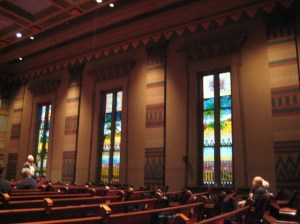
Interior of the Downtown Pres. ChurchBut there was more to come. Saturday dawned bright and early for us with the Closing Plenary in the Downtown Presbyterian Church, an example of Egyptian Revival architecture. We were about to be treated to a talk by Chief Justice of Indiana Randall Shepard and Congressman and Civil Rights Leader John Lewis of Georgia.
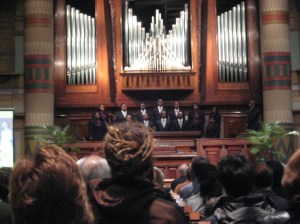
Fisk Jubilee SingersBefore we talk about them let me say a few words about the Fisk Jubilee Singers. First started in 1876 as a means to raise money for Fisk University (the first American University to offer a liberal arts education without any stipulations as to race) the group is now known for preserving one of America’s greatest treasures—that which the website refers to as the negro spiritual. Let me say from first hand experiences that those voices rose in perfect harmony, bouncing off the walls with a clarity and resonance so vivid and vital that I got chills.

As for the talks-despite coming from two tangentially different directions (preservation and law/preservation and civil rights/politics)-Chief Justice Shepard and Congressman Lewis had ultimately one message for preservationists. The Chief Justice surmised our mission in one eloquent sentence, that “we stand up for livability, for a sense of place and architecture that lifts up the soul rather than deadens it.” His words were followed quickly by a call for continued agitation by Congressman Lewis who proclaimed that “If we do not fight for these places then history wont be kind to us.” In both speeches there was a rallying call that said, to borrow a popular phrase from the National Trust at this conference, what we do matters. That preserving buildings, music, and the spectacular architecture that Nashville has to offer effects how people live and breathe and connect with the world around them.

This dialogue intermingled with my thoughts on the music, the lights and the life in Tennessee and led me to ponder the following question: Where do we go from here?
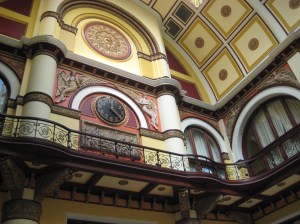
Union Station Hotel in Nashville

All right. Maybe not. But it does allow me to segue into the final event of the conference (for me at least) which was the Forum Lunch, and I urge everyone who is interested on where Preservation should be and could be going in the next fifty years to take a look at Don Rypkema’s talk here. Particularly intriguing for me was his assertion that as historic preservationists we should work (at least in urban areas) to manage change over time and not necessarily a point fixed in time. At the heart of his talk he is asking us about how we remain relevant in a world that incorrectly sees history and historic preservation as a luxury, as something that will not create jobs, will not help the economy, and is not important enough to consider a priority at every level of living. He says that we are evolving–(for those not familiar with it, This Place Matters is a program of the National Trust that asks citizens to look at the world around them and identify the places that matter to them.)

Here is my test – look at what made the list of the National Trust’s “This Place Matters” program. Virtually none of the finalists met the test of either being an architectural masterpiece or of particular significance to our national history. Those places were nominated because they mattered to the local community and in many cases not on architectural grounds. I for one think that is a wonderful way for historic preservation to have evolved.

Stained Glass at Union Station Hotel

I say that this is exceedingly clear when we think about the evolution of historical thought in the last few decades. We have moved from looking only at the big men of history to understanding the everyday—the people on the streets, the forgotten and the silenced. Social history has done amazing things for democratizing what we know about our pasts and our future—we can now step inside museums and watch on television stories that make connections on a more visceral level than before. It is the same way with Historic Preservation whose history may have began with the rich and the elite but has long since moved to a movement that seeks to preserve the places we live in, the character of neighborhoods, the places that, in essence, make the world unique and diverse in every sense of the word.

So I think my one takeaway from this conference is that we have to be open to expanding our definitions and boundaries, looking to new horizons to let the past and present stand the test into the future.
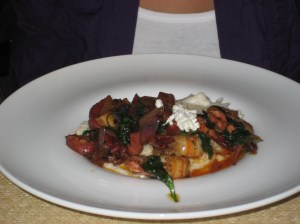
Shrimp & Grits from Prime 108Whew. Did you think I was going to forget to talk about the food?

This is one of those towns where being a Vegetarian is really difficult—luckily I eat chicken, and boy did I eat a lot of it.

Here are my recommendations:

  1. The Fried Chicken at BB Kings
  2. While the Mac n’ Cheese I had at Robert Hicks’ house was to die for, I’ll just say that Nashvillians know how to make a mean mac n’ cheese.Mike's Ice Cream Fountain-Ceiling detail
  3. Make sure to check out Mike’s on Broadway by the River where you can get some of the most delicious ice cream cones out there.
  4. For brunch—go fancy and hit up the Wyndham Union Station (Prime 108) where I had some delicious French Toast, and my friend had some true southern grits with shrimp. While we waited for food we ogled the stained glass windows.

Don’t forget to Check out the pictures on Picasa!

National Preservation Conference in Nashville

Nashville: My Place Matters, Opening Plenary

It has been a wild few days. I meant to post this earlier but was struck down with a crazy head cold.  Sad that I missed the partner’s reception but the early bedtime put me in a much better position to enjoy yesterday’s events.

First though–I wanted to say a few things about an event I worked on Tuesday. Charlotte Bonini (Senior Education Planner for the National Trust for Historic Preservation), Kimberly Nyberg (director of the Tennessee Main Street Program), Andrea Blackman (Director of Special Collections at the Nashville Public Library), and Kathryn Bennett (Librarian at Hillwood High School) put together a program for a group of fifth graders from Rose Park Magnet School. Called My Place Matters the goal of the program was to introduce kids to the role of historic places in their lives and get them thinking about why places matter on many levels. It was inspirational and I have to say those kids were some of the smartest kids I have ever had the opportunity to speak to.

The first half of the program took place in the Nashville Public Library. The first stop was the Young Adult Room where the kids showed us pictures of places that matter to them why they matter to them. It didn’t take long for them to make the connections between why their places matter and why historic buildings are important to preserve. The second room was the Special Collections room where the kids had an introduction to some of the very cool features offered by the Nashville Public Library everything from lesson plans, oral histories and videos.

The third part of the library the kids stopped at was the Civil Rights Room where a quotation from Martin Luther King Jr. sums up the story of Civil Rights in this city: “I came to Nashville not to bring inspiration but to gain inspiration from the Great Movement that has taken place in this community.” The Nashville Public Library stands where many of the events during the Civil War occurred. The room is dotted with images of the marches, sit ins and boycotts from this era. The students were treated with lectures from two of the participants from the demonstrations–Rip Patton and Frankie Henry. Rip talked to the kids about the  non-violence doctrine and at one point a little girl looked at him and said–“You keep saying we did this…were you a part of the demonstrations?” When he said yes, the resulting awe revealed just how much the kids had internalized what had happened.  They were most shocked by the stories from Frankie which revealed just how strong you had to be in the face of resistance.  She explained how at the age of 19 she had sat at a lunch counter and had been deliberately burned by a cigarette, and despite wanting to fight back the rules of non-violence meant she just had to take it.  In talking with my group afterward I was surprised by how much they recognized the importance of that moment–that the movement was too important and too big to fight back. That non-violence was key to accomplishing their goals.

The second part of the program involved a walking tour around Nashville where the kids took a look around at the buildings that make up this neighborhood, focusing on details with a Zoomer (a rolled up piece of paper that served as a telescopic focusing device) and sketching in their My Place Matters sketchpad. It was a great exercise in revealing the connections between space, place, history and the past and I know the teachers and students involved all walked away excited and energized.

So that was Tuesday. Yesterday, I attended the Opening Plenary where Dame Fiona Reynolds and Bill McKibben served as keynote speakers. It kicked off with some great music by singer/songwriter Dave Berg. I live twittered through the entire thing so you can check out some of my thoughts on my Twitter Feed @pc_presnation. For the purpose of this post I want to talk about how both Dame Fiona Reynolds and Bill McKibben underscored the theme for this year’s conference–which is Sustaining the Future in Harmony with our Pasts. Dame Reynolds spoke about how we’re moving past seeing preservation as a luxury, something we should think about only when we have money. She described how the UK National Trust has started up a bunch of programs involving sustainability but has tailored those programs to be simple, useful and meaningful. The one that Dame Reynolds highlighted dealt with the idea of growing produce seasonally and how they are cultivating sections of of their land for gardens that will be used in their various restaurants across the country.

The second keynote speaker, Bill McKibben talked about his cause 350.org which is what scientists say is the safe upper limit for carbon dioxide in the atmosphere and how the Copenhagen talks in December on climate change may very well be the most important meeting of our lifetime. For us historians, I think his point was driven home when he talked about our sense of place and space and how climate change relates to that. He says that how we relate to these places won’t be the same anymore.  One of the best examples he gave involved Robert Frost’s home in Vermont.  How will we, as human beings, contextualize his poems that talk about the snowy wood when there is no snow in Vermont?  So much of what we do as public historians (and preservationists) depends on the materiality of the past and making those physical connections between what we know of the world around us and what we know existed in the past.  Just as those kids in the My Space Matters program were asked to take something familiar and extrapolate out to understand how places matter, McKibben is saying unless we do something about carbon emissions we won’t have those familiar links that define our very identities.

Something to think about.

Pictures to come later.

The Battle for Franklin: Visiting the Widow of the South

Yesterday was the first actual work day for the National Preservation Conference. As with every year the day ends with a special treat for staff which often includes a tour that explains why the city we are in is ideal for preservationists. This year, of course, was no different.

Barely an hour before the meeting I finished Robert Hicks’ Widow of the South a book which tells the story of Carrie McGavock, a woman who despite the recent loss of three children steps up and makes a time that was so terrible mean something. During the Battle for Franklin, which is essentially the death knell for the Confederate Army, Carrie’s house, Carnton Plantation, was chosen to be the best place for a field hospital. What  makes this story so remarkable, aside from the heroic measures Carrie McGavock took that day to save young Confederate lives, is what happened two years later.

1500 soldiers from the battle had been buried where they had fallen. When faced with a landowner who wanted to plow under the land to turn it back into cotton and other commodities, Carrie fought and successfully re-interred all of the boys to her home creating a large private cemetery in her backyard. For five years she wrote to the families, and when the families came to take their boys home, four ended up leaving them there after seeing Carrie’s strength of character.

During our tour we heard from Robert Hicks himself (who is a speaker this coming Friday here in Nashville–something that will be web cast on our virtual attendee page) who described those bloody five hours at Carter House, and later the aftermath at Carnton. We saw the bloodstains that had seeped through the carpet and imagined the upper porch (the columns apparently a bright yellow) lined with a hundred injured souls.

He told us a story of one such Union officer who amidst the fog and the darkening night shot a young Confederate soldier dead. As he turned around he found himself impaled through with a sword, realizing that it was the sword of the young man he thought he had killed.  The duel continued with knives, and perhaps fists, until the Union officer lay injured with nine wounds that by all means should have been fatal.

Twenty years later he marries and has a son. That son is Douglas MacArthur.

Back at Carnton, despite not being able to see the cemetery I think we could imagine what things had been like. Having seen this house described in his novel, I could see the history come to life, but perhaps what is more powerful and more telling is the power we have as individuals to do what is right and to make a change.

Earlier in the day we had been going through the conference schedule and I had been asked to say a few things about Congressman Lewis–and perhaps these are the same words I can say about Carrie McGavock. There are individuals out there who step up and fight for what is right,  regardless of what that means for their personal safety and daily lives.

Congressman Lewis threw himself into the cause of Civil Rights in the 1960’s, Carrie McGavock spent the rest of her life documenting those dead soldiers and made sure that they were remembered, even though the cause had been lost.

Note: While Widow of the South is a fictionalized narrative it is based on real people and a real battle. Visit Carnton’s website here.

View my pictures from Nashville on my Picasa page.

National Preservation Conference in Nashville

I’m on Twitter!

This coming week I will be attending the National Preservation Conference in Nashville, Tennessee. As part of the efforts I’m part of a group of staff who are tweeting from the conference. My general “tweet beat” is Genral History and you can follow me @pc_presnation.  If you’re going to be at the conference and are tweeting make sure the hash tag #PresConf.

Otherwise, if you’re interested in checking out some of the events and sessions at the conference check out the virtual attendee page where we’ll be blogging, webcasting, webchatting, uploading images to Flickr, posting on Facebook  and of course tweeting. Not convinced? Check out this awesome video with Sarah and Jason!

I’ll also be posting a blog or two right here on …and this is what comes next.

See you in Nashville!

Quickly Turning Pages

Four Book Reviews in One
For  a review of the following books with a history/preservation slant click here.

In the Woods
The Likeness

By: Tana French

Dublin, Ireland. In her first two novels, Tana French writes a story that is hauntingly engrossing and equal parts frustrating. The first tells the story of a murder. A young girl is found at an archaeological dig and her case seems connected to a cold case, one where three children go into the woods, and only one comes out–his shoes filled with blood.

That child, now grown, is Detective Rob Ryan who along with his partner Cassie Maddox are in charge of investigating the death of Katy Devlin. This first book, narrated by Ryan, is about more than solving the murder/disappearances. Its about making decisions, breaking the rules and crossing ethical boundaries that end up changing the course of your life. I found myself pulled into Rob’s past and watching his every move with interest—not knowing that there is more to the story than what French gives us. While Operation Vestal (Katy Devlin’s murder) is trying in its own right, it is Rob’s story that hooked me. I’m hoping that we will see more of him in French’s future work, since my only disappointment with the book is a lack of resolution to what actually happened In the Woods. Then again, maybe that was the point. Not knowing defines the story, and the speculation and results of the two disappearances provide the contours to understanding Rob, his relationship with Cassie and how Operation Vestal finally plays out.

The Likeness takes place six months after In the Woods, and this time Cassie is our narrator. While some say you can read them in any order, I think understanding the events surrounding Operation Vestal gives you insight into Cassie Maddox’s state of mind. This book is also about the death of a young girl: Alexandra Madison. Not only does she have Cassie’s face, but the name is a fake identity created by Cassie and her former handler when she worked in undercover.

So Cassie who had once been Alexandra Madison a drug dealing student, becomes Lexie Madison—a dead, English doctoral student murdered and left alone in a ruined cottage. Just like with In the Woods Cassie makes choices that blur the lines of ethics, choices that force her to confront her own demons.

So two books and hopefully a series that I highly recommend.

Book of Air & Shadows
by Michael Gruber

This book is my choice for book club (the Royal Pinkerton Society for Novellic Exploration). I had high hopes. The plot in a nutshell? Someone discovers evidence indicating that somewhere out there is a missing Shakespeare manuscript, written in his own hand—and there are many out there that would kill to get it. The narrator of the story is Jake Mishkin who is writing the events out as he sits alone in a cabin waiting for people to kill him.

While I’m still not a hundred percent sure what happened at the end of the book I can say the best parts  involved reading the letters that speak of the missing manuscript. I appreciated seeing the actual text rather than having the characters repeat the text for us. That being said, unnecessary tangents and detail pulled me out of the actual drama surrounding the search for the book, making getting through it a bit distracting. Also, I’m not entirely sure that Gruber was successful in weaving the plots within plots, not to mention the fact that I guessed who the puppet master was long before the I hit the final confrontation. So—what’s the verdict? Could have been better, Could have been worse.

The Lost Symbol
by Dan Brown

The final book I wanted to mention in this review is by Dan Brown. I will go into this review with one caveat. I have read Angels & Demons and The Da Vinci Code, both were entertaining, but Brown’s writing style kept pulling me out of the story. I tried to go into this one with an open mind, but since it was set in DC I knew that the inevitable inaccuracies would drive me crazy.

I’m only going to mention two here, just to give you an example. At 10pm at night, it is not possible to get from Federal Triangle to King Street in 15 minutes via metro. As I often make the trip it takes more like 45 minutes. My second point, as you’re driving over Memorial Bridge with the Lincoln Memorial in front of you, its not possible to see the Tidal Basin.

I know, that’s being incredibly nit-picky. Here are some more specifics—if it were possible for me to hate Robert Langdon I would. What’s even worse is that Dan Brown chooses to use Langdon’s inner monologues to tell us every single piece of research he’s done for this book. Instead of weaving it into the story he decides to tell us everything rather than showing it to us. Also, for only taking place over the course of 4-5 hours the story moves really, really slow. Too many twists, and the identity of the big-bad guy is fairly obvious from the first 20 pages.

And then the ending. While I suppose Brown’s intention was to be awe-inspiring finding out what the title meant only made me groan (though I will admit the imagery of watching the sun rise over the Washington Monument from the top of the Capitol was nice, since that view of the mall is one of my favorites.) Maybe the final conflict intense, but the Return of the King like ending (you know, how the movie had 12 different “final scenes”) made the conclusion fairly tedious.

Last thing that bugged me? There is one point where there are five lines that make up a single chapter. That’s it. A one paragraph chapter. Also the events in question during that paragraph, though explained later, read more like Brown is trying to break out of his genre, and I feel could have been dealt with in another way.

Read it if you feel like it, but I was not impressed. Maybe you should just wait for the movie.

Run as Fast as You Can

Over the weekend I ran the  Army Ten-Miler (in honor of my friends who currently serve here and overseas–that’s you CC & AE).

Here are some cool things about the race….

1. Running without my ipod on a beautiful day can be exhilarating.

2. That Batman and Glinda the Good Witch can exist in the same dimension.

3. The day after, walking down stairs is more painful than walking up stairs.

4. That music does make each mile shorter  (thanks to all the bands- Paul VI your music made Mile 6 bearable).

5. The Rocky theme does pump you up.

6. Gatorade rules.

7. That it is possible to run from the Pentagon to Foggy Bottom and down to the Capitol in 2 hours and 10 minutes (13 minute pace).

8. Carbs are really, really good when it’s all over.

9. That having someone to yell encouraging words at you really does make you feel great.

10. The last 50 yards are the hardest, but once you cross the finish line its all worth it.

How Sweet the Sound

For the Chicago review click here.

Where: Fed Ex Field (DC/MD/VA)
Set List:
Breathe,  Magnificent, Get on Your Boots,  Mysterious Ways, I Still Haven’t Found What I’m Looking For/Stand By Me (snippet), Elevation, Your Blue Room, Beautiful Day/Blackbird (Beatles snippet), New Years Day, Stuck in A Moment, The Unforgettable Fire, Mofo (snippet)/City of Blinding Lights, Vertigo, Crazy Tonight/Don’t Stop Till You Get Enough (Michael Jackson snippet), Sunday Bloody Sunday, MLK, Walk On

Encore 1:One/Amazing Grace snippet, Where The Streets Have No Name
Encore 2: Ultra Violet (Light My Way), With or Without You, Moment of Surrender

Blue Claw in DC
Blue Claw in DC

I have to say that the crowd around you often sets the tone of a concert. So I’ll start with my biggest gripe and then move on. I like standing up at concerts, and really see no point to remaining a huddled mass when there is energizing music around me and we are being hit by a fairly chilly breeze.  Anyway, just remember the next time you want to sit at a concert that asking nicely will get you a lot further then a sarcastic “I have a nice view of your back.”

Enough of that. Once again the show was a remarkable splendor of lights, sound and soul. While it took a little coaxing to get most of the stadium to go with his call and response , Bono and the band were in great form. There were a few songs that were not in the last show (Mysterious Ways for one), and two that I didn’t recognize at all (Your Blue Room, Mofo) . Other than that I got some really cool images seen here and a great live video of With or Without You.

There are a few things about Fed Ex that caused befuddlement.

1. Why aren’t camera’s allowed? (I mean clearly we were able to get in with ours but it was strange that the sign AND the security guards were stopping people from bringing them in.)

2. It has really terrible acoustics….so I suppose not really meant for a large rock concert. It was harder to hear what Bono was saying for most of the concert.

3. After being in existence for so long why do they have such a hard time with traffic patterns? I’ve heard about easy rides home, and hard rides home. The metro was a bit crazy but not tooooo insane for me……maybe its part and parcel of the DC driving experience. Who knows.

Orange Claw in DC
Orange Claw in DC

Good Things: Playing Top 5 with S.F. (see below), Running into people I haven’t seen in ages in the Bathroom (random), and of course that opening band which was pleasantly awesome. (Go Muse!)

I thought this time around I’d pick two or three songs and do a rundown about what was going on in the world when the Album came out. Sort of a U2 soundtrack for our lives.

New Year’s Day (War, 1983–this CD also has Sunday Bloody Sunday, 40): Michael Jackson does the Moonwalk, Congress releases a report about Japanese Internment, US invades Grenada, Hello World! Microsoft Word and the Nintendo Entertainment System (in Japan) are first released.

Unforgettable Fire (Unforgettable Fire, 1984–this CD also has Bad, Pride & MLK): Indian troops storm the Golden Temple at Amritsar, Indira Gandhi Assasinated, The first Macintosh, Ronald Reagan reelected.

Mysterious Ways (Achtung Baby, 1991-Even Better than the Real Thing, One, Until the End of the World):  Also in music? Nirvana’s Nevermind, Pearl Jam’s Ten, Freddy Mercury of Queen dies. Operation Desert Storm, Germany formally regains complete independence after the US, France, Soviet Union and UK relinquish rights. Indian PM Rajiv Gandhi is assasinated, Boris Yeltsin elected. Soviet Union disolved.

Mofo (Pop, 1997-Discotheque, Staring at the Sun): Notorious B.I.G. killed, Clinton  inaugurated for his second term, Timothy McVeigh convicted, Harry Potter and the Philosopher’s Stone first published, Hong Kong goes back to China, Princess Diana killed, Bill Berry leaves R.E.M….and of course Titanic comes to theaters.

Purple Claw in DC
Purple Claw in DC

Earlier I mentioned that I got to go to the concert with one of my music guru’s. S.F. is an old college roommate. She and I spent most of the lead up to the concert listing our top 5 (top five U2, Beatles, REM, Pearl Jam, Bon Jovi & The Decemberist songs). So tell me what your top five songs are (U2 or in general). Let’s get this party started.

My Top 5

U2: Sunday Bloody Sunday, Far Away So Close, Bad, Unforgettable Fire, One and I have a soft spot for Walk On though it often gets swapped out for other classics.

Beatles: Blackbird, Norwegian Wood, Obladi-Obladah, In My Life, Let it Be (But really is it possible to come up with a Top 5 for this band? There are soooo many songs)

R.E.M.: Losing My Religion, Walk Unafraid, Nightswimming, She Just Want’s To Be, Finest Worksong

The Decemberists: Red Right Ankle, Mariner’s Revenge, Sons & Daughters, Chimbly Sweep, O’ Valencia

Thoughts? Don’t forget to Check out the Picasa Album below and the video of With or Without You.

U2 in DC