Eating My Way Through New York City, Portland, and Miami

In the last two months I have done a lot of traveling and eating. I’ve been up the east coast to New York City, then across the country to Portland, Oregon followed by a quick vacation in Miami. Each of these trips was for an entirely different reason but in the end the food made me smile.

In New York City we went to…..

I have nothing but good things to say about the Rocking Horse Cafe. Suggested to me by a co-worker we landed there more than 40 minutes late for our reservation (we were essentially traveling the Friday after the crazy snow storm in DC so our sure fire travel plans landed us in the city a full half day later than expected) and had to get out of the restaurant within the hour to see Wicked. They got us in and out with fifteen minutes to spare, and while we inhaled our food I know each and every one of us will go back next time we are in the City.  Want to know why? Check out these images of delicious Chicken Enchiladas with pomegranate sauce.

We also ate at  Elmo’s (for one dinner and brunch). The decor and music were great, and my food was delicious. I had the latin american chicken tacos and the creme brulee (can I help it if I like Mexican food?). During brunch I had the baked french toast with grand mariner and baked apples.

The last place in New York City we ate at was a Otto’s Enoteca Pizzeria. While the Pizza was naturally really, really good–I loved how knowledgeable our server was and the great variety of cheese we had to pick from.

In Portland, Oregon….

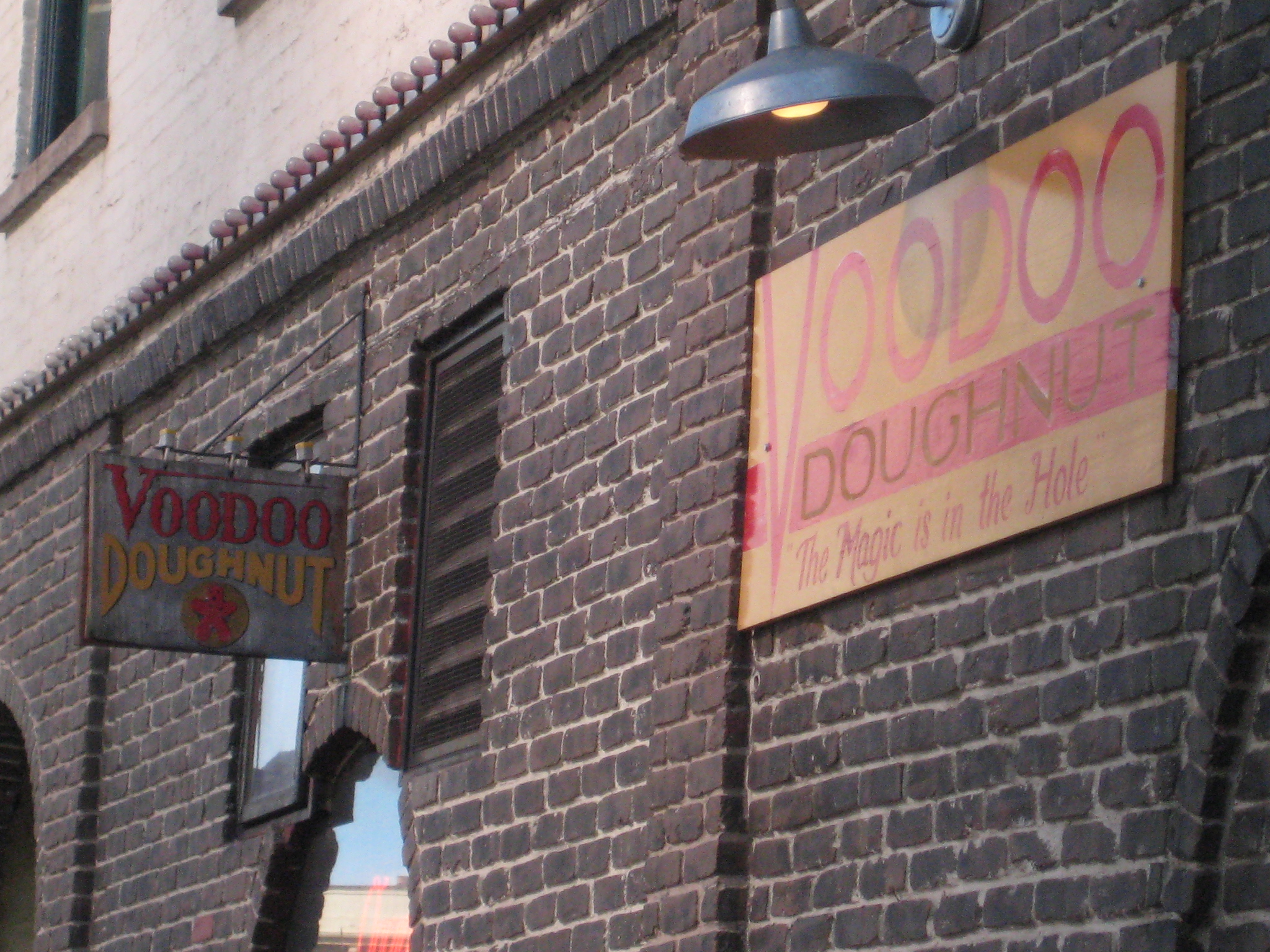
All places I would suggest you try? The Flying Elephant Cafe for lunch, if you want a variety of different bar food try a McMenamins bar (I tried the Ringler’s Annex next to the Crystal Ballroom). The Cajun tater tots were delicious. I also was picked up by a friend and driven out of the main part of the city to the Hawthorne District (I think?!). Where I ate a great meal at Savoy Tavern (I guess the website is coming soon). Here I ate a great salad, sauteed mushrooms that were a little garlicky and a really good onion soup. This meal was quickly followed by dessert at Pix Patisserie where we got individual desserts whose names escape me. I think I was charmed by the toy monkey’s hanging from the ceiling.  Of course, let’s not forget about the incredible doughnuts from Voodoo Doughnut for breakfast.  Really good, quirky and enough to give you a great sugar high for hours.  Also, if you’re in Portland you have to get lunch from one of the carts. I had a great Kabob Sandwich that made me smile.

As for Miami

I’m just going to write you a short list. I ate at Opa’s Tavern on Ocean Drive. The food was good, very filling. They had great entertainment that was maybe a mite too loud for dinner unless you are prepared to dance on your table while you are eating. We picked up sandwiches along the boardwalk and some so-so Cuban food at a place whose name I sadly can’t remember. That being said if you are in Miami make sure you eat at Big Pink’s, but I would recommend sharing unless you have an appetite for four people.

So…that’s the food run. Are you hungry yet? I know I am.

The Story of US Through Save America’s Treasures and Other National Trust Reads

I have a new blog post on PreservationNation.org. Sort of an homage to the variety of sites supported by Save America’s Treasures.

Before we were Americans we lived off the land, within the cliffs and earth. We were Cherokee, Iroquois, Cheyenne; we were the Sinagua, ancestors of the Hopi, who lived here at Honanki (AD1100-1300).
I also wanted to point out this well written blog posting on Cape Wind by Roberta Lane. Its an issue that I actually have only paid a little bit of attention to as the issues have progressed. I found this to be a very well reasoned, well thought out discussion about dealing with cultural resources while we are also trying to save our planet.

Lastly, if you like Chicago Architecture here’s a great interview with Chicago’s First Lady of Modernism by Arnold Berke.

Stepping Out in Portland

Portland, Oregon is a beautiful city. It’s not too enormous or too small in its harmonious setting between the Columbia and Willamette Rivers, which are flanked (on a clear day) by the snowy peak of Mount Saint Helens reaching into a beautiful blue sky.

That’s what Saturday was like at the National Council on Public History Conference, revealing to me just what a walkable, bike-friendly city looks like. I spent one of my breaks eating at Voodoo Doughnut and at various food carts, all while meandering through street fairs and Powell’s Bookstore (their architecture and history sections are like time warps – prepare to lose four hours in a flash). All in all, a good ending to a fantastic four days.

That being said, let’s take stock on the last two days of the conference. Friday morning I moderated a panel with David Brown (the National Trust for Historic Preservation’s executive vice president), Ian Fawcett (deputy executive director of the Land Conservancy of British Columbia), and Liz Dunn (consulting director of the Preservation Green Lab). The session explored the work of the International National Trusts Organization (INTO) and how climate change is being thought about by their member organizations across the globe. In putting together this panel, I wanted to spread the great information from the INTO conference in Dublin this past year. You can read one attendee’s reaction here.

Following this, I boarded a bus out to Dundee Hills to visit the Sokol Blosser Winery, an organic sustainable winery that is home to the first LEED certified silver wine cellar. The owners of Sokol Blosser understand the need for sustainable farming and viticulture and have adopted it wholeheartedly, managing to convince the vineyards surrounding them to work with them to accomplish their goals. More on that in a bit.

So, what does all this have to do with preservation?

On the one hand, the story of the vineyard speaks to what historians can accomplish (the founders of the vineyard were both history majors in the 1970’s), but it also attempts to answer a question we struggled with earlier in the week – how do we reach the public and show them that sustainability is a part of our future, and more specifically that historic preservation and sustainability go hand in hand within that future?

When I first started at the National Trust almost four years ago, I knew almost nothing about how the environmental movement was linked with old buildings (aside, of course, from the role of Teddy Roosevelt and John Muir in the creation of the National Park System). It took time reading and listening for me to understand why this is an integral part of what we do.

As a public historian/preservationist, it is important to recognize all the ways that history and the past connect with the public, even when this connection reflects highly volatile and controversial current issues like global warming and sustainability. We always throw around the fact that history is relevant in the here and now – that it is an important part of daily life and is ingrained in community character. The acknowledgement of this link between the public at the grassroots level and our role as historians/preservationists/public historians at the professional level needs to happen in sync with the work we do on policy and other legislation.

Let’s take a step back to the vineyard. The owners of Sokol Blosser knew they wanted to have a vineyard that was organic and sustainable, but they knew they couldn’t do it by themselves. So they reached out to their neighbors, trained their employees, and created a mindset within their own community about the importance of being green. Similarly, we recognize that the work we do on this issue is about more than just saving historic places; it is about preserving ecosystems and landscapes that are a part of historic view sheds, and consequently a way of life. We work within our organizations to communicate this belief and to spread the word to our memberships. We are ambassadors that are helping to usher forth an engaged, knowledgeable, and determined public.

Yes, this is a slow process, but it will continue to be advanced by gathering at conferences like the 2010 National Council on Public History/Environmental Historian Conference, where we all stepped out of our disciplinary silo’s and talked to one another.

Also cross posted on the PreservationNation.org Blog and the NCPH2010 Blog.

Things I heard at the National Council on Public History Conference

Overheard at the NCPH Conference:

How does one communicate about sustainability at the local level?

Is it better to be pretty good at a lot of things or really good at one or two things?

My Top Twitter Posts:

@pc_presnation: Important to train public historians to be adaptable . Knowing about digital tools is just as important as intellectual knowledge #ncph2010

@p_presnation: In a working group on sustainability and h.pres. How are you talking about it with your communities? #preservation #ncph2010

These two questions (and tweets!) lie at the heart of my first day of the National Council on Public History Conference here in Portland Oregon. I love this conference, first of all—its a small, yet open, community of historians that often like to look outside the box. Secondly hearing about these two things within the same day is not unheard of. In fact at any given moment you can hear about dissertations, practical applications for oral history, or even section 106 mitigation review all in one conversation.

The first tweet and the first question came from a session on digital history in a master’s program. We had some great examples from the folks at the Center for History and New Media, that was supported by a student at American University (who also works for the National Trust for Historic Preservation), an individual at the National 9/11 Memorial Museum and a doctoral student NYU who works on outhistory.org. What was great about this program is that it was, in the end, about more than just digital curricula in an educational setting. It was really emphasizing that sometimes, and especially in the case of public history work (including historic preservation) it is better to know how to do a lot of different things so that you can build upon that knowledge easily to further the goals of your institution and work. While Jeremy Boggs from CHNM was talking specifically about basic digital tools (html/CSS, FTP file sharing, writing grant proposals) its really an idea that can be discussed across the board. Its really important in any field to be adaptable, something that I also talked with another NCPH participant on my very early morning flight across the country on Wednesday morning. In terms of digital tools this is something that can be seen at the National Trust through our very recent Save Americas Treasures campaign which used traditional media to contact congress, but also provided the guidance for advocates to use Twitter, Facebook, Flickr and YouTube to spread the word.

Which comes to the second lesson from this session. Sometimes you have to take a little bit of a risk and have a little bit of trust to move forward. Without either of these things we, as historians/public historians/historic preservationists will never be able to adapt to the changing world. New communication tools, mean new communication strategies. New research techniques and sources, means new methods of talking about those sources to tell the stories we want to tell.

The second session of the day was about historic preservation and sustainability. This is a topic, as I mentioned in my earlier post, that is near and dear to the heart of preservationists. This is not something that NCPH, traditionally, has really discussed which is why having this conference in conjunction with the American Society of Environmental Historians was a great idea.

At the heart of the conversation was a self-examination regarding how sustainability and historic preservation connect back to the role these buildings play in the community. That while we talk about relationship between the two subjects to our peers at the USGBC or at sister organizations like NCPH that we also have to recognize the continuing disconnect at the local level. What strategies have been done to develop outreach and communication strategies for those at the local level? Whose responsibility is it to get the word out? How can we get the word out?

All in all, a successful day which ended with a chance to speed network (its like speed dating but you end up with a lot of business cards) and a great dinner with one of the panelists from my own session on the International National Trust Organization’s Dublin Declaration. So stay tuned on Monday for some concluding remarks and, I hope, some pictures from an organic and sustainable vineyard here in Oregon.

Follow the Conference on Twitter #ncph2010 or on the conference blog at http://ncph2010.blogspot.com/
This post has been cross-posted on the preservationnation.org blog

Currents of Change: Thinking about the Environment and History in Portland, Oregon

For the next few days I’ll be attending the National Council on Public History (NCPH) conference in Portland, Oregon. Not only is this city the furthest west I have ever been, it is also the first time I’ve ever been in Oregon. The topic of this year’s conference is “Currents of Change” and involves looking at the connections between history and the environment. The conference is particularly exciting because this year it is in conjunction with the American Society of Environmental Historians. You can see the program at www.ncph.org but I’ll pull out a few highlights over the next few days (and will be tweeting @pc_presnation). Until then here are a few thoughts from the first day of the conference which also includes a celebration of NCPH’s 30th birthday.

Sustainability is something we at the National Trust for Historic Preservation have made a priority. We’ve had tweets, and resources and discussions at various events including the National Preservation Conference. I know its something we care about on many levels. On my way in from the airport I overheard a snippet of a radio conversation that asked about why young people aren’t involved with the fight against global warming like they were back in the 1960s for Civil Rights. The commentator whose name I didn’t really catch, wanted to know where the sit ins, the protests, the civil disobedience to urge government action. His conclusion: That its not happening because no one has put forth a call.

I think a bigger question is: If someone puts out a call how will historians and preservationists answer?

Which of course leads me to more practical questions: how does the green movement and history interact with the public? more importantly what strategies and ideas are currently being used to reach people on the local level? How can we use our knowledge of the history of the environment in America to reveal how historic preservation is also green?

I’ll be look for answers when I attend a panel that talks about historic preservation and sustainability, the opening plenary session with Adam Hochschild and my Friday tour of an organic winery, and much much more. So stay tuned!

Save America’s Treasures: Save America’s Jobs

So I wanted to pass along some of the things going on at work this week. Some of the programs threatened by the 2011 Federal Budget is Save America’s Treasures, Preserve America, and Heritage Area’s funding. I know we have a budget that is gluttoneous and out of control, I know that sometimes we have to make “hard decisions” but this is something that we can say is the “wrong” decision.

Obviously I’m a big fan of these programs because of what they do for our cultural heritage but did you  know that they have created jobs and partnerships across this country? If you want to take action you can send a letter to your congressperson by clicking here, and use the power of blogs and social media to spread the word about how important these programs are. For the social media toolkit click here.

Don’t know what Save America’s Treasures is? Click here. Also check out the video below.