Outside the Box: Strong Female Characters and Moving Out

Quick post before I head out on vacation for the rest of the week. In the last month I’ve been busy working on two different blog posts. The first was personal about big life changes, while the second took a look at some of my interests outside history (namely my love of reading). So here are the two links. I’m working on a few more posts before I head out to the 2011 National Preservation Conference in Buffalo at the end of October.

My first blog was for the Smithsonian Homespun Project where I talked about the act of Moving Out.  Not an easy thing to do, but something that forces you to think about your past, present, and future. Check out You Can Take it With You  here.

In a slight departure from my normal blog writing I recently wrote a post for a blog called Fangirl.  In the post I try to look at what makes a up a strong female character. By no means a definitive recipe for success it was a great exercise in thinking about why I’m drawn to some books over others, and how dynamic and interesting female characters can be. Read my take on The Anatomy of a Strong Female Character on www.fangirlblog.com.

The Power of the Cover

At first glance it is the color that forces me to stop. Something about the way they play together—within shapes, images, old photographs. The different hues mash together into an emotion….

…as I read the words. The Bluest Eye, Cat’s Cradle, A Dance with Dragons.

Together the design serves as a teaser for the text that lies between—a teaser for the good, the bad, and the horribly disappointing.

This post is about the power of the Cover, and how sometimes the cover is the difference between reading the summary flap or just walking by without a second glance.

When I was in college I worked at a Barnes and Noble where one of our jobs was to go through the shelves and do face outs to make the shelves look full. This also served as a way to highlight a specific title. Often times when I walked through I tended to be influenced by what had read, or heard about from others,  and those were the books that got that extra attention. But sometimes the cover that I highlighted was one that was beautiful, intriguing, and expressive.  Because our store was a hub of tourist activity (it was in the middle of Merchant’s Square in Colonial Williamsburg) we tended to get a lot more browsers in addition to our regular customers and so making sure that those shelves were especially attractive was important.

Another part of my job involved working at the information desk. On more than one occasion I would have conversation that went like this:

Customer: Hi I’m looking for a particular book.

Me: Sure, can you tell me the title?

Customer: No.

Me: How about the author?

Customer: Nope.

Me:    

Customer: …but I do know that the book was redish orange, with a circle in the middle. And it was set in Scotland?

More seriously, this is where the power that lies within a cover came up. If it was a piece of popular fiction more often than not one of us would recognize it based on the cover description, and would be able to find the book for the customer.  It provides an element of identification, a marker for those looking to read it. In other cases if we could narrow down the genre just walking through the shelves sometimes produced results.

So let’s take a moment and look at the book cover as an object/a piece of material culture:

Observation: The cover serves a variety of purposes. As mentioned above it is an illustration of what exists with in the book. A symbolic summary of what we will learn, enjoy, and experience. It is also meant to be, perhaps first and foremost, a piece of information. What is this book called, who is its author. You know that when you pull the book off the shelf, the back cover will tell you either more about the title or provide titillating one sentence reviews of the book from similar authors, and newspapers. Thirdly, the cover is a marketing piece. It distinguishes this particular book from that particular book.  Sometimes the cover design distinguishes one publisher from another (my favorite? Vintage Classics).

According to this essay in the Guardian, illustrated book covers, particularly early dust jackets, did not come into vogue until the late 19th century. Until then the covers of books were served as protection or as a space for advertising what other books the publisher was producing rather than the specific title in hand. The article, as do many other sites around the web, also point out the importance of the book cover/dust jacket/book jacket in the mode of identification—something that I described in an earlier blog post “Prelude to the Power of the Cover.

Continued Analysis leads me to acknowledge that even over the years book covers change with time. If one were to trace the evolution of an older title one would find multiple versions of the book depending on who and when it was published. Even today it has become popular practice to publish new reprints of books in tandem with the movie adaptation, and despite liking said adaptation, these covers often invoke a sense of impurity. A sense that is especially frustrating when the movie adaptation is nothing like the words that you have grown to love.

Just for fun, open a new browser window and do a search under Google Images. Type in “Lord of the Rings Book Covers.” to see how many different versions pop up. The version I have (left below) is very different from the version my roommate (right below). I’m sure that somewhere out there are book cover collectors who can identify who the artist and the creator of each edition of their favorite book is by—and the availability of said edition determines worth. I know that when choosing a book to own and when presented with multiple cover options (all other things being equal)–I tend to lean towards the more aesthetically pleasing edition.

Interpreting covers is a larger conversation—and probably demands a lot more research that I have had time to give. However, each edition, each design, says something about the times in which we live (see above commentary on movie covers). And in an age of e-books the purpose of covers has changed—e-ink doesn’t allow for full color imaging, despite making the ability to read text easier on the eye. Additionally the art on the page is probably a reflection of imagination, but also cultural influences in that particular period of time.  More specifically I find myself thinking about how the widespread censorship in Nazi Germany dictated how books were designed and marketed–and what we can learn by looking at these different covers about the messages that the Nazi’s were propagating.

As a piece of every day life, a cover says a lot about what we as a country and as a society are reading. In an age of mass marketing, seeing the cover everywhere only stimulates the brain into wanting to know more, learn more, and experience it first hand.

The Guessing Game

I first started thinking about this blog post almost a year ago when CBS Sunday Morning put together this segment (watch it here). Narrated by Erin Moriarty the piece looks at book covers as an element of our visual landscape—that they are, in fact, pieces of art.  Art  provides a glimpse into how people are feeling about particular events in the outward world–and like the Mona Lisa, a Mark Rothko painting, or Monet’s Water Lilies covers are seared into our minds. So let’s play a little game:

Can you identify this book by its cover?

How about this one?

or this one?

This exercise made me think about the book cover as it moves into its next phase of existence, where (as both the Guardian and the Sunday Morning piece explain) the digital world is using the cover in entirely new ways that shift the function of the book into a new medium (after all you can’t see what someone is reading when they are on a Kindle or a Nook). In fact, when I start reading a book on my Kindle it starts on the first page, automatically bypassing the title/author acknowledgement/index.  In this way the cover is perhaps reduced to playing merely an informational role, without the vivid colors and design elements translating easily into e-ink.  I do acknowledge that on color e-readers you can see covers in much the same way as you see them off screen–but even then its a digitized form, without the texture of the physical copy.

Of course books aren’t completely gone from our physical landscape, and I very much doubt that they will ever be completely eradicated.  I also recognize that not everyone cares as much as I do about the face of a book–and look to word of mouth to find new titles. I do hope, however that we’ll still be able to see a book cover that is as with iconic as the covers for Catch-22, Jurassic Park, and The Great Gatsby.

Personal Inspiration

In preparing this post I thought it would be fun to look at some of my favorites. So here are a few book covers that I love:

Tana French’s book is startlingly creepy–the branches of the tree emblematic of the complexity of the mystery that lies within. This is my favorite cover of Little Dorrit partially because it juxtaposes the door of the Marshalsea with Amy’s form. The way her hand clutches her skirt indicates movement as she passes from her father’s walled prison into the chaos of London. I love this cover of Stardust primarily for its whimsy.

As I mentioned on this blog, a few weeks ago a dear friend passed away. Before she died we had talked about “the power of the cover” and she took the time to send a few of her favorites my way:

I also sent the request out over Twitter, and one of my followers pointed out these two covers. When I asked for an explanation @EttaHRichardson tweeted that the covers are attractive because of “the grandeur that the building maintains” for the first and “it’s the style, a bit Voo-doo & Cartoon but fresh and edgy” for the second.

I guess for me, the power of the cover is in its ability to inspire imagination. That the artwork, the layout, and the text all provides that initial jump into the unknown,  into a world that is filled with tales of heroic acts or dastardly deeds, a world filled with the enigmatic, the charismatic, the magical, and the ordinary, and a world filled with stories, and storytellers.  It is the power of the cover which starts us on this journey, one that begins  long before you even open the book in your hand.

Note: Just a note that for those of you that are in DC that you should visit the National Book Festival down on the National Mall. It will take place September 24-25, 2011.

Image Credits: Courtesy of Google Images, Amazon.com, WSJ.com
Be an Upstander: Youth Programming and the 2011 AAM Conference

By guest blogger Linda Neylon

This year’s American Association of Museums Annual Meeting in Houston, Texas, was the third of these that I have attended. And while each year varies in usefulness to me,  this year’s conference in Houston proved to be one of the most interesting I have been to. Though it has been a few months since the conference I still have many thoughts running through my head from the sessions, as well as from the city itself.

I have never been to Texas, and was looking forward to the experience. One of the people I met at the conference grew up in Texas, and told me that people often ask her if she rode a horse to school.  While I did not think that would be the lifestyle, I will say I was surprised that the only people I saw in cowboy boots at the conference were from the north.  Besides the clothing expectation, I am not sure exactly what I thought Texas would be like—but Houston was definitely not it.

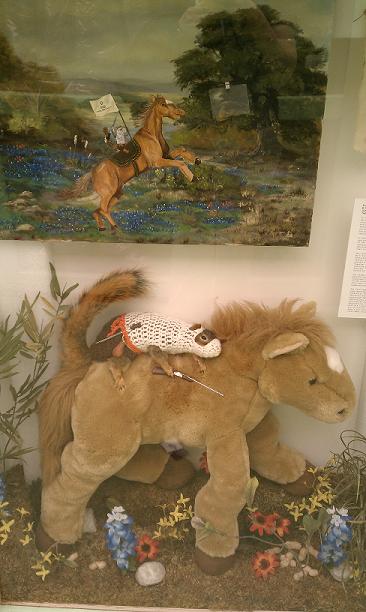
PODS ArtThe city was sprawling, and parts of it reminded me of Levittown, Pennsylvania.  But the area around the conference (downtown, and near Minute Maid Park) was great.  There is a park there call the Discovery Green, that I wish I could have brought back to Pennsylvania.  There were basic science experiences, such as seats with concave backs where two people could talk from a distance and still hear each other.  There were PODS set up in which artists had created pieces, including a “box of curiosities” with an exhibit about Joaquin Squirrelieta: The Battle for Campo De Los Cacahuetes.  This particular art piece spoke to me, seeing the artists’ interpretation of what museums—particularly history museums, are.  And if this is the case, it needs to change.  It was a funny and creative parody, but it would be a sad, sad museum.

So how should we be moving forward with museums?  Many of my colleagues and I are realizing that we need to think beyond the traditional methods of interpretation in museums, and to look at perhaps the scariest audience group we have…teenagers!  I think many of us have something to learn from the Holocaust Museum Houston.

The mission of this museum is: “Holocaust Museum Houston is dedicated to educating people about the Holocaust, remembering the 6 million Jews and other innocent victims and honoring the survivors’ legacy. Using the lessons of the Holocaust and other genocides, we teach the dangers of hatred, prejudice and apathy.”  This mission is summed up very succinctly throughout their website, marketing materials, and gift shop, in sentences like “Stop Hate.  Starting Here.”  The museum is a very powerful one, with a very active group of volunteers who are also survivors.  The topic, artifacts, and exhibits are moving, but every step of the way, visitors on a guided tour are reminded of a triangle that the docent carries.  This triangle has three points- “perpetrators,” “bystanders,” and “upstanders,” with “victims” in the middle.  The triangle is used to show that everyone outside of the victims, or targets of hate, have a choice in how they handle it.  Will you pretend that you don’t hear your friend making racist jokes?  Will you stand up for the people your friend is making jokes about (be an “upstander”), or will you participate in making those jokes?

This idea is carried throughout the museum and its programming.  Its program,  Youth and the Law, takes these ideas to at-risk juveniles, as part of the city’s anti-gang task force.  Listening to the educator, I became truly inspired.  She told us that the recidivism rate (the number of times someone re-offends) for teens in her program is lower than that of the standard punishment for juveniles considered at-risk for gangs. While not every museum has the content and ability to participate in something exactly like this, I do think we all have the ability, no matter how hard it is to see at first, to connect to our youth in an important way.

While most of the conference was full of thought-provoking sessions, the time spent at the Holocaust Museum Houston has stuck with me.  It has reminded me of what is possible, and where I have been.  When I worked at the York County Heritage Trust, I worked with teen volunteers (ages 13-18) each year, teaching them history and how to interpret.  Today, many of the teens that have reached college age are studying history in school.  They connected to their history, and it has had a lasting impression.  I feel like I have lost sight of that possibility in recent years, and my time in Houston reminded me of my love for working with teens, and the endless opportunities this age group really does present.  If the Holocaust Museum Houston can have the impact it has had on teens, imagine what more our history museums can accomplish!

~~~

Linda Neylon is a public historian with experience in youth and adult education and interpretation.  She is a graduate of American University’s Public History program, and most recently directed the education program at Eastern State Penitentiary Historic Site.

My Heart is Aching

Dear Charisse.

How can I even begin to say goodbye.
It isn’t fair. It isn’t right. It doesn’t even seem real.
I’d like to think that you’re looking down
Finally able to see the brilliant azure of sky
And green of earth the way God intended.
But all I can think, all I can hear is your voice, your laughter
A daily comfort from 9-5

Who will I talk to about the practice of writing,
Of finding time to give beauty the time it needs
To learn to not hasten, or look forward to the light
Or the Spark! of inspiration.

Idris Elba doesn’t know what he missed
But I do. We do.
It’s like one of your paintings
A splash of color, and shape
Full of meaning, full of heart
Full of soul

I’d like to think you can see us–can see how much you will be missed.
But I know, that you know, that I won’t see your reaction
That tilting head, that eyebrow raised….
The face that says so much with so little
It isn’t fair. It isn’t right. It doesn’t even seem real.

~*~*~

Today I found out that a dear friend and coworker passed away. Like much in life we aren’t prepared for, you don’t quite know how much someone means to you until they are no longer there.  Charisse painted with skill, and wrote with the weight of her history and her life experience. Every day that I got to know her was a lesson in how to be more optimistic, unselfish, and to imagine that greater things are just on the horizon. My heart is aching–for her family, for her friends, and for those of us who will no longer be able to tell her how very much she meant to us.

Prelude to The Power of the Cover: The Deathly Hallows

Eleven years ago July (ELEVEN years!). I’m on my way home from an internship, just a few weeks before I go to college. It is Pre-Twitter. Pre-Facebook. Pre-easy access to the internet.

Map of the blue line. We started off at Federal Triangle and continued straight on until Franconia Springfield.

I settled myself on a blue line train at Federal Triangle with a woman who is holding a pretty hefty book in her hand. It’s a green cover with a cartooney looking boy with horn rimmed glasses.

She ends up sitting across the train from me, but still within my line of vision, and as we travel I find myself without anything to occupy myself, choosing to look out the window instead….and people watch. We approach Crystal City. Stop. At this point I notice the woman looking up with the classic oh I missed my station expression on her face. She half stands, then sits back down, pulling out the book to read again.

She reads on, and we travel past Braddock Road, King Street, and Van Dorn Street easily 30 minutes past what must have been her original stop to the end of the line. She closes the book, finger firmly marking her place, exits out of my train and then renters the one waiting on the other side of the tracks to take her back to her destination.

As I move up the escalator I can see that she is lost to the outside world again, engrossed in whatever is written between the hard green covers.

It was the Summer of 2000, and the book was Harry Potter and the Goblet of Fire.

I want to say that I was drawn to the series because of the cover because even then you could see it in bookstores, coffee shops, and on the Metro. But I wasn’t. I was drawn to the texts ability to draw in the mind, and clearly the imagination.

But it was the cover that told me what to read.

Now, eleven years (ELEVEN!) later I spent the weekend watching the final chapter of the Harry Potter saga on the big screen. Nothing is more exhilarating than Midnight Madness for a movie of a book that changed how you look at fantasy and storytelling. Feeling slightly otherworldly, you find yourself playing Harry Potter twenty questions for two hours as a stream of kids roll by dressed up as the Hogwarts Express in a conga line. In my head I was thinking that this must be how those moviegoers felt when they sat for the first Star Wars movie in 1977—the feeling of wonder and surprise that a story of dragons, and quests, heroes and heroines opens your hearts and makes your imagination travel to new heights.

But while the on screen spectacle was arresting, it was another reminder of just how strong of an impression a book can make. I testify that this series made me smile and at times, cry. There were tears when Deathly Hallows book first came out, and again as the revelation that we had all misjudged a certain potions master played out across the screen. While this series grew up with its primary audience, I can say that it saw me through my twenties–through college, grad school, job uncertainty—essentially the start of my adulthood. And so while I was never in the same age range as the trio of friends, I recognize the impact the story had on my love of storytelling and writing.

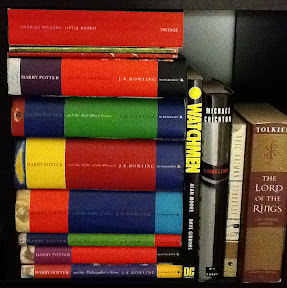
My Harry Potter Books, along with a few other of my favorite titles. PS: If you haven't read Little Dorrit I highly recommend it.

As for my physical copies of the books? I really did end up choosing them based on their covers. Even though I was curious after that initial metro ride, it wasn’t until a trip to India that I started collecting my personal copies. Each book has its own story: 1, 2, 3 & 4 I got in Mumbai during a family vacation (though at the time 1-3 were in paperback, my mom got me the hardcovers after someone donated them to her library). Book 5 (Order of the Phoenix) I bought in the States, until a fortuitous trip to visit a friend revealed that this was the only book where she had the British version, so we made a switch. Harry Potter and the Half Blood Prince made it to my shelves after a midnight purchase in 2005, another midnight trek to a bookstore in the London suburb of North Harrow.

For Harry Potter and the Deathly Hallows I was in New York City, moving my sister into her first apartment. I stood in line, by myself, at the Union Square Barnes & Noble, until someone told us (well past midnight) that there was another store a half a block away with no line and plenty of copies. I’ve never read a book faster in my life. (Once again playing switcheroo helped me complete my matching set as a friend visiting abroad made an exchange when she returned to the states.)

After seeing the movie this weekend, I wanted to write a piece in farewell. However, I realized I’m not quite ready to say goodbye, and probably never will be. Many articles this week have listed favorite parts, characters, objects—and have posited clever praises on Rowling’s femininity (or lack there of). Instead I thought I would leave you with a passage in the book that made me think—one that speaks to the power of imagination, but also of knowing your own self—and trusting what is in your own heart.

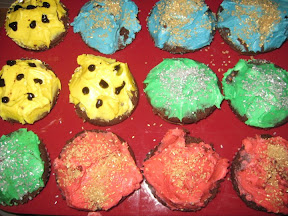
Cupcakes from Midnight Madness. Three for each of the Hogwarts Houses. Recipe for Cake and Buttercream from Real Simple Magazine (Click to view).

From Harry Potter and the Deathly Hallows (pp579)

“Tell me one last thing,’ said Harry. “Is this real? Or has this been happening inside my head?”

Dumbledore beamed at him, and his voice sounded loud and strong in Harry’s ears even though the bright mist was descending again, obscuring his figure.

“Of course it is happening inside your head, Harry, but why on earth should that mean that it is not real?”

The Sorting Hat Says Goodbye

When we first met he was very young
As, of course, were we
But as we grew, he found his place
To fight Voldemort and be Free

In our minds the wonder sparked
And imagination soared
Whimsical and fantastical
We were never bored

And then the end in published form
Came to say goodbye
But we all knew we’d still have
On the movies to rely

Soon there will be no more Harry Potter
To look forward to in time
No Hallows, Horcruxes, or Hogwarts
And I’ll have nothing left to rhyme

So join me on the 15 of July
As the stroke of midnight chimes
And we’ll say fare-the-well to the wizarding world
With a flick of our wands, our hearts and our minds

—P. Chhaya 6/21/2011

Note: More on The Power of the Cover will follow next week.

When In the Course of Human Events

Another Fourth of July has passed. Gone are the sparkling fireworks while the BBQ’s-hallmarks of summer–have been consumed by the hazy heat of the morning after. My Fourth began with a cup of tea with my parents–while Regis and Kelly asked America about the first seven words of the Declaration of Independence.  Heavy stuff  is what they said when the words (the title of this post) were read out loud, and found myself (spurred on by the patriotic Facebook status messages filled with uncommon quotations) digging out my pocket sized Constitution (which also had the text of the Declaration) so that I could think about the complexity of this 235th birthday of the United States of America.

On this day I honored not merely the ideal of America, or the date in which a document (a piece of our civic scripture–to borrow from Pauline Maier) was signed. Rather I chose to recognize the struggle-the one that re-examined our self evident thruths. The struggle that redefined “men” to include race and gender, and molded the meaning of life, liberty, and the pursuit of happiness.

Ironically, my Fourth of July did no include a BBQ or Fireworks. Instead, I went to see “Midnight in Paris”, a film which turned out to be a perfect backdrop for reflection on Independence Day.  In short, the film follows a Hollywood script writer turned aspiring novelist as he is magically transported to 1920s Paris. It is during these “suspension of reality” moments where Gil encounters idols of film, literature, art and culture. As a Woody Allen film, the movie mocks pretentiousness, while also being slightly pretentious–and also in a less than subtle fashion drives full force into the commentary on nostalgia (even to the extent that Gil’s novel is set in a nostalgia shop). The man is caught between his fiance and her friends who don’t understand the magic of Paris, and a slow realization that his forays into the past are really ventures into fantasy.  This mystical Paris in the 20’s pulls those who reminisce away from the demands (or as one character states the “dullness”) of the present and leaves them disconnected–unable to see the realities of the time that they fill with the veneer of romance. As one of my fellow movie viewers pointed out, the past became a way for the writer to feel affirmation and confidence rather than genuinely earning it through his actual actions.

At the same time that Gil is realizing the imperfectness of remaining in the past, he is also acknowledging the beauty of the urban. His walks through the city provided him with vision–and make him, in his mind, a better writer. For  Gil the lure of Paris is in its character both in its modern and historical sense–though even then he uses rain as a way of hiding reality (for Paris is at its most beautiful when it is raining).  It is the city–the power of place–that brings inspiration.

Fourth of July Fireworks (NYC 2011, Thermal view) Taken by T. Chhaya

I thought this was a great way to think about America on it’s birthday. That though the day is filled with nostalgia–summer days with a slightly romantic sheen, our Founding Fathers fighting for our rights against a tyrannical king–we all recognize the reality of the day–the sacrifice and yes, the struggle to get where we are. That the power of our place– our country –is not just in the sites we like to visit, but also in our people who make history with every vote, every breath, and every step.

O! say does that star-spangled banner yet wave. 

O’er the Land of the Free, and the Home of the Brave. 

And the Crowd Goes Wild: Introducing Hall of Famer Jim Percoco!

In high school you know how good a teacher is based on the rumor mill. Sometimes it is because the teacher is an “easy grader,” or someone who never notices that you cut class. Sometimes the teacher is Jim Percoco.

I’m not sure when I first heard about Percoco’s class. I must have been fifteen, a sophomore that had just dumped her computer science class for a course on typing. I can’t remember if I was unhappy, or just finding myself stagnated intellectually, but it was clear, that sometimes I was just bored. The next year I was assigned to Jim Percoco’s course, and from the moment I stepped through that door I could tell I was in a different world.

All the best teachers encourage you to look beyond yourself, to look up from the text book and learn from the world around you. Jim Percoco did more than that–he took a subject that many found stogy, boring, and lacking in relevance (in a generation before social media, blogging the ease of access of the internet on your telephone) and forced kids to willingly step outside and look at the “stuff” of history–to look beyond the words on the page and actually see the people who lived before us.

A lot of this continued into my senior year through his course called Applied History. The first half of the year was coursework, and the second half was spent in an internship (mine was at the Octagon House in Washington, DC). All just another step on my way to an undergrad degree and eventually an M.A. in history concentrating in public history.

The benefit of Percoco’s teaching style did not limit itself to his lesson plans. While the “reel” vs ” real” programs (looking at history on film and in the textbook), or the time we staged our own protest a la’ the Civil Rights movement were great, practical experiences, it was the way he carried and articulated his passion for the past that had the most impact. He wasn’t just a football coach teaching history, he actually cared about the lessons it could teach us–and the inspiration it could bring–Clio style.

From where I stand, almost eleven years since I first set foot in that corner room at West Springfield High School, there is no one more worthy of induction into the National Teachers Hall of Fame than Jim Percoco. (The induction ceremony is today June 17, 2011, in Emporia, Kansas).

Congratulations Jim!

Hodge Podge: On Memory, Weddings, and Original Recipes

I have been working on this post for a few weeks, but alas the post-wedding catch up has taken over, plus every time I think I am done something else comes up that I want to add to it. But sometimes you just have to hit publish!

We will start with a quick word about weddings. Historically speaking weddings are the bringing together of two families and thus creating a new path of history. Two stories become one thus creating a new narrative.For those who love genealogy these events and the documentation of these events will one day let our great, great, great, great, grandchildren trace their own ancestry.

In addition to the immaterial the actual physical landscape of a marriage reveals heritage and culture, an opportunity to show the more recent past of the bride and groom. For my sister it was the trappings off India mixed in with with the quintessential American rituals (the first dance, cutting of the cake). My friends Mary and William embraced their inner Irish and love of fantasy for a ceremony filled with beauty and heart a week later.

For this hodge podge I’ll talk about This American Life episodes, a play on memory by Harold Pinter, a short conversation about fictionalizing the past through Geraldine Brooks’ work People of the Book and Year of Wonders, and finally a pop culture meets history link.

This American Life

There are actually three episodes that I wanted to talk about here. The first was an episode about Kid Politics. Where reporter Starlee Kine describes a program at the Reagan Library which asks kids to reenact the invasion of Grenada. While the show looks to see if kids make better decisions than adults, I found myself reacting to the subtle cues the library educators used to emphasize that the presidents decision was the “right one”. The kids who spent some time learning about Grenada before arrival are divided into three groups “the president and his cabinet”, “the military”, and “the press.” Than whenever the student makes a decision that Reagan did not make a light flashes along with a loud buzzer and a red light. On one level it is one way to indicate that the President made a different decision, but I think that by painting other options as wrong or right pushes kids away from critical thinking/analyzing presidential history as a series of decisions rather than because it happened this was the only course we could have taken.

The second episode had a segment that examined a television show, “This Is Your Life.” The premise interviewing individuals, and then surprising them with a carefully constructed vision of their life. Two separate episodes brought on a Holocaust survivor and a Japanese man who survived the atomic bomb-introducing these very sensitive subjects to the American audience in a way that they had never been discussed before. Each person also had a “surprise” guest–in the case of the Holocaust survivor it was a fellow camp mate, while the Japanese man (who was in the United States getting operations for girls who had been disfigured from the blast) was presented with one of the pilots of the Enola Gay. “This is your Life” seems almost like a modern day reality show. In both cases described above the individual being profiled used the show to bring awareness to what had happened to them, despite the shows structure feeling a little intrusive and voyeuristic.

And finally, for a light-hearted turn. Ira Glass believes he found the original recipe of Coke. While it is possible that it is a version of the drink we all know and love, this episode is a testament to the power of the document. Of finding things in boxes years from now that can tell a missing story. Above all else this episode showed that history is fun…especially when it involves an element of food ways and a little history of an American industry, regulation history and pop culture all at once.

Shakespeare Theatre: Old Times

The second to last show of the 2010-2011 season wasn’t a traditional tale by the bard but rather a reflection on memory written by Harold Pinter. The two leads are a married couple Kate and Deeley (played by Stephen Culp, of West Wing Fame, and the Tracy Lynn Middendorf who played Bonnie in LOST), who are expecting an old friend of Kate’s named Anna. In the course of the show, the play becomes less about a visit, and more a battle of remembrances between husband and guest. It is stark full of imagery that asks the audience to question, what is real what is true, did that really happen. It’s at times funny, yet equally gloomy as tension rises. Yet the woman at the center of each memory, Kate demands no attention. She seems content to live merely as an object of this memory, trapped in her own thoughts, often letting her husband’s former friend memorialize her as if she does not exist. The show ends in a bizarre parody leaving us to wonder about what memory really is.

I know that we see things one way in the moment, and that with time that vision shifts and is colored by the receding years. Collective memory works the same way. This play fiddles with the past, and illustrates in an evocative way about how even what we believe to be true can change in an instant. Old Times is playing at the Shakespeare Theatre in DC through July 3.

Of the Book: Two Titles by Geraldine Brooks

I’ve been doing a lot of reading, as usual. From fantasy, to catching up on my Public Historian, I find reading to be incredibly cathartic. Occasionally you come across a text so engaging that you feel inspired. This is so with books by Geraldine Brooks. Best known for winning the Pulitzer Prize for March which follows the father in Little Women through his wartime journey, I picked up People of the Book and Year of Wonders. Both books use history as the backdrop for remarkable examples of storytelling. Year of Wonders is the story of a town hit by the plague, and how it voluntarily closes its boarders to keep those outside safe. People of the Book follows a book conservator and narrates her story and that of the object she is trying to save–it is the Sarajevo Haggadah, a real book with a really engaging past. It is an amazing piece of writing–in that as we step back in time with the book’s history we see fragments of the world, of Europe during times of intense upheaval before being brought back to our guide’s life. For anyone who is not convinced that material culture tells us more about the past than anything else–I would pick up People of the Book immediately.

.…and finally

I took a moment for fun and went to see the latest X-Men movie. It was fairly well plotted and takes place during a particular part of the cold war (1962 to be exact). However, like most movies–it gets some things wrong. Ta-Nehisi Coates went to see the movie with his son and tells us about it in “You Left Out the Part About….“. A good opening for a discussion….so tell me what you think in the comments.

Preservation in Pop Culture: How I Met Your Mother

As I mention in the description of …and this is what comes next (and perhaps as can be evidenced by my inordinate love of the television show LOST) I am both a historian and a pop culture fanatic. This year one of my favorite shows, How I Met Your Mother had a long running story line about an old hotel and one woman’s fight to save it. There are lots of hijinks along the way, but in the end the way the storyline portrayed preservation wasn’t pretty.

In response, my friend Will (who works at the Preservation Alliance of Minnesota) and I wrote this blog post over at the PreservationNation blog where we talked about the plot line and what it says about preservation in pop culture.

Check it out and let me know what you think!

From Mountains to Stones…and Hope

Memory. Symbolism. Knowledge.
Vision.

It isn’t so often that an opportunity presents itself…an opportunity to gaze upon something that few others have yet to see.

Of course I was by no means the first, the only, and after August 28th I certainly won’t be one of the few–but yesterday I had an opportunity to see the memorial to Martin Luther King prior to dedication.

The tour, made possible by the DC chapter of the National Organization of Minority Architects, was an hour long journey through the memorial’s creation — which began with a discussion by a group of brothers from Alpha Phi Alpha (the first African American fraternity) about inclusion, and that the lack of recognition of African American contributions to the American story in DC was why African American’s did not come to the National Mall.  After the origin story our guide walked us through design and development–explaining how an international jury of 11 judged 900 projects from 52 countries and brought them down to less than twenty in 3 days…and then to one.

With this Faith….

During the tour we walked through the process of meaning. Who was this for? Why is it being built? Where should we build it? Despite the initial conversation, this memorial is not meant only for African Americans. The foundation sees it as an international monument to a man who advocated for peace across the globe.

Symbolism.  As our guide,  Dr. Ed Jackson, Jr. (executive architect), walked us though the Foundation’s intent he also described the path of choosing a sculptor (Master Lei) based on artistic merit, to the quotations (each one following along the themes of love, justice, democracy, and hope) that will edge along the site each revealing a man, though imperfect personally, that saw beyond civil rights to human rights.

The memorial sits along the tidal basin juxtaposed between Jefferson and Lincoln. While the connections between this historical lineage are obvious, it is clear that the memorial is speaking to the individual–emphasizing, as King did time and again that each of us have the potential to ask/demand change. Day or night his face on the largest free standing granite statue serves as a mechanism to encourage and remind visitors of the struggle:

With this faith, we will be able to hew out of the mountain of despair, a stone of hope.

This is the memorial. Stepping through a narrow passage between two natural rock formations-despair, and coming around to see the relief of Martin Luther King with his message of hope. An image intense in its realism, right down to the veins on his hands.

On Memorials and Meaning:

There are realities to consider when building a memorial on the National Mall. In a post  9/11 world stopping cars from running aground are just as important as determining the symbolism of cherry blossoms that come alive, every year, around the time of MLK’s assassination.  Details matter and I couldn’t help wondering, as we walked around the space, of what meaning visitors will derive from the memorial. Will they sense the work of the architects, historians, the King family? Will they sense all the hands and hearts and minds that brought it to this existence?

Will they see, as I do (and despite this not being a civil rights memorial), the influence of Gandhi and the knowledge that without the work of King and the courageous acts of ordinary people who took a stand during sit ins and freedom rides that my life would have been drastically different.

What meaning will they gain from the visit? The Foundation and all of the others involved in the project have thought long and hard about the message they want to convey, however meaning, like many other elements of the past, are derived from the individual. It is that meaning which will determines the legacy of Martin Luther King and tell us if this memorial will enable that message to withstand the test of time.

~*~

Why no pictures? While I did take some there was a request to not post the image online. I will try to post them following the dedication on August 28. In the meantime you can see them on the monument site.  Check out this article about the memorial in the Washington Post.