Ghosts for a Future We Do Not Yet Know (Vote, AND)

Today is Election Day, so naturally I want to talk about ghosts.

But first: 

By the time you see this piece we will be at the start, in the middle, or on the other side of Election Day. We might know the direction our country is heading, we might still be in limbo, or be staring into a world that is unrecognizable. I write this, on some level, to quell my own anxiety. My own fear. My own gnawing worry that even with a win, we will still have lost some essential promise of a more perfect union. That even if the outcome I prefer occurs, we are still facing a host of challenges that won’t just be wiped away with one day.

As I so often do, when facing uncertainty I turn to words, in this case pages and pages of notes that I took on two warm summer days this past July at the Monument Lab Summit (MLS), a gathering of individuals dedicated to expanding the vision of what commemoration looks like in this country. A summit where ghosts lurked around every corner (Note: Ghosts is also the theme of Monument Lab’s journal Bulletin, and is an inspiration for this post)

View of Independence Hall in Philadelphia, Pennsylvania.

The MLS took place in Philadelphia, within and around Independence National Historical Park. Steps away from the place where a group of men made choices that rippled out to our current circumstances. By hosting the summit on that particular piece of land we were actively engaging in a commemorative conversation that was in relationship to and a reflection of that particular set of historical circumstances. 

We heard from oral historians and artists, community organizers, and advocates as they shared the ways in which monuments and memorials can disrupt, heal, and shift perspectives toward a more empathetic future.  

Continue reading “Ghosts for a Future We Do Not Yet Know (Vote, AND)”
Narrative, Empathy, Trust, and #NCPH2019

Circles are interesting things. Providing an illusion of comfort, they are made up of a series of dots meant to be equidistant from its central point. If you are standing in one, the shape provides a sense of belonging. That we are all in this, whatever this is, together.

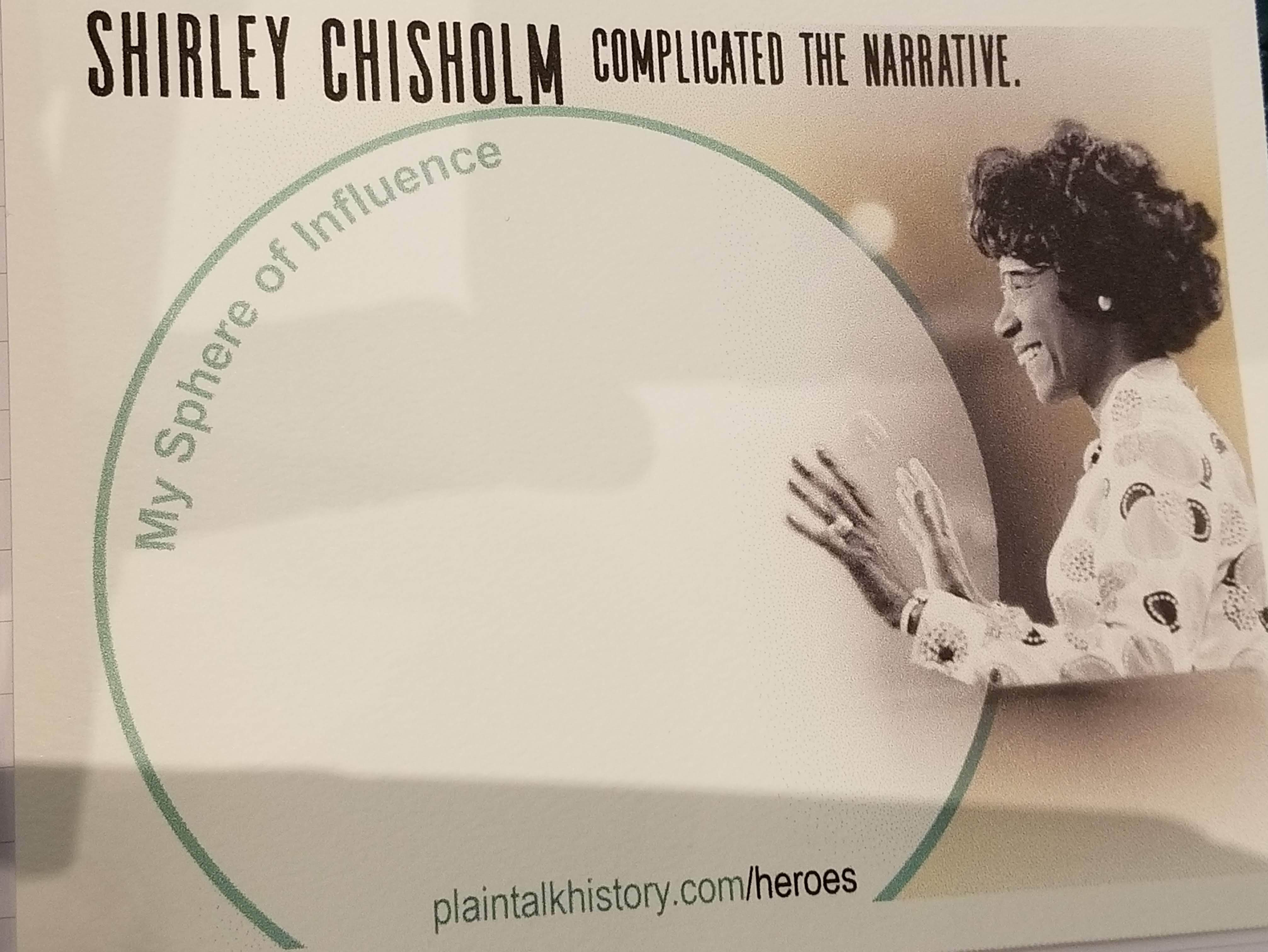
Plain Talk History Postcards
A give away from one of our exhibitors at NCPH 2019, I brought a stack of these postcards back to my office for my colleagues to fill out.

However, in a circle there is nowhere to hide. While they imply equal footing, equal power, they also represent transparency, or the hope for clarity.

With that in mind, I spent the 2019 National Council on Public History Annual meeting in circles. These circles were tangible, physical, and metaphorical — but they all connected to a central conversation about the ethics of being a historian. About our truths as professionals where neutrality is no longer an option.

Continue reading “Narrative, Empathy, Trust, and #NCPH2019”

Podcasting, Podracing, and Celebrating Star Wars

IMG_20190519_200609
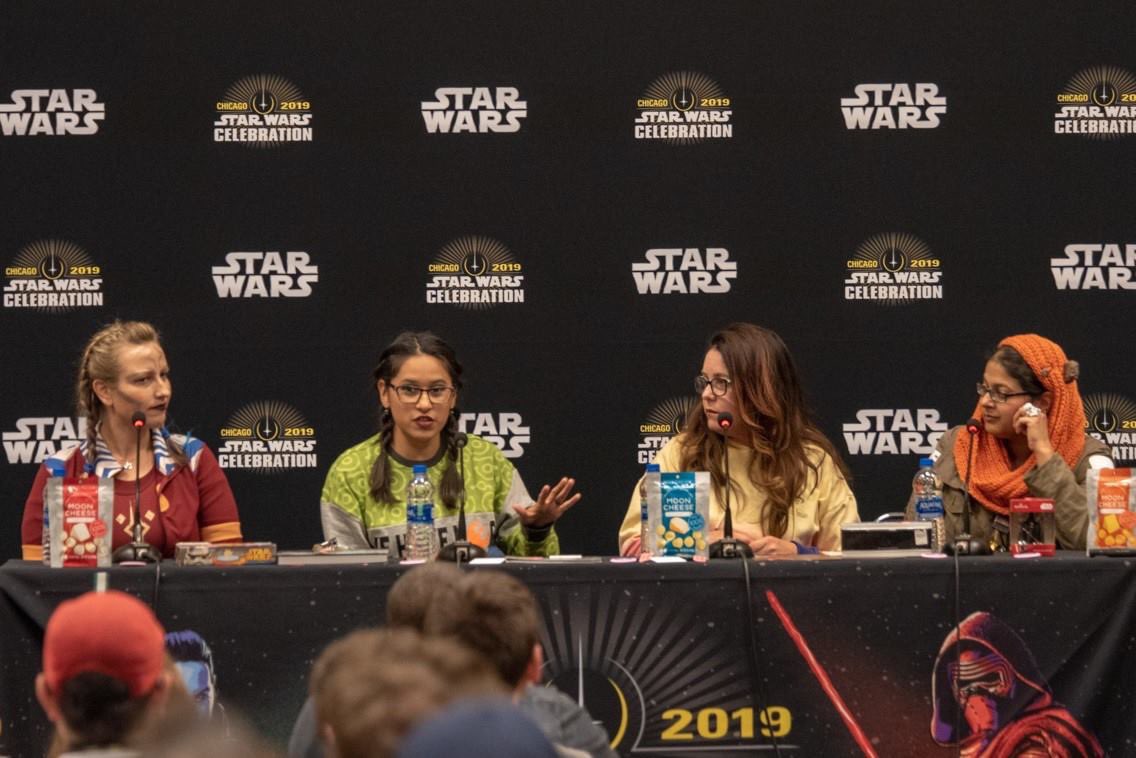
L-R Fangirls Going Rogue hosts Sarah Woloski, Teresa Delgado,  and Tricia Barr,  and myself at the Podcast Stage for Star Wars Celebration. | Credit: Brian Sims

I am not at all impulsive, but one day last year I gave in and purchased, without really thinking, tickets to Star Wars Celebration 2019. The event, which took place last month was what I had always expected it to be — a party with 65,000 of my fellow fans. Before attending I had been apprehensive about my diminishing levels of fandom for the GFFA, and this convention was the moment to see how I really felt.  As I wandered amidst the crowds I realized that:  Continue reading “Podcasting, Podracing, and Celebrating Star Wars”

MuseumNext: Ten Things I Learned About Storytelling and Collaborative Projects

Last November I received a grant to attend a conference I’d had my eye on for a while. A two-day speaker driven event, MuseumNext  is a space where individuals from across the museum world (and I do mean world) gather to share the best examples in museum production and practice. For this particular Museum Next, the focus was “designing the future of museums,” and the talks presented dealt with topics ranging from using augmented and virtual reality, to creating unique experiences for visitor engagement.

20181102_143417-e1547524837162.jpg

While not all of the talks were useful to me, I did end up with some key takeaways. These lessons ranged from the philosophical or motivational to practical tips for planning big (and small) innovative projects. Continue reading “MuseumNext: Ten Things I Learned About Storytelling and Collaborative Projects”

Challenging the exclusive past | Challenging my inclusive past

This post originally appeared on History@Work. You can read it here.

 Musicians at opening reception of NCPH annual meeting in Baltimore. Photo credit: Priya Chhaya
Musicians at opening reception of NCPH annual meeting in Baltimore. Photo credit: Priya Chhaya

My daily job at the National Trust for Historic Preservation doesn’t involve day-to-day interaction with the broader public. Rather I am a historiographer, in that in my work as a content manager for preservation professionals, I am constantly thinking about the methodology of history–how we protect, communicate, and talk about the past. At the National Council on Public History annual meeting this past April, I realized that our most successful conversations and discussions were the panels and sessions that actively included the public’s viewpoint as part of the presentation. Continue reading “Challenging the exclusive past | Challenging my inclusive past”

Milwaukee’s Best: The 2012 NCPH/OAH Annual Conference

Many of my posts on this blog are often connected more often than not to my thoughts about the past through books, movies, exhibits, and travel. Seeing the reflection of the past in the “stuff” we consume, produce, and leave behind.

However, sometimes I like to look past the “why” and to the “how,” to the practice of public historians — what we do well, what we should be doing, and how I can engage in this broader conversation.

This year’s annual conference for the National Council on Public History involved a convergence and a merging of ideas with the Organization of American Historians. As expected the five days in Wisconsin were filled with networking and sessions which integrated your typical academic style paper(s) with the more hands on, interpretive style of the public historian presentations.

So I thought that I would use this, my first of three [the second will come in a few days, the third on food will post in June] posts on my trips to talk about methodology — providing examples of different (or not so different) conversations through the lens of the meetings and sessions I attended.

Continue reading “Milwaukee’s Best: The 2012 NCPH/OAH Annual Conference”

Smelling the Flowers and Taking in Tech in Milwaukee

The Mitchell Park Conservatory

Earlier yesterday, this post went up on the PreservationNation.org blog.

In the next two weeks I will find myself in Milwaukee, WI (where I am right now) and Ft. Worth Texas. Both trips are professional in focus, the first for my annual pilgrimage to a new US city for the National Council on Public History. This is a conference that every year introduces me to new people and new conversations.

Mentally, the historian in me battles with my inner foodie and urbanist. I’ll spend an inordinate amount of time trying to figure out what to see, what to eat, and what makes these cities tick.

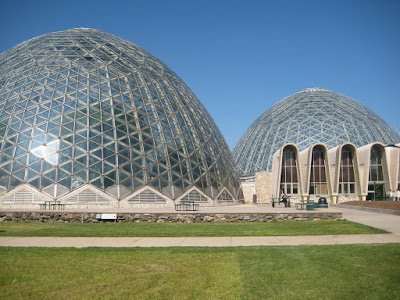
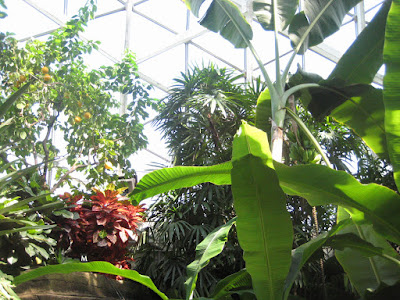
We hit the ground running here in Milwaukee. Not only did I get to stay at the historic Ambassador Hotel the first night, I also got to visit the Domes, three modernist greenhouses that are a part of the Marshall Park Conservatory. If you think the exterior looks cool, check out the inside….the three domes had flowers and plants from a tropical ecosystem, a desert ecosystem, and the final one, which demonstrated the human effect on landscapes and flowers.

Then we had the second annual THATCamp NCPH. If you remember from last year this is an unconference, an informal learning experience having to do with digital and new media in the humanities. The sessions I attended had to do with the future of blogging, the issues surrounding bringing scholarly publications to the digital realm, and a closer examination of branding and promotion for organizations and projects. I walked away, as usual, with a plethora of really cool websites and links.
I’m hoping to do a more analytical post about content at the end of the conference but I wanted to emphasize my goal for the next two weeks as I experience Milwaukee and travel to Texas:

I’m feeling the pull — that urge to make sure that I don’t miss a minute, a site, or a story, and to walk away from both these places seeing them as more than just a meeting room space.

Flinging Ourselves into the Unknown: The Preservation Lesson of Buffalo

Delay. Delay. Delay. I’m going to be honest—this post has been a challenge to conceive and write. Not because I had nothing to say, but because I didn’t know how to frame my lessons from the 2011 National Preservation Conference. Much of this has to do with the fact that I wasn’t able to see the closing plenary—which serves not only as an end cap to a week of knowledge sharing, and networking, but as a launching point for where we are going.

Thankfully, that changed with the magic of the internet. First, the usual acknowledgement: I wasn’t a normal attendee of the conference. My daily job was to serve as conference staff—sitting in on sessions, passing out evaluations, taking tickets, which meant that with the exception of a session or two (and the major plenaries) what I saw and heard was often confined to the room in which I was assigned (or the Twitterverse), but what I did hear and learn afforded a glimpse into the future.

In closing her speech (and the conference), Isabel Wilkerson, author of a book about the migration of African Americans from Jim Crow South, quoted Richard Wright re his decision to migrate to New York City.

“I was leaving the South
to fling myself into the unknown . . .
I was taking a part of the South
to transplant in alien soil,
to see if it could grow differently,
if it could drink of new and cool rains,
bend in strange winds,
respond to the warmth of other suns
and, perhaps, to bloom”

This may be an awkward analogy but preservation is, has been, migrating. In the last ten years alone, the way we do business, the way we interact with others has changed dramatically. And it all started by sticking our toe, and in some places, jumping right headlong, into the unknown. We’ve seen how important our work is in regards to community development, we’ve stepped up about the importance of character, and how where we live, how we live, and why we live there matters. We’ve also spoken out about the importance of existing buildings in the sustainability movement. We are getting involved, making partners in ways that those outside the movement don’t expect.

But we are a reflection of events in the larger, broader world—where we as a country, as a global system have to re-think the way we’ve always done business or else run ourselves into the ground. We have to change the way we live in order to survive. Everything will not just work out “in the long run.”

That’s a pretty awful phrase, “the long run.” Often a justification to keep doing things the way they’ve always been done, because in “the long run” everything will work out the way it was meant to. It isn’t a phrase we can depend on anymore. As preservationists—heck, as historians—we have the ability to see where we’ve been and embrace change—bucking perception of our work. This conference showed me this. That all around this country there are preservation professionals taking risks, and finding new ways to meet the challenges of the coming years. So perhaps that is the biggest preservation lesson of Buffalo—that change is going to come, whether we want it to or not—but that we as a movement are prepared to meet it, to take our ethic, and transplant it in new directions, to cultivate it to respond to the the warmth of other suns…and bloom.
~~~

There are a few ways to catch some of the sessions from this National Preservation Conference. Visit www.preservationnation.org/conference for more information.

Awestruck, Inspired, and in #buffalove

The tower at Central Terminal in Buffalo, NY

Update 11/3/11: The full documentary is now online!

Have you ever been somewhere where it was clear that the residents had so much pride in where they lived that they defied expectations? Next time you are in New York, forget the Big Apple and head North to Buffalo and you’ll see how this city has wiped away the illusions of the so-called rust belt and are actively rebuilding and investing in the future rather that allowing others to write them off.

Nothing says this more than Buffalo Unscripted, a documentary by the National Trust for Historic Preservation (yes, my employers). Earlier this year three of my co-workers went up to Buffalo and interviewed over 500 people about the city in which they live. The result is an hour long documentary that not only pulled at my heartstrings, but also made me see possibilities where I might have previously dismissed it.

The power of place is a phrase embraced by public historians. It reveals how much of our shared past is connected to where we live, where we interact, and and where we dream. For ordinary Americans it is not the site of major monument or a historic house, it is our neighborhoods, our churches and temples, our restaurants, and our homes. The power of place is the grit and the polish of an urban and rural setting; or the civic parks and landscapes where we meet. The power of place is in its community.

Two weeks ago I was in Buffalo for the National Preservation Conference and got to attend the premiere of Buffalo Unscripted. For months I had been hearing about the beautiful buildings, the enterprising people and was excited to cap off my visit in a theatre full of Buffalonians listening to how important their city was to them.

It is easy to be proud of a place like New York City, which in the media and the world’s eye exudes cool. It’s the same for cities like Chicago, DC, Dallas, San Francisco which have a reputation based on a particular image and idea of the cities personality. For places “in decline” it’s an uphill battle. How do you hold on to that pride when others put you down? How do you encourage investment when no one is able to see the promise? I say you do it Buffalo style and paint your own picture of growth, your own vision of rejuvenation, and invest in yourselves in a way that that takes the cultural capital of the past and leverages into a very real future.

The people of Buffalo are saving their historic buildings, rewriting their zoning code, and rebuilding their neighborhoods one school at a time.

Through Buffalo Unscripted I found myself encouraged by those who have made their lives and homes in a changing city. For them, where they live isn’t limited to a single building or block, rather it is about making a dream reality for an entire city. The power of place is in Buffalo’s people.

For more information about Buffalo Unscripted visit www.buffalounscripted.org, or follow hashtag #bufunscripted on twitter. The full documentary will be online soon, until then enjoy this clip about “Buffalo in one word.”

Buffalo In One Word: Authentic from PreservationNation on Vimeo.

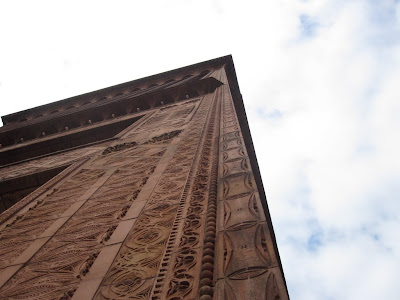
I am in #buffalove, and want to emphasize that if I could marry a building it would probably be the Guaranty Building.

You can view the rest of my pics here, and keep an eye out for more on the National Preservation Conference next week!

Bring it on Buffalo

It is October! Which means I have been spending a full week here in Buffalo, NY for the National Preservation Conference. Last night I made a decision that instead of trying to write a bunch of posts for each day I would wait until I came home to share my thoughts. It will be a little bit more focused with less summary and more interpretation/reflective than I usually do. So stay tuned!

In the meantime you can follow along with the events in a variety of ways online.

Live Streamed Sessions: www.preservationnation.org/conference
Twitter: #presconf, or follow just me (but where is the fun in that) at @pc_presnation
Flickr: Preservation Nation Flickr stream
Blog: Preservation Nation blog.
Facebook: National Trust Facebook page

And check back here next week for more observation and thoughts.