A is For Arizona

I can’t believe that April is nearly at an end.  In a month that saw prep work for THE BIG EVENT in less than three weeks, and the NCPH conference in Pensacola I also had a quick, mini-vacation in Scottsdale, Arizona.  While we spent a good amount of time by the pool enjoying the warmth (it was still very chilly in DC, something that is no longer the case) there was an opportunity for some good eats, hiking, and a moment to take in a historic house tour.

I’ll be honest and say that this trip had an agenda–it was my sisters bachelorette party–and the goal was relax, relax, relax. So while we did take a lovely hike up Camelback mountain (you can see me in the slideshow sporting my PreservationNation.org shirt) the rest of the time pretty much just involved….

Food
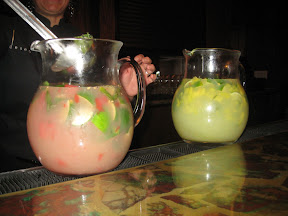
Mohitos!

While in Scottsdale we ate at a lot of places. I did want to take a second to mention that as great as the food at Deseo was , the private mixology class where we learned how to make three different types of mohitos was fascinating–historically speaking of course. The instructor gave us a brief history of the drink and explained the different variations of rum and how they are developed. From some of the courses I took on foodways I remember thinking about the different regions of the world that make the liquor and how the histories of those nations were affected and transformed by production.  Specifically the history of sugar and the slave trade. If you want a really good book about the subject check out Sydney Mintz’s work Sweetness and Power: The Place of Sugar in Modern History.
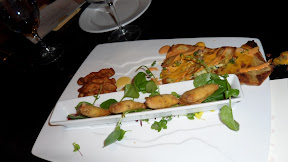
Food at Deseo

We also ate at…

Old Town Tortilla Factory

In addition to perfect weather, this restaurant had amazing southwestern/Mexican cuisine.  Built from a 75 year old Adobe, diners at the Old Town Tortilla Factory sit in the open air.  I would recommend getting the green enchiladas.

Hotel Valley Ho–Cafe Zu Zu

French Toast at Cafe Zu Zu

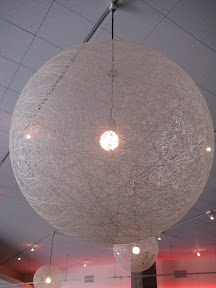
Brunch at Cafe Zu Zu was the perfect way to start our leisure filled Saturday. It also gave me an excuse to visit a very chic modernist hotel (part of the Historic Hotels of America collection). With awesome chandeliers, and a pretty trendy lobby–I thoroughly enjoyed my french toast.  If you love mid-century modernist hotels I recommend visiting the Valley Ho–or just read about its past.

Olive and Ivy

Our first stop when we landed was getting some food at Olive and Ivy. Despite it being the hottest day of the year (so far) in the area, we decided to sit outside. While we tried a lot of different food–the Sweet Corn and Tomato Flatbread was (to me at least) the star of the meal.

And Now for the History: Taliesin West
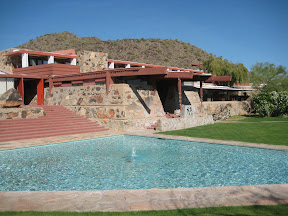
View from the front of Taliesin West

Earlier this week I posted this post over at PreservationNation about the perfect house tour. It stemmed from my general dissatisfaction of a tour I had received at Taliesin West. I wanted to elaborate on this a little. For me the typical house tour is symbolic of a time when great men dominated our history lessons. So while many tours work very hard to look “downstairs” or interpret slave quarters occasionally you get to a tour that hasn’t quite made the leap.

Now of course, the difference with Taliesin West is its connection to Frank Lloyd Wright and his influence on American architecture–but the same principals apply. Instead of trying so hard to convince the captive audience of his greatness, the tour may have been better if his concepts and ideas were relayed narratively, using the house and the school to illustrate the points.  Instead, as an audience member, the conversation felt a little condescending. Rather than talk about the school in a way that talked curriculum and how it uses Wright”s vision to train new architects, we got discussions of accreditation and how many students are accepted. It felt, at times, much like an advertisement for applicants rather than a  story of Wright’s legacy–continuing on beyond his lifetime.  I am willing to concede, as I mention in the post above, that the temperature may have contributed to the ineffectiveness of our guide–or that it was a particular off day–but when you feel like the hour long tour could have been concluded in half the time, there is a problem.

Detail of a statue at Taliesin West

The tour aside, if you do have a  chance to visit this masterpiece do so. Every angle produces a new vision — of sky, water, stone against Arizona’s natural landscape. A is for Arizona–which means it was absolutely amazing.

Note: Speaking of historic moments. While we were in AZ, some of the party attendees stayed up all night to watch the final cricket match of the cricket world cup between India and Sri Lanka. At this moment the Indian team was playing against a team that had dominated the series, while they had fought tooth and nail to make it to the end. It was a team that had not made the finals since the year I was born (1982). While very much an important part of Indian culture, I found myself unexpectedly caught up in witnessing the exciting win–and felt like I was a part of a nationwide moment of joy. So I say Bravo India!

View the full album of pictures.

A House Tour – Just Like a Building – Should be Greater than the Sum of its Parts

This blog has been re-posted from the PreservationNation blog.

Chris Madrid French’s recent blog post on Phoenix modernism on Preservation Nation reminded me of a recent weekend jaunt I took just a few miles east in Scottsdale, Arizona.

While there I did what any self respecting historian/preservationist would do and dragged my two cousins and my sister to see a Frank Lloyd Wright masterpiece, Taliesin West. I’m going to start off by admitting that I do not know much more about Frank Lloyd Wright and his architecture style than his overarching building ethic of having structures that are “in tune with nature.” I love the way they mirror the landscape, providing an almost abstract art-like vision, modernist masterpieces that are close to the earth. They remind me that the soul of a building is much more than the sums of its parts—as Taliesin West exhibited with its tilted roofline, low ceilings, and sunset colored walls.

As magnificent as the building was, I found myself contemplating another art form—the art of a house tour. Being an interpreter is a tough job. No tour is alike—as I well know from giving historic house tours when I was in college. A guide has to be on his/her toes ready to pull from the reams of knowledge they have amassed. My experience—both in giving and attending—tells me that moving a house tour from good to great also involves the following:

  • Know your audience—at the start of the tour it is fine to ask your group about where they are from—but delve deeper. Find out how much the group knows about the site and why they’ve come to visit. And then ADAPT.
  • Show—don’t tell. Obviously there is a reason that this home/structure/architectural wonder has been preserved. However, a repeated exclamation stating that it is wonderful is not instructive when the evidence is right in front of us.
  • Time. I’ve often found that one of the biggest problems with house tours is the need to fill a specific time frame. It is important to recognize when you don’t have enough material—so as to prevent repetition. It is better to produce a tight program, rather than one that rambles and is repetitive over the course of an hour.
  • Tell us a story. This is a personal preference of mine. The house tours I tend to gravitate to make the broader connections between the architect, the place, and those who lived there. It is that interconnectedness that makes a space come alive and makes those past lives tangible.
Taliesin West

Maybe the early morning 95 degree heat in late March may have had something to do with it, but the last point is why I found the tour at Taliesin West slightly unfulfilling. We had the building, we had the great story of an architect whose work dots the American landscape in many forms, but we also had this amazing living history of a school—and the students who lived (and continue to live) there. However, as we moved around the main area, each of these pieces remained disconnected from one another; each existing as a part of their own separate sphere, ultimately lacking the organic, natural flow emphasized by the teachings of Wright.

As our guide stated—entering a Frank Lloyd Wright house is like listening to music. Each element blends seamlessly with the other—low entryways opening up into a robust chorale of space—with its own volume and tone leading to a symphony of nature in something that is man-made. This is how a great house tour should be: elements building upon one another, sifting through the potential cacophony of information creating seamless (with occasional improvisation) orchestration.

See pictures from Taliesin West.

Learn more about my trip to Arizona.

NCPH 2011: Shared Authority, Creating a Commons–Another Day at THAT Camp

THAT: The Humanities and Technology Camp

Last May I attended THATCamp prime in Fairfax, VA where I investigated digital storytelling, local history, and social media in the non profit world. This two day event was incredibly rewarding, and so it was natural for me to sign up for another round at the 2011 National Council on Public History conference in Pensacola, Florida this weekend. As with the first THATcamp I attended each of the sessions served as discussion points for larger conversations about public history and the digital humanities.

First, though I would like to encourage you to head over to twitter and check out the hashtags #thatcamp and #ncph2011, both of which should give you a glimpse into the real time conversations that went on during this day long event.

For our purposes here I am going emphasize a discussion from two separate sessions. The first one looked at how institutions across the historical spectrum deal with user generated content–and how reactions to UGC effects visions of historical authority while providing valuable interaction with an engaged audience. More specifically we talked about crowdsourcing and social media–and how institutional transparency can effect the narrative in a different way.

The second session on social media that I went to actually ended up to be about the creation of a public history commons (check out the post by Kate Freedman on the NCPH conference blog), and how to collaborate within the profession on existing platforms.

In both cases we had to ask ourselves the essential question about audience–who is this project for, and what do we hope to accomplish. In the first instance, it had more to do with institutions and the idea of relinquishing “authority” and “expertise” over the objects and the past, so that the visitors interaction with history rather than the factual nature of this interaction became paramount ( and how to walk that fine line). For the second, since the audience would end up to be public historians, the idea was to provide a space for collaboration within the digital world and so we talked about what content might prove useful and be cross purposed.

The purpose of THATCamp is to spur conversations you would not usually get through traditional conference models–it serves as a spontaneous brain collective where inquiry and experience work together to find solutions. After attending discussions on oral history and web publishing the camp capped off with an overview session that asked philosophically “What is digital history?” followed by the alternative question “Is all digital history public history?”

The answers varied but in the end we asked how much do the definitions matter and is it enough to identify shared values between those who identify as either digital or public historians (a point brought up by @publichistorian). She pointed out that the National Council on Public History has one–visit the website and look for the code of ethics.It is definitely something to consider and I’ll be thinking about it as the week progresses.

Tomorrow I am attending a myriad if sessions, so stay tuned…as I try and bring some of this sunshine and spring weather to the page.

Reel vs. Real: Speeches of Kings

I love going to the movies, however with the exception of certain films involving a boy wizard and other sci-fi epics, I rarely go to see films twice in the movie theater.

I made an exception for The King’s Speech. As a historian I often go into historical films with the recognition that the film we see on the “reel” is not at all going to be a one-hundred percent accurate vision of what actually happened, the “real” history. So I was hardly surprised after my first viewing of seeing this article by Christopher Hitchens that talks about the glossing over of Winston Churchill’s real relationship with the royals and it having a very light treatment of the Nazi’s and the issues of World War II.

On one level, this movie isn’t about the history at all. It is about a man overcoming an incredibly debilitating speech problem–one that leads to abuse by his father, his brother, and attacks on his own self confidence–and his relationship with his therapist to overcome that problem. The classic triumph over adversity storyline.

Obviously though, the movie’s additional strength comes from who the man is, and the reason why he has to overcome stuttering. As Bertie (King George VI, played by Colin Firth) points out near the end of the movie, the monarch has no power in England except to speak to the people; and what the filmmakers, screenwriters, Colin Firth and Geoffery Rush did was provide an incredibly humanizing glimpse into a man thrust upon the throne following his brothers abdication–on the eve of another war.

Sometimes a film or a miniseries, demands accuracy on all levels in order to do justice to the story–and sometimes the artistic license is acceptable. However is it only excusable because The King’s Speech is a fantastically plotted and acted movie? That is, would I be quick to defend other films like The Patriot (or even Pocahontas) which whitewash much of the past to serve the narrative?

Probably not–but I try, at least, to see the flaws for what they are–a limitation of the medium, and another example of human subjectivity when it comes to historical truth.  So tonight–on Oscar night–I’ll be rooting for this crew of British actors that were able to move me.

The Noble Six Hundred

Lives of great men all remind us
We can make our lives sublime
And, departing, leave behind us
Footprints in the sands of time

Last September during my trip to India I found myself in conversation with my aunt, a former principal and history teacher. We talked about our favorite periods in history (mine: colonial America and the Napoleonic era), and those moments of inspiration when everything clicked. There was also the discussion about current events, and how we can see glimpses of past actions in our current situations (with the nod to complexity).

We also discovered our mutual love for Henry Wadsworth Longfellow–more specifically the Pslam of Life.

TELL me not, in mournful numbers,
Life is but an empty dream ! —
For the soul is dead that slumbers,
And things are not what they seem.

The poem talks about living life to the fullest, that even though each life ended in death, our goal should not include blindly walking towards the end, without fully making our mark, without placing our footprints in the sand…

Footprints, that perhaps another,
Sailing o’er life’s solemn main
A forlorn and shipwrecked brother,
Seeing, shall take heart again

She gave me a list of her other favorite poems (If, by Kipling; The Mountain and the Squirrel, Emerson; Wander-Thirst by Gould;  Cargoes by Masefield;  and a childhood love-the Charge of the Light Brigade by Lord Tennyson), and with each one I was struck by the incredible imagery that invoked times past.

Like the poem Cargoes by John Masefield which talks of Stately Spanish galleon’s that drip through the tropics by the palm-green shores, and how it is juxtaposed with a Quinquirme of Nineveh from distant Ophir or the Dirty British coaster with a slat-caked smoke stack.

When we write about the past nothing expresses the feeling of the moment than a quotation from someone who was, well, in the moment–but poetry can capture another perspective. Often invoking high emotion it reveals how bystanders react to events around them–as in The Charge of the Light Brigade. Written in honor of a cavalry of British Forces during the Crimean War (1854-1856) that charged opposition forces had casualties of 247 out of 637. “The Noble Six Hundred” they were called–and to this day–their acts are memorialized in a poem read by students all across the world.

When can their glory fade?
O the wilde charge they made!
All the world wonder’d
Honour the charge they made!
Honour the Light Brigade
Noble six hundred

~*~

…and just because I love it so.  Here is Wander-Thirst by Gerald Gould

Beyond the east the sunrise; Beyond the west the sea
And East and West the Wander-Thirst that will not let me be;
It works in me like madness to bid me say goodbye,
For the seas call, and the stars call, and oh! The call of the sky!

I know not where the white road runs, nor what the blue hills are,
But a man can have the sun for friend, and for his guide, a star;
And there’s no end to voyaging when once the voice is heard,
For the rivers call, and the road calls, and oh! The call of a bird!

Yonder the long horizon lies, and there by night and day
The old ships draw to home again, the young ships sail away
And come I may, but go I must, and if men ask you why,
You may put the blame on the stars and the sun,
And the white road and the sky.
~*~

Some off-site blog posts

If This House Could Talk…What Would It Say?
…And that’s the Beauty of the Open Mic

…is that a five or a four? And some losses


It is a historian’s dream to walk into an archive and look at primary source documentation that no one has touched in hundreds (and sometimes thousands) of years. Making that discovery, that connection that no one else has made before—brings a level of credibility that elevates.

But if that dream is based on a lie….would it be worth it?

I’m talking about, of course, the startling revelation a few days ago that a civil war historian brought a fountain pen into the National Archives, some thirteen years ago, and edited one of President Abraham Lincoln’s pardons. Just a small change…..after all, what does it matter if the pardon was signed in 1864 instead of 1865. Just one year from April 14, 1864 to April 14, 1865—and viola, in a blink of an eye that single pardon, becomes the final act of a presidency, for that night Abraham Lincoln made his way to Ford’s Theatre and the end of his life.

At all levels of education we talk often about the lure of plagiarism, of taking the easy way out—because the ends justify the means—but in the end you lost more than you’ve gained. Credibility. You may have gained it on an external level, but some part of you will always know that it wasn’t deserved. That discovery, that connection—that priceless document does not belong to you, because history is not something that the historian owns. We do not have the right to change what we see before us on a whim—since in the end that discovery, that connection is for more than just you.

As students we discuss the meaning of truth, and how sometimes truth in history can be as amorphous and intangible as a foggy night. That finding the truth and determining a historical fact are, for the historian, an aspiration. We can know that the bombing of Pearl Harbor happened on a particular day, but it won’t be possible to know what was going through the minds of those who died. Our fact, our truth, is only as good as the sources left behind.

So the question I have for our forger, our so-called historian, is—who do you think history serves?

All of this came to a head on a particularly difficult two days—one which, as I wrote most of this, included a loss of electricity thanks to the heavy snow coming down here in Northern VA.

For my M.A. in history I attended American University where I concentrated on a subfield called public history. One such professor was Robert Griffith—who as my department chair represented the epitome of what a historian is. In the university setting he was supportive and engaging to every student that came through his office. Between my first and second years of graduate school I found myself attending a three month internship in London at the British Museum. As part of that internship I got to work with the Lifelong Learning Program—the education division dedicated to adult learning. My project for the summer was to develop a way to exhibit the work of a group of older adults who had come to the museum, looked at objects, and developed a walking tour for visitors. This small, poster exhibition was going to be on display in the education center for all to see—but unfortunately well after I had returned to the states.

Between advisors, I went to Dr. Griffith and he immediately gave me information to facilitate a trip back to the UK to see the project come to its fruition. It was a small act of support, but that is what made being a student of Robert Griffith so great.

On Tuesday afternoon I learned that Dr. Griffith passed away. I, for one, will miss him.

I think his death was especially hard as it was preceded by knowledge of a fellow graduate student from AU—a friend on Facebook now, but someone who I had spent those long hours before, during, and after class with. I hadn’t kept in as much touch after graduation, but learning about his passing made me remember just how wonderful a person he was.

And then there is David Larsen, a vision in the field of interpretation–someone who I never had direct contact with, but who you heard about from time to time. I don’t think I would do a good job describing his contribution to the historical world and the field of public history—so I urge you to head over to the memorial page on Facebook to learn more.

I guess my point is that all three of these individuals left a mark on the world, with their family, fellow students, and profession. All three of them, in their lives, exemplify that the study of history is about more than just the act of discovery. We will miss them all.


Edit: Here is the memorial page for Dr. Griffith.

Another Day, Another Year

What’s an end-of-the year blog without an end-of-the-year list? I’ve tried to fill 2010 with a lot of history—from great trips with my family to intelligent conversations with colleagues in San Francisco, Austin and Portland. At every step I’ve learned a little bit more about life, and a little bit more about myself. Below is a list of my top 3’s for the year. Some, like my music picks, are not necessarily from songs released in this year—but since they were new to me, I’m going to count them anyway. Others on the list you might recognize from other posts on this site.

Top 3 Books
Faithful Place by Tana French
French’s third book in the Dublin murder squad series is gritty and gripping, raw and emotional all at the same time. (Like how I used those adjectives without telling you anything?) Anyway if you like great mysteries that are well written check out this book. While reading In the Woods and The Likeness might be helpful it isn’t 100% necessary.

The Immortal Life of Henrietta Lacks by Rebecca Skloot
History. Science. All with a very clear consequence for every individual in the United States and abroad. And all due to one woman whose life changed forever with her death.

Little Dorrit by Charles Dickens
Like I said some of these picks that are new to me—but after watching the BBC/PBS adaptation I had to read the real thing. Dickens, while always providing a dearth of genius does an amazing job showing the shifts between the rich and the poor—and the circumlocution office is just icing on the cake. Not to mention the vivid detail and characters in all walks of life.

Top 3 History Fun
I wrote a lot about these three experiences on this blog. I learned much about the western immigrant experience in San Francisco, saw how you can tell the story of times past through the remains of ordinary people, and catch a unique vision of America (one that is cleaned, up and brightly colored). For that I choose Angel Island, Written in the Bone, and Telling Stories: Norman Rockwell from the Collections of George Lucas and Steven Spielberg.

Top 3 Music Picks
Rodrigo y Gabriella: Awesome strains of drifting guitar, rich in melodic sounds and rhythmic beats.

O’ Children by Nick Cave and the Bad Seeds: This song was featured in the latest Harry Potter movie, but once I downloaded it I found it entirely engrossing in texture as his voice mixed with the chorales.

Wicked Soundtrack: I am a sucker for musicals and while I did love my purchases this year of the latest Green Day CD I found this to be the album that I am in love with the most. Kristin Chenoweth and Idina Menzel’s voices are remarkable and for a show with such a fantastic message you can’t go wrong with a song about fighting gravity.

Top 3 Television Picks
Fringe: How can you go wrong with parallel worlds and creepy X-files like cases. What really brings in this show, however is the phenomenal acting this season by Joshua Jackson, Anna Torv and John Noble. I know many are all about the awesomeness of cable, but sometimes its shows like this that can tell a story within network constraints that I love.

Masterpiece Theatre (Little Dorrit, Wallander, Sherlock): All three of these mini-series were at the highest caliber of storytelling. Little Dorrit, as I mentioned above, is one of the classics; Wallander had gripping mysteries with an awesome soundtrack (and Kenneth Branagh blew it out of the park); and Sherlock which looked at the classic stories with a modern day slant.

Lost Season 6 Finale: I know this was a controversial ending for those who once loved the show, but even now months after the finale I can say I loved the ending for the series. I’ll admit that there were times this last season that it was clunky and could have had a tighter narrative, but it ended just as I would have wanted it to. Most of what I said right after the episode aired still holds here.

Top 3 Movies
My top three movies for the year are all fairly popular ones. The first part of Harry Potter and the Deathly Hallows was amazing. While the book is still superior, there were elements of the film that had me emotionally involved, not to mention mesmerized (the scene where we are told the story of the Three Brothers). In the same vein Inception proves that you don’t need 3D to tell a story, and to be an excellent entertaining film. The fight in the hotel hallway is probably one of my favorite parts. Lastly, what can we say about Toy Story 3 that others haven’t already said. Any animated movie that can have you at the edge of your seats and cheering has my vote.

Now while this is a top 3 list, I do have to also give props to my favorite Hindi film of the year—3 Idiots which was compelling, and funny at the same time (though some of the songs could have been more memorable), and Morgan Freeman and Matt Damon in Invictus were excellent.

And the rest….

I’ve also had the chance to see some pretty great theatre. As a season ticket holder for the Shakepeare Theatre I was blown away by The Liar and more recently Candide. I also saw Wicked in early January and as I mentioned with the soundtrack the actual musical was beyond words.

Which brings me to 2011. What are my resolutions for the coming year? Well I hope to work on my two National Novel Writing Month projects—cleaning them up, tightening characters which will in turn help with my overall attempts at fiction writing. I also would really like to try my hand at learning Hindi, a language that I’ve never quite grasped, despite hearing it at home for most of my life. I am also looking forward to working on an exciting archive project not to mention my New Year’s Resolutions for preservation. I’ve also realized that this blog is now over a year old—so happy birthday blog!

Add to the list! Tell me what your best ofs for 2010 are, or what your new years resolutions are.

Farewell Twenty-Ten
I guess I knew you when
And while this year was not great
I’d like to think, not the worst to date
But 2011, here we come
Looking for brighter skies, and then some
With something for the spirit too
After all, I’ve got all of you

Happy New Year!!

Telling the Whole Story

I am a sucker for a good book, especially stories that are steeped in their own…history. There is one part of me that lives firmly ensconced in reality where I constantly think about our own past and its public component, but then there’s this other half that becomes engrossed at made-up worlds and marvels at how writers are able to create complete visions filled with music, art, and culture all through the written word. And when that vision integrates a mythology with heroes and morals like our Greek/Roman/Etruscan/Hindu myths it is all the more fantastic.

When those books end up on the big screen, I find myself thinking about how the director’s imagination measures up (of course, no movie is ever quite as satisfying as a book for me). That being said when the first part of Harry Potter and the Deathly Hallows came out I was floored.

I’m not the most critical movie watcher.  Generally, I’ll always try to find a reason to justify sitting in the theater for 2.5 hours (Though Avatar, the 3D is the only thing that saved you.) Anyway…when I saw Harry Potter 7 (Part 1) a few weeks ago I realized that the strength in the narrative came from J.K. Rowling’s ability to create a wholly believable world. When reading the books the reader is bombarded with the tools of the historical trade to tell the story–and each step hearkens back to something that had been prophesied not only when Harry Potter was a young boy, but even further back through the veil of mythology.

What are some of the key primary sources we use in writing about the past? Objects, written sources, art, music.  Material culture includes things like jewelery, funerary objects, items from everyday life that ultimately create meaning for an individual, a community and a nation. In terms of the written word we look to the text in the form of diaries, newspapers, and books for contextual clues.

So in order to understand the wizarding world of Harry Potter we are pulling from the stories told in the last six books, but Rowling also pulled together tools of historiography to tell her story.

In terms of material culture we have the standard trappings of the witch or wizard, but more specifically there are the Horcruxes–magical objects that hold individual pieces of Voldemort’s soul, objects that hold an overarching meaning for him due to their connection with his own mangled past with Hogwarts.  Then we have pieces from Harry’s own past–a golden snitch which holds his key to survival, the diary of Tom Riddle, and the three Deathly Hallows.

Of course this final chapter of the Harry Potter saga is not bereft of textual sources.  Dumbledore’s last will and testament plays a role in setting the three on their journey, not to mention the actual gift to Hermione–The Tales of the Beedle the Bard which adds yet another rich layer to the world. Then we have the book written by Rita Skeeter, which uses (albeit doctored) oral history from Bathilda Bagshot to put together Dumbledore’s past connections to Grindlewald a history that is also told by Elphias Doge. Competing sources of the past, both with kernels of information that are hidden by the other individuals bias. To some extent the last Harry Potter book finds Harry, Ron and Hermione playing the historian and try to suss out the means to destroy Voldemort in the end.

I think one of the additional strengths of the story, and why it resonates with some many, is how it emphasizes the importance of place and that subsequent connection to a community, family, and a people. I know that the sadness I felt (both in the book and the film version) of going back to Godric’s Hollow is directly related to knowing the ‘historical’  moment that happened there. I loved how in the book at the home of Harry’s birth there is a monument to the sacrifice–and how those pilgrims have written of their connection to the events that occurred there.  This isn’t all that different to the writings at Abby Road near the Beatles studio, or the guest books at any major historical site around the world. Good fiction, often makes connections to reality. (As an aside, I also love how cemetery markers provided Hermione with a clue re: the Hallows. As a primary source, gravestones can tell you a lot about the people who lived there).

As I mentioned, part of the reason my blogging has been slow the last few months is because of my participation  in National Novel Writing Month.  I tried to integrate some of my favorite things about history (material culture, landscape analysis, and mythology) with a kernel of a story.  While I’m not sure about how successful I ended up being (while I hit 50k words, the book isn’t done) I did gain a new appreciation for J.R.R. Tolkien, Robert Jordan, George R.R. Martin, Orson Scott Card, and of course J.K. Rowling. I definitely recognized that history isn’t just about revealing fragments of the past, but about trying to engage with and embrace the whole story–in the fictional and non-fictional realm.

~~~

On a side note, here is my work blog post from PreservationNation.org. If you didn’t know already the Historic American Landscape Survey turned ten this year. I also took a trip to Baltimore to learn more about preservation efforts by Baltimore Heritage, Inc.

Seeing What’s Real

There is a counter at the bottom of this page that I hope will explain my month long absence from the blog.  I’m participating in the 2010 National Novel Writing Month–which pretty much requires that I write 50,000 words in 30 days. We’re reaching the last week, and I’m about 6100 words behind so this weekend requires me to put on my game face and write as fast and as much as I can.

If you want to check out some my other writing this month I did post twice on the PreservationNation.org blog.

The second blog post is about my recent trip to the National Archives to view the original copy of the Emancipation Proclamation, which was on display for four days following the opening of the second part of an exhibition entitled Discovering the Civil War. In “The Power of the Document” I wanted to describe how seeing the physical object was just as important as reading the text:

So why is seeing the original document so important to me? Its history is well known, including its role in the larger narrative of the United States beyond the Civil War era. Many have undertaken analysis on Abraham Lincoln’s reasoning and timing in presenting the proclamation, and we can see the text written out after a quick Google search. We know that on January 1, 1863, President Abraham Lincoln proclaimed that all slaves within rebelling states would be “thenceforward, and forever free.”

It makes it real. In a modern world where much of the conversation lives in the virtual realm, the tactile, the physical existence of an object in space strengthens its meaning and connection to the actual events that you read and learn about in history courses around the world. The value of seeing Abraham Lincoln’s signature—teeny and cramped–and reading the words scrawled across sheets of paper gives history texture and life.

For this post I wanted to talk about historical reality and the present. I’ll admit, part of this was due to the recent publication of President George W. Bush’s memoir, and how much of the discussion about the events during and around his eight years in office have, within two years, turned into a trip down nostalgia lane. What I mean is talking about events from two yeas ago as part of a very distant, closed past, without (and admittedly I only watched fragments of two interviews) discussing the future. What I’m asking does not have anything to do with politics, or choosing a side, though I will admit that I am moderate who leans to the left.  What I want to know is the following: at what point do we, as Americans, look at recent events and instead of acknowledging these events as part of a still moving present, put it in the bucket of history–it happened, case closed, book shut.

As a historians, we know that of course, naturally, nothing lives in a vacuum. Everything has consequences–sometimes consequences that cannot be seen until a longer period of time has passed (or as Marc Bloch, and the other historians from his school of thought believed, after the longue duree [long term]). However, we also recognize the role of the individual in shaping those events and realities.

When we made the field trip down to see the Emancipation Proclamation these questions popped up again–that the power of the document was partially in knowing its effect beyond Abraham Lincoln’s initial issuance. That despite what it said, its proclamation had far more, long reaching consequences–some of which reverberated into the twentieth century and the civil rights movement.

So, in seeing what’s real–we are only able to interpret, at any given moment, a fragment of the bigger picture, a picture that is always changing and growing.  But like those before us, we have the opportunity, and the responsibility to look at that fragment from a unique position in time, and place.  Right here, right now, today–but with the forethought that recognizes that those interpretations will shift and change as we shift and change.

Landscape & “Look at what you see, and then see beyond that”

So I’m actually writing this blog from the middle of the social media session (have you been following us on #presconf this week?) but I’ll save that conversation for the wrap up post on Sunday/Monday.

Yesterday was the day for “Next American Landscape” and we started again with a large general session to frame out the day. Panelists included John Bullard (Mayor of New Bedford former Mayor of New Bedford and director of  Sea Education Association) who has a different view on the role of preservation and environmentalism (especially in the case of Cape Wind), Preservation magazine editor James Schwartz and Director of our Southern Field Office Rob Nieweg. Bullard asked two questions: What’s going on here & What are we going to do about it?

The Cape Wind issue is large, complex and hard to explain in brief—so I ‘ll just send you here for more information but Bullard’s essential point is this: with the parts per million of carbon emissions higher then it has ever been, we cannot afford to not put up renewable energy resources as quickly as possible, because if we do not, everything else won’t matter. We can fight for old buildings and historic sites, but what good will that do us if we’re all suffering the effects of global warming.

He also says that while everyone was focusing on the visible intrusion of the windmills, they are ignoring the other terrible things going on in Nantucket (heavy boat traffic, sewage dumping etc.)

In the same vein Nieweg talked about the fight against high powered transmission lines through the Journey through Hallowed Ground. Some of which rely on coal plants and become “industrial intrusions on the landscape”

Both of them are asking us to think about the relationship between power, the landscape, and the preservation of our historic past. At one point Niewig asked “Do we want to sacrifice landscape for cheap power?”

These are the tough questions right? On the Next American City day a lot of the conversation was about finding balance, and looking at ways to bring sustainable design into adaptive re-use buildings, here we are talking about the same thing—but from the opposite angle, where environmentalism clashes with the tenants of historic preservation (saving viewsheds and shaped land).

It was a thought provoking session that once again stayed on my mind throughout the rest of the day—and what I found through my three sessions (Nominating Large Cultural Landscapes to the National Register, Land Conversation and Ranching, and a fantastic session on culinary agritourism in Washington State) is the need to ask those tough questions and find creative solutions because dealing with landscapes is a lot harder than dealing with a physical structure.

In the first session of the morning (the breakout on Nominating Large Cultural Landscapes) we saw that very complexity in identifying and discerning the different pieces of a a historic landscape (structures, layers of history, changes to the land). Unlike a building or a neighborhood with finite boundaries, a landscape has no start or no end, and often has multiple owners (some public, others private). The second session gave two case studies in Colorado. At one point one of the panelists mentioned that the driving force to doing the ranching survey projects was the fact that developmental threat (I think the Army was going to use the land for exercises) stated that the space was perfect because “there was nothing there.”

My third session, was about the world of agritourism. I first learned about the role of food in telling stories about a place and the past during my undergrad at William & Mary—and it is also the idea that pulled me down the rabbit whole hole into looking at history and culture writ large. That is telling the story of a space through music, film, art and food. So this session looked at the land and the landscape of farming and turned it into a central part of Washington State Tourism.

So how does this link to the general session this morning? I think that it has to do with looking at the big picture taking a deep breath, and trying to figure out a new way of doing business. In Thursday’s general session they talked about changing the rules—and for the real world maybe that’s what is on the horizon.

~~~

Later on yesterday night I attended the National Preservation Awards at gorgeous Paramount Theatre. You can see the winners on www.preservationnation.org but the videos are the real star and will be rolled out on the web in the next few weeks. From Main Street Iowa, a school in Las Vegas, and the 2010 Crowninshield winner Tony Goldman it was a night of pride. I think some of you will be interested in seeing all the work he has done in Philadelphia, New York and Miami. During his acceptance speech he said his one advice for preservation is to take a look at what you see before you, and then to look beyond that to a broader, complete vision.  Words to live by.

Check out pictures here.

We’re packing up now, and I’ll be on my way to DC in a few hours. In the wrap up post next week I’ll talk about the last session I attended, the Forum Lunch and put a few final thoughts down for closure.