The Story of US Through Save America’s Treasures and Other National Trust Reads

I have a new blog post on PreservationNation.org. Sort of an homage to the variety of sites supported by Save America’s Treasures.

Before we were Americans we lived off the land, within the cliffs and earth. We were Cherokee, Iroquois, Cheyenne; we were the Sinagua, ancestors of the Hopi, who lived here at Honanki (AD1100-1300).
I also wanted to point out this well written blog posting on Cape Wind by Roberta Lane. Its an issue that I actually have only paid a little bit of attention to as the issues have progressed. I found this to be a very well reasoned, well thought out discussion about dealing with cultural resources while we are also trying to save our planet.

Lastly, if you like Chicago Architecture here’s a great interview with Chicago’s First Lady of Modernism by Arnold Berke.

Stepping Out in Portland

Portland, Oregon is a beautiful city. It’s not too enormous or too small in its harmonious setting between the Columbia and Willamette Rivers, which are flanked (on a clear day) by the snowy peak of Mount Saint Helens reaching into a beautiful blue sky.

That’s what Saturday was like at the National Council on Public History Conference, revealing to me just what a walkable, bike-friendly city looks like. I spent one of my breaks eating at Voodoo Doughnut and at various food carts, all while meandering through street fairs and Powell’s Bookstore (their architecture and history sections are like time warps – prepare to lose four hours in a flash). All in all, a good ending to a fantastic four days.

That being said, let’s take stock on the last two days of the conference. Friday morning I moderated a panel with David Brown (the National Trust for Historic Preservation’s executive vice president), Ian Fawcett (deputy executive director of the Land Conservancy of British Columbia), and Liz Dunn (consulting director of the Preservation Green Lab). The session explored the work of the International National Trusts Organization (INTO) and how climate change is being thought about by their member organizations across the globe. In putting together this panel, I wanted to spread the great information from the INTO conference in Dublin this past year. You can read one attendee’s reaction here.

Following this, I boarded a bus out to Dundee Hills to visit the Sokol Blosser Winery, an organic sustainable winery that is home to the first LEED certified silver wine cellar. The owners of Sokol Blosser understand the need for sustainable farming and viticulture and have adopted it wholeheartedly, managing to convince the vineyards surrounding them to work with them to accomplish their goals. More on that in a bit.

So, what does all this have to do with preservation?

On the one hand, the story of the vineyard speaks to what historians can accomplish (the founders of the vineyard were both history majors in the 1970’s), but it also attempts to answer a question we struggled with earlier in the week – how do we reach the public and show them that sustainability is a part of our future, and more specifically that historic preservation and sustainability go hand in hand within that future?

When I first started at the National Trust almost four years ago, I knew almost nothing about how the environmental movement was linked with old buildings (aside, of course, from the role of Teddy Roosevelt and John Muir in the creation of the National Park System). It took time reading and listening for me to understand why this is an integral part of what we do.

As a public historian/preservationist, it is important to recognize all the ways that history and the past connect with the public, even when this connection reflects highly volatile and controversial current issues like global warming and sustainability. We always throw around the fact that history is relevant in the here and now – that it is an important part of daily life and is ingrained in community character. The acknowledgement of this link between the public at the grassroots level and our role as historians/preservationists/public historians at the professional level needs to happen in sync with the work we do on policy and other legislation.

Let’s take a step back to the vineyard. The owners of Sokol Blosser knew they wanted to have a vineyard that was organic and sustainable, but they knew they couldn’t do it by themselves. So they reached out to their neighbors, trained their employees, and created a mindset within their own community about the importance of being green. Similarly, we recognize that the work we do on this issue is about more than just saving historic places; it is about preserving ecosystems and landscapes that are a part of historic view sheds, and consequently a way of life. We work within our organizations to communicate this belief and to spread the word to our memberships. We are ambassadors that are helping to usher forth an engaged, knowledgeable, and determined public.

Yes, this is a slow process, but it will continue to be advanced by gathering at conferences like the 2010 National Council on Public History/Environmental Historian Conference, where we all stepped out of our disciplinary silo’s and talked to one another.

Also cross posted on the PreservationNation.org Blog and the NCPH2010 Blog.

Things I heard at the National Council on Public History Conference

Overheard at the NCPH Conference:

How does one communicate about sustainability at the local level?

Is it better to be pretty good at a lot of things or really good at one or two things?

My Top Twitter Posts:

@pc_presnation: Important to train public historians to be adaptable . Knowing about digital tools is just as important as intellectual knowledge #ncph2010

@p_presnation: In a working group on sustainability and h.pres. How are you talking about it with your communities? #preservation #ncph2010

These two questions (and tweets!) lie at the heart of my first day of the National Council on Public History Conference here in Portland Oregon. I love this conference, first of all—its a small, yet open, community of historians that often like to look outside the box. Secondly hearing about these two things within the same day is not unheard of. In fact at any given moment you can hear about dissertations, practical applications for oral history, or even section 106 mitigation review all in one conversation.

The first tweet and the first question came from a session on digital history in a master’s program. We had some great examples from the folks at the Center for History and New Media, that was supported by a student at American University (who also works for the National Trust for Historic Preservation), an individual at the National 9/11 Memorial Museum and a doctoral student NYU who works on outhistory.org. What was great about this program is that it was, in the end, about more than just digital curricula in an educational setting. It was really emphasizing that sometimes, and especially in the case of public history work (including historic preservation) it is better to know how to do a lot of different things so that you can build upon that knowledge easily to further the goals of your institution and work. While Jeremy Boggs from CHNM was talking specifically about basic digital tools (html/CSS, FTP file sharing, writing grant proposals) its really an idea that can be discussed across the board. Its really important in any field to be adaptable, something that I also talked with another NCPH participant on my very early morning flight across the country on Wednesday morning. In terms of digital tools this is something that can be seen at the National Trust through our very recent Save Americas Treasures campaign which used traditional media to contact congress, but also provided the guidance for advocates to use Twitter, Facebook, Flickr and YouTube to spread the word.

Which comes to the second lesson from this session. Sometimes you have to take a little bit of a risk and have a little bit of trust to move forward. Without either of these things we, as historians/public historians/historic preservationists will never be able to adapt to the changing world. New communication tools, mean new communication strategies. New research techniques and sources, means new methods of talking about those sources to tell the stories we want to tell.

The second session of the day was about historic preservation and sustainability. This is a topic, as I mentioned in my earlier post, that is near and dear to the heart of preservationists. This is not something that NCPH, traditionally, has really discussed which is why having this conference in conjunction with the American Society of Environmental Historians was a great idea.

At the heart of the conversation was a self-examination regarding how sustainability and historic preservation connect back to the role these buildings play in the community. That while we talk about relationship between the two subjects to our peers at the USGBC or at sister organizations like NCPH that we also have to recognize the continuing disconnect at the local level. What strategies have been done to develop outreach and communication strategies for those at the local level? Whose responsibility is it to get the word out? How can we get the word out?

All in all, a successful day which ended with a chance to speed network (its like speed dating but you end up with a lot of business cards) and a great dinner with one of the panelists from my own session on the International National Trust Organization’s Dublin Declaration. So stay tuned on Monday for some concluding remarks and, I hope, some pictures from an organic and sustainable vineyard here in Oregon.

Follow the Conference on Twitter #ncph2010 or on the conference blog at http://ncph2010.blogspot.com/
This post has been cross-posted on the preservationnation.org blog

Currents of Change: Thinking about the Environment and History in Portland, Oregon

For the next few days I’ll be attending the National Council on Public History (NCPH) conference in Portland, Oregon. Not only is this city the furthest west I have ever been, it is also the first time I’ve ever been in Oregon. The topic of this year’s conference is “Currents of Change” and involves looking at the connections between history and the environment. The conference is particularly exciting because this year it is in conjunction with the American Society of Environmental Historians. You can see the program at www.ncph.org but I’ll pull out a few highlights over the next few days (and will be tweeting @pc_presnation). Until then here are a few thoughts from the first day of the conference which also includes a celebration of NCPH’s 30th birthday.

Sustainability is something we at the National Trust for Historic Preservation have made a priority. We’ve had tweets, and resources and discussions at various events including the National Preservation Conference. I know its something we care about on many levels. On my way in from the airport I overheard a snippet of a radio conversation that asked about why young people aren’t involved with the fight against global warming like they were back in the 1960s for Civil Rights. The commentator whose name I didn’t really catch, wanted to know where the sit ins, the protests, the civil disobedience to urge government action. His conclusion: That its not happening because no one has put forth a call.

I think a bigger question is: If someone puts out a call how will historians and preservationists answer?

Which of course leads me to more practical questions: how does the green movement and history interact with the public? more importantly what strategies and ideas are currently being used to reach people on the local level? How can we use our knowledge of the history of the environment in America to reveal how historic preservation is also green?

I’ll be look for answers when I attend a panel that talks about historic preservation and sustainability, the opening plenary session with Adam Hochschild and my Friday tour of an organic winery, and much much more. So stay tuned!

Save America’s Treasures: Save America’s Jobs

So I wanted to pass along some of the things going on at work this week. Some of the programs threatened by the 2011 Federal Budget is Save America’s Treasures, Preserve America, and Heritage Area’s funding. I know we have a budget that is gluttoneous and out of control, I know that sometimes we have to make “hard decisions” but this is something that we can say is the “wrong” decision.

Obviously I’m a big fan of these programs because of what they do for our cultural heritage but did you  know that they have created jobs and partnerships across this country? If you want to take action you can send a letter to your congressperson by clicking here, and use the power of blogs and social media to spread the word about how important these programs are. For the social media toolkit click here.

Don’t know what Save America’s Treasures is? Click here. Also check out the video below.

The Lies That History Tells Us

Wicked Logo
Wicked Logo

I finally did something last week that I have been looking forward to doing for months. I saw the musical Wicked. Based on the book by Gregory Maguire the story essentially inverts the Wizard of Oz on its head and and asks “What if the Wicked Witch of the West Wasn’t Wicked?” Its one of the “certain point of view” stories and the musical is filled with incredible performances and musical numbers that do everything a musical is supposed to do: make you laugh, make you cry, and make you sing.

Here are some lyrics to start this discussion (for those who haven’t read the book or seen the play, Elphaba is the Wicked Witch):

Elphaba, where I’m from, we believe all sorts of things that aren’t true.
We call it – “history.”

(sung) A man’s called a traitor – or liberator
A rich man’s a thief – or philanthropist
Is one a crusader – or ruthless invader?
It’s all in which label
Is able to persist
There are precious few at ease
With moral ambiguities
So we act as though they don’t exist

—the Wizard, “Wonderful”

When we think about and write about history we take some facts as exactly that—as facts. Hitler was evil, the Holocaust did happen, but historians know more than anyone that the “label” that persists sounds very much like the adage that “history is written by the winners.” In the case of Wicked we’re brought into a world that begins long before Dorothy takes her first steps into Oz, a land that is inhabited by animals who can talk and teach but are mysteriously becoming uncivilized and speechless.

Enter Elphaba who, in the classic hero’s journey makes sacrifices and choices to right a wrong, and ultimately finds herself vilified in the process. The ultimate strength of the story is its ability to turn the “wicked” into the underdog, and Dorothy into a footnote.

As a historian I can see how this applies. Every source we read, every oral history we listen to comes form someone with a point of view. We know that social history (that which looks at the slaves, the women, the ordinary people instead of merely the Big White Men) changed what we know about various facets of American History, and that different administrations are looked at and analyzed differently based on how conservative and how liberal our own bias’ are. We make choices as to what is important and what is not based on training and the ability to interpret and read between the lines to piece together history.

Now I’m not saying that if we looked a little bit harder the great evils of our time will miraculously be not as bad, or that the invaders will turn into “liberators.” I guess I’m merely acknowledging that what we do in thinking and writing about the past is as much of an art as it is a science and that sometimes opposing views give us a bigger picture of what actually happened.

Consider this image for another point of view:

Better History, Bitter Future
Better History, Bitter Future in Chelsea, NYC
Liberty from the Highline

While I was in NYC we walked by this piece of graffiti in Chelsea, just near the bottom of the High Line. It provides another interesting perspective. Histories document the good, the bad, and the ugly—but to some it seems like it is all with the wide brush of progress, rather then with strokes of reality. I believe that we document the past so that our futures are better, that injustices can be prevented before they happen. I’d like to think we aren’t writing better histories while ignoring the future, but do know for some, that is exactly what seems to be happening.

I am, in the end, ever the optimist, and so I’ll leave you with a few lines from another of Wicked‘s hits:

Something has changed within me
Something is not the same
I’m through with playing by the rules
Of someone else’s game
Too late for second-guessing
Too late to go back to sleep
It’s time to trust my instincts
Close my eyes and leap

—Elphaba, ‘Defying Gravity”

Pandora, Alderaan, Caprica: The Many Faces of Earth

I’m writing this as a blizzard comes down outside my house and I figured its as good a time as any to write out the last of my movie posts. It will come as no surprise that I have seen James Cameron’s latest blockbuster Avatar, and like most viewers I was blown away by the 3D special effects and just how it transformed the movie experience. I’m also not surprised to hear that a sequel is already in the works.

That being said, at some point I heard some reviewer or the other (probably from Entertainment Weekly) pose the following question: Is Avatar a bigger movie than Star Wars?

It is a hard question to answer. First off are we comparing the first Star Wars movie (the one we know now as Episode IV, A New Hope) or are we comparing the whole series? Are we doing an overall comparison or just a technology to technology comparison? That is are we looking at how transformative the technology in Avatar is to the movie industry in the same vein as how path breaking the technology from a galaxy far, far, away was to special effects? If that’s the case then Avatar has only been out a few short weeks so can we really tell what its impact is, or is it simply amazing since it is the first to truly use 3D technology for the entire movie?

I’ve discussed this with a bunch of friends, some of whom see it as transformative only in the fifteen minutes of fame sense—that is, until the next 3D spectacular film comes out. Others, including me, see a story that pales in the face of even a surface scrutiny, especially sine the plot is reflective of Dances with Wolves and Disney’s Pocahontas put together.

But all of that has been talked about ad nauseum. My favorite thing about science-fiction, and one of the particular aspects of Avatar that I liked the most was the world-building. That is the creation of whole new cultures and histories that are, really, based on actual histories and stories from our world. True, many of them carry the same trophes (all knowing mystical energy that can be felt by a specific group of people), or try and successfully pull their own twists to a previously created tale (the recent Battlestar Galactica).

To some extent we see this process with historical fiction. That which looks at events like the Civil War and asks the infamous “what if” questions to create a new world that is still grounded in reality. Science Fiction, on the other hand, takes that question a step further, masking the harder questions in the cloak of something magical and mystical.

Avatar to some seemed a loose metaphor on our dependence on oil (unobtanium), while Star Wars has clear elements derived from Hitler’s Germany. One of my favorite things about the latest iteration of Battlestar Galactica is how it takes what we as a culture finds abhorrent (suicide bombings) and puts the good guys, the humans in the position of resorting to that violence, and for a moment, just one sliver of a moment you find yourself seeing the world through their eyes. BSG had no qualms about beating us over the head with their historical references, and analogies to the present and in the end just made me think.

It also might be said that these narratives are about the search for Utopia in the face of chaos. Looking for perfection when our own world seems to be rife with environmental destruction and political mistrust. I know one thing though—I think movies and stories like Avatar and Star Wars, and television shows like Lost and Battlestar Galactica give us a change in perspective and ultimately let us take a step towards understanding what makes us human.

Historian 2.0: Finding the Past Through Social Media

From the PreservationNation.org Blog

I think, like it or not, social media is here to stay. We may choose to use it to obsess over celebrity, or catch up on our daily news but I’m often surprised at how much about the past I’m able to learn and examine through the likes of Twitter, Facebook, Flickr, and a wide variety of blogs. So here we go—here’s a day in the life of a historian in the age of social media.

8:00 am:  I’m on my way to work and I plug my iPod into my car or my headphones depending on my travel situation for the day. I key up my favorite podcast, one that reminds me of the art of storytelling and oral history that is so prevalent in our profession, despite most of the stories being of relatively recent times. Yes, it is the This American Life podcast—my favorite of which is this one called The Ghost of Bobby Dunbar.

10:00 am: After dealing with the most important work of the day, open up my Twitter account (@pc_presnation) and look at my feeds. It usually takes me about 10 minutes to see what I may want to read later at home, and what might be interesting to share with members. While I tend to tweet little historical factoids, I like how everyone has an angle and is coming from their own unique perspectives.

Who do I follow? @publichistorian, @history_book, @trustmodern, @historyfaculty, and of course @presnation, where I have access to lists of preservation Twitter feeds.

Noon: So around lunch is when I’ve got a little bit more time so I visit my Google Reader for the latest in the blogosphere. The blogs that I subscribe to are varied but I usually like to check out Preservation in Pink’s preservation photos, and the History Carnival, which works with other bloggers to showcase history posts on a common theme once a month. For instance, January’s History Carnival was hosted by Westminster Wisdom and took a Scroogesque theme for the new year. It was by reading @PublicHistorian’s blog that I was pointed to the 2009 Cliopatria Awards by the History News Network. These awards are presented at the American Historical Association conference every January and honors great blogs in the field of history. I’ve added Georgian London and A Historian’s Craft which won for this amazing post.

2:00 pm: It’s time for e-mail lists. While I am the moderator for Forum-L (the list for Forum) I also participate in a number of free lists from H-Net. Specifically I subscribe to H-Public (for Public Historians), and H-DC (which tells you about all things historical in Washington.) While these are e-mail based I like how I can send out one message and reach a ton of people at the same time, it often spurs great discussions.

4:00 pm: Around this time sometimes I need a break, so I check out the latest This Place Matters photos on Flickr or visit the American Memory collection from the Library of Congress to peruse the HABS/HAER collection. (Want to see some great images? Search for the Statue of Liberty or the Washington Monument. If you want to see something more local, try looking for your home town.) If you like this, also check out their  American Folklife Collection.

5:00 pm: It’s time to go home, but not before I take a scan through the National Trust for Historic Preservation fan page on Facebook to see what I need to think about for the next day.

Those are my social media habits. What are yours?

For the Love of the Game

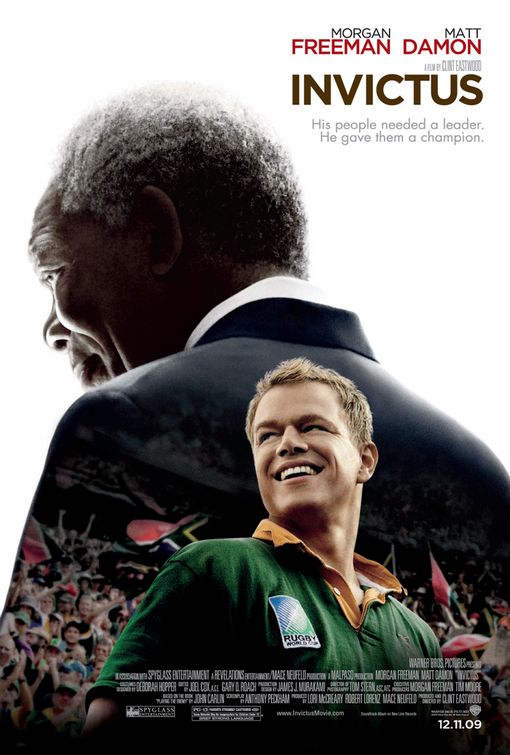
Invictus Movie Poster
Movie Poster for Invictus with Morgan Freeman and Matt Damon

Happy New Year!

I’ve been spending a lot of time at the movies lately. I’ve seen a sports movie set in post-apartheid South Africa, a Hindi movie that made me laugh, a film about loneliness in the so-called friendly skies, and stepped into a fantastical 3D world that provided much food for thought. So, for the next two weeks I’m going to look at these movies and try to pinpoint what they say about winners, finding your passion and epic, fantastic narratives that are really masks for the colonial past.

I know floating out there is the common adage that “history is written by the winners.” Which is true, to some extent. Winners are the one’s who seemingly get to dictate the terms for the narrative, those who survive to describe the victorious battles and the defeat of their foes on their own terms. In effect provide their interpretation for the events that brought them success.

Winning also brings forth a certain amount of pride, and in the case of sports team, a sense of identity with those the team represents. Over the holiday I saw the movie Invictus, which narrates the presidency of Nelson Mandela through his work to bring the South African rugby team (the Springboks) to victory in the 1995 World Cup. While I think Mandela’s role and his relationship with the Springbok’s has been dramatized for the film, his years long relationship with Captian Francois Pienaar (played by Matt Damon in the film) has not. Mandela’s hope was that this team could heal a nation trying to move past the legacy of Apartheid, and to bring unity between black and white South Africans.

I was thinking about this later in the week when my sister and I attended my first ever NFL game at FedEx Field in Washington, DC. As had become the norm this year the home team—the Redskins, were defeated by the Dallas Cowboys. But amidst the maroon and gold I could see that this team, like many in the NFL stirs such strong emotions in those who have been long time fans. We all know how loud and proud fans of the Boston Red Sox and the New York Yankees are—and that many stick by their teams in the good years and the bad—or more often than not, just during the good years. What is it about winning that makes the bond of local identity stronger? Does losing cause some erosion of faith in the city, making it a less enticing place to live and work?

Nelson Mandela and Springbok's captian Francois Pienaar in 1995
Nelson Mandela and Springbok's Captain Froncois Pienaar in 1995 after the Rugby World Cup.

In terms of looking to the past, if the movie is to be believed fully, Mandela saw the Springbok’s as an opportunity, a way to give both black and white in South Africa something to look forward to, a symbol that there was something both sides had in common. What does this say about the larger narrative—including things like the Olympics or other World Cup events where athletes are specifically chosen to represent their country at worldwide tournaments?  Are sports-as-unifiers merely temporary panacea’s to larger issues? Do they actually heal wounds, or just a temporary band-aid that keeps slipping open?

Below is the poem that Nelson Mandela held onto while he was being held in prison.

Invictus
William Ernest Henley

OUT of the night that covers me,
Black as the Pit from pole to pole,
I thank whatever gods may be
For my unconquerable soul.

In the fell clutch of circumstance
I have not winced nor cried aloud.
Under the bludgeonings of chance
My head is bloody, but unbowed.

Beyond this place of wrath and tears
Looms but the Horror of the shade,
And yet the menace of the years
Finds, and shall find, me unafraid.

It matters not how strait the gate,
How charged with punishments the scroll,
I am the master of my fate:
I am the captain of my soul.

Historic Preservation and Higher Education: What is its Purpose?

This post is one I did for work and is posted on the National Trust for Historic Preservation Blog. It came out of a larger conversation on the preservation professional listserve.

Historic Preservationists wear many hats. They are advocates, architects, community organizers, accountants, webmasters, managers, conservators, and teachers. In the same vein, preservationists come to the field from a variety of entrances—from main street, grassroots advocacy for a local building, policy work, or just by accident. Increasingly the decision to enter the field has come from academic institutions.

During the last two weeks on Forum-L preservationists (one of the benefits of being a Forum member) have been discussing the purpose of academic training in historic preservation. Prompted by this article, which takes a look at some of the possible changes for the University of Kentucky Historic Preservation Program, members debated the benefits of theoretical versus technical knowledge and the need to affiliate historic preservation programs with allied fields. In particular some members emphasized how the theoretical underpinnings of the field are not enough, that to truly succeed in the field students have to find their own niche and specializations. member) have been discussing the purpose of academic training in historic preservation. Prompted by

I come to this conversation from the standpoint of a public historian, essentially someone who practices history outside of the academy where the primary audience is the public writ large. It is a field that, in my opinion, really examines the same issues that the historic preservationists on Forum-L were discussing, albeit from a slightly different angle.

To read the full post visit the PreservationNation blog here.