A is For Arizona

I can’t believe that April is nearly at an end.  In a month that saw prep work for THE BIG EVENT in less than three weeks, and the NCPH conference in Pensacola I also had a quick, mini-vacation in Scottsdale, Arizona.  While we spent a good amount of time by the pool enjoying the warmth (it was still very chilly in DC, something that is no longer the case) there was an opportunity for some good eats, hiking, and a moment to take in a historic house tour.

I’ll be honest and say that this trip had an agenda–it was my sisters bachelorette party–and the goal was relax, relax, relax. So while we did take a lovely hike up Camelback mountain (you can see me in the slideshow sporting my PreservationNation.org shirt) the rest of the time pretty much just involved….

Food
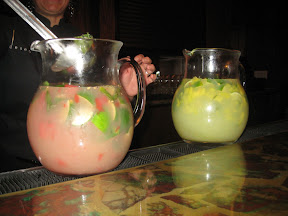
Mohitos!

While in Scottsdale we ate at a lot of places. I did want to take a second to mention that as great as the food at Deseo was , the private mixology class where we learned how to make three different types of mohitos was fascinating–historically speaking of course. The instructor gave us a brief history of the drink and explained the different variations of rum and how they are developed. From some of the courses I took on foodways I remember thinking about the different regions of the world that make the liquor and how the histories of those nations were affected and transformed by production.  Specifically the history of sugar and the slave trade. If you want a really good book about the subject check out Sydney Mintz’s work Sweetness and Power: The Place of Sugar in Modern History.
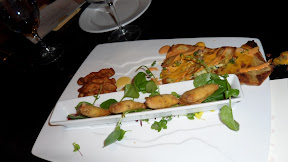
Food at Deseo

We also ate at…

Old Town Tortilla Factory

In addition to perfect weather, this restaurant had amazing southwestern/Mexican cuisine.  Built from a 75 year old Adobe, diners at the Old Town Tortilla Factory sit in the open air.  I would recommend getting the green enchiladas.
Hotel Valley Ho–Cafe Zu Zu

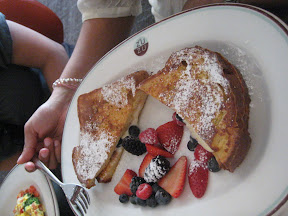
French Toast at Cafe Zu Zu

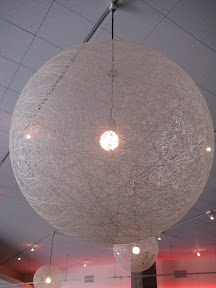
Brunch at Cafe Zu Zu was the perfect way to start our leisure filled Saturday. It also gave me an excuse to visit a very chic modernist hotel (part of the Historic Hotels of America collection). With awesome chandeliers, and a pretty trendy lobby–I thoroughly enjoyed my french toast.  If you love mid-century modernist hotels I recommend visiting the Valley Ho–or just read about its past.

Olive and Ivy

Our first stop when we landed was getting some food at Olive and Ivy. Despite it being the hottest day of the year (so far) in the area, we decided to sit outside. While we tried a lot of different food–the Sweet Corn and Tomato Flatbread was (to me at least) the star of the meal.

And Now for the History: Taliesin West
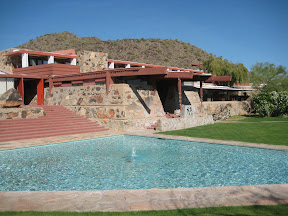
View from the front of Taliesin West

Earlier this week I posted this post over at PreservationNation about the perfect house tour. It stemmed from my general dissatisfaction of a tour I had received at Taliesin West. I wanted to elaborate on this a little. For me the typical house tour is symbolic of a time when great men dominated our history lessons. So while many tours work very hard to look “downstairs” or interpret slave quarters occasionally you get to a tour that hasn’t quite made the leap.

Now of course, the difference with Taliesin West is its connection to Frank Lloyd Wright and his influence on American architecture–but the same principals apply. Instead of trying so hard to convince the captive audience of his greatness, the tour may have been better if his concepts and ideas were relayed narratively, using the house and the school to illustrate the points.  Instead, as an audience member, the conversation felt a little condescending. Rather than talk about the school in a way that talked curriculum and how it uses Wright”s vision to train new architects, we got discussions of accreditation and how many students are accepted. It felt, at times, much like an advertisement for applicants rather than a  story of Wright’s legacy–continuing on beyond his lifetime.  I am willing to concede, as I mention in the post above, that the temperature may have contributed to the ineffectiveness of our guide–or that it was a particular off day–but when you feel like the hour long tour could have been concluded in half the time, there is a problem.

Detail of a statue at Taliesin West

The tour aside, if you do have a  chance to visit this masterpiece do so. Every angle produces a new vision — of sky, water, stone against Arizona’s natural landscape. A is for Arizona–which means it was absolutely amazing.

Note: Speaking of historic moments. While we were in AZ, some of the party attendees stayed up all night to watch the final cricket match of the cricket world cup between India and Sri Lanka. At this moment the Indian team was playing against a team that had dominated the series, while they had fought tooth and nail to make it to the end. It was a team that had not made the finals since the year I was born (1982). While very much an important part of Indian culture, I found myself unexpectedly caught up in witnessing the exciting win–and felt like I was a part of a nationwide moment of joy. So I say Bravo India!
View the full album of pictures.

A House Tour – Just Like a Building – Should be Greater than the Sum of its Parts

This blog has been re-posted from the PreservationNation blog.

Chris Madrid French’s recent blog post on Phoenix modernism on Preservation Nation reminded me of a recent weekend jaunt I took just a few miles east in Scottsdale, Arizona.

While there I did what any self respecting historian/preservationist would do and dragged my two cousins and my sister to see a Frank Lloyd Wright masterpiece, Taliesin West. I’m going to start off by admitting that I do not know much more about Frank Lloyd Wright and his architecture style than his overarching building ethic of having structures that are “in tune with nature.” I love the way they mirror the landscape, providing an almost abstract art-like vision, modernist masterpieces that are close to the earth. They remind me that the soul of a building is much more than the sums of its parts—as Taliesin West exhibited with its tilted roofline, low ceilings, and sunset colored walls.

As magnificent as the building was, I found myself contemplating another art form—the art of a house tour. Being an interpreter is a tough job. No tour is alike—as I well know from giving historic house tours when I was in college. A guide has to be on his/her toes ready to pull from the reams of knowledge they have amassed. My experience—both in giving and attending—tells me that moving a house tour from good to great also involves the following:

  • Know your audience—at the start of the tour it is fine to ask your group about where they are from—but delve deeper. Find out how much the group knows about the site and why they’ve come to visit. And then ADAPT.
  • Show—don’t tell. Obviously there is a reason that this home/structure/architectural wonder has been preserved. However, a repeated exclamation stating that it is wonderful is not instructive when the evidence is right in front of us.
  • Time. I’ve often found that one of the biggest problems with house tours is the need to fill a specific time frame. It is important to recognize when you don’t have enough material—so as to prevent repetition. It is better to produce a tight program, rather than one that rambles and is repetitive over the course of an hour.
  • Tell us a story. This is a personal preference of mine. The house tours I tend to gravitate to make the broader connections between the architect, the place, and those who lived there. It is that interconnectedness that makes a space come alive and makes those past lives tangible.
Taliesin West

Maybe the early morning 95 degree heat in late March may have had something to do with it, but the last point is why I found the tour at Taliesin West slightly unfulfilling. We had the building, we had the great story of an architect whose work dots the American landscape in many forms, but we also had this amazing living history of a school—and the students who lived (and continue to live) there. However, as we moved around the main area, each of these pieces remained disconnected from one another; each existing as a part of their own separate sphere, ultimately lacking the organic, natural flow emphasized by the teachings of Wright.

As our guide stated—entering a Frank Lloyd Wright house is like listening to music. Each element blends seamlessly with the other—low entryways opening up into a robust chorale of space—with its own volume and tone leading to a symphony of nature in something that is man-made. This is how a great house tour should be: elements building upon one another, sifting through the potential cacophony of information creating seamless (with occasional improvisation) orchestration.

See pictures from Taliesin West.

Learn more about my trip to Arizona.

Pursuing Pensacola: Final Thoughts

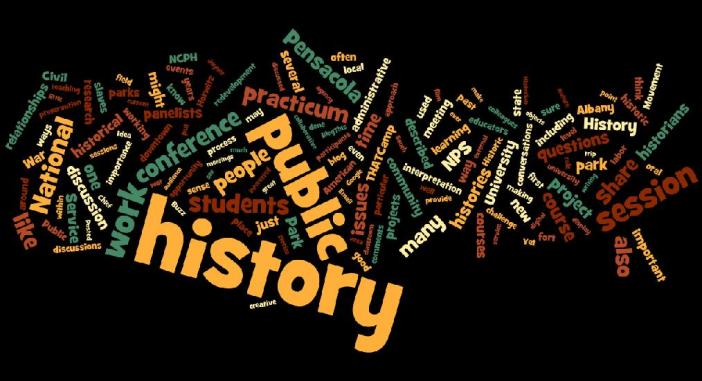
Wordle Map of the NCPH 2011 Conference by Cathy Stanton

In the last week I’ve written a bunch of blog posts about Pensacola….

NCPH 2011: Shared Authority, Creating a Commons–Another Day at THAT Camp
NCPH 2011: A Public History “Spring” Break (blog.preservationnation.org)
History that is Difficult to Do (NCPH Conference Blog)
Preservation Roundup: Public History Edition (Part 1)
Preservation Roundup: Public History Edition (Part 2)

…and this one is the last. As always NCPH brought with it a meeting of minds, and a reminder of why I love history so much. The commitment and passion that comes with this yearly gathering forces me to look at how I work, and how I see the past with different tools and audiences. Often, I leave with a lot of great ideas, without enough time to bring them to fruition–and I would love for this year to be different. Specifically, I am excited about the next five years and what the commemoration of the 150th anniversary of the Civil War (which started this morning with shots being fired at Fort Sumter) will mean for the growth of historical discourse and memory in this country. How can we look to and learn from other commemorations to make sure that this volatile and game-changing period of America’s past is understood to  its full measure?

It’s an exciting time for public history–and I am proud and exhilarated to be a part of it.

Food. Food. Food.

What would a blog post about my travels be without a conversation about food. While I did eat at various places in the Historic Pensacola Village, there are three that I wanted to highlight

Dolce in Historic Pensacola Village: I really should only have to type out the following words–home made ice cream. With chocolate flavored with beer, or vanilla with fig each of the flavors at this store were great to eat. Especially in the lovely spring weather. The fact that it is located inside one of the Village’s restored homes makes it even better.

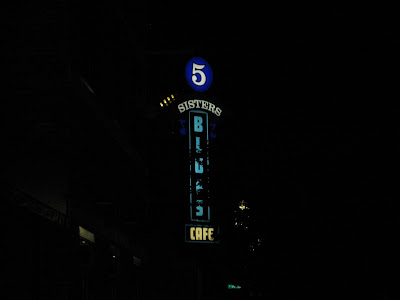
Five Sisters Blues Cafe: The marquee at the left may give you an idea of what the ambiance of this cafe was like. With live blues music, and perfect fried chicken and macaroni I was left in a puddle of southern home cooking goodness. I ate far too much for my own good, but would tell you that even if you eat until you can’t eat any more, you must try the mashed potatoes.

Nacho Daddies: I know the name is slightly ridiculous, but I loved the pineapple-mango salsa on my vegetarian/chicken tacos. It’s a great, independent fast food place with an excellent vibe. The sopapilla‘s were flaky and sweet and complimented the light nature of the tacos.

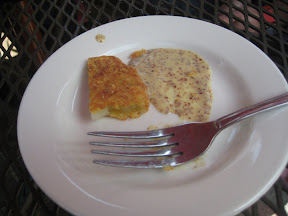
Everyone ate ate at least one Fried Green Tomatoes while in Florida. Yum!

Pictures!

NCPH 2011: Shared Authority, Creating a Commons–Another Day at THAT Camp

THAT: The Humanities and Technology Camp

Last May I attended THATCamp prime in Fairfax, VA where I investigated digital storytelling, local history, and social media in the non profit world. This two day event was incredibly rewarding, and so it was natural for me to sign up for another round at the 2011 National Council on Public History conference in Pensacola, Florida this weekend. As with the first THATcamp I attended each of the sessions served as discussion points for larger conversations about public history and the digital humanities.

First, though I would like to encourage you to head over to twitter and check out the hashtags #thatcamp and #ncph2011, both of which should give you a glimpse into the real time conversations that went on during this day long event.

For our purposes here I am going emphasize a discussion from two separate sessions. The first one looked at how institutions across the historical spectrum deal with user generated content–and how reactions to UGC effects visions of historical authority while providing valuable interaction with an engaged audience. More specifically we talked about crowdsourcing and social media–and how institutional transparency can effect the narrative in a different way.

The second session on social media that I went to actually ended up to be about the creation of a public history commons (check out the post by Kate Freedman on the NCPH conference blog), and how to collaborate within the profession on existing platforms.

In both cases we had to ask ourselves the essential question about audience–who is this project for, and what do we hope to accomplish. In the first instance, it had more to do with institutions and the idea of relinquishing “authority” and “expertise” over the objects and the past, so that the visitors interaction with history rather than the factual nature of this interaction became paramount ( and how to walk that fine line). For the second, since the audience would end up to be public historians, the idea was to provide a space for collaboration within the digital world and so we talked about what content might prove useful and be cross purposed.

The purpose of THATCamp is to spur conversations you would not usually get through traditional conference models–it serves as a spontaneous brain collective where inquiry and experience work together to find solutions. After attending discussions on oral history and web publishing the camp capped off with an overview session that asked philosophically “What is digital history?” followed by the alternative question “Is all digital history public history?”

The answers varied but in the end we asked how much do the definitions matter and is it enough to identify shared values between those who identify as either digital or public historians (a point brought up by @publichistorian). She pointed out that the National Council on Public History has one–visit the website and look for the code of ethics.It is definitely something to consider and I’ll be thinking about it as the week progresses.

Tomorrow I am attending a myriad if sessions, so stay tuned…as I try and bring some of this sunshine and spring weather to the page.

Come As You Are: Maximum India on Homespun

Suspended from the ceiling
A map filled with arts
Culture
Symbols
Dancing over a wheel, a chakra
Calling for virtue from the people.

And at the crowded, energetic stage
Sounds of Rajasthan flow into the melody of the violin

Embrace the dance styling of Punjabi rhythm
Din. Dinaka. Din Din. Dinaka. Din Din.

The art, the dance, the music, the film
All merge together amidst the written word
Imagining the city, embracing the politics
Tagore debates Gandhi
Margins and Majority on the silver screen

India is more than just the sum of its arts
More than a saffron-colored sari, or an exotic smell
But for a short while there is a glimpse,
An attempt to encompass, to gather, to embrace
India at the Max.
Maximum India.

I recently spent the first part of March attending a bunch of events for Maximum India. Today I published a review at the Smithsonian Homespun blog. Unlike the literature panel I wrote about last week, this time I tried to take a broader view of the entire festival as a whole–looking at the music, art, dance and what it told us about India and identity. So stop by the Homespun blog–if you saw part of the festival, let us know what you thought.

Pushing Language Towards the Joyful

I am maxed out.

For the last twenty days the Kennedy Center in Washington DC has put on a vision of India. A vision filled with art, music, politics, literature–a vision filled with noise and texture and soul. Maximum India looked to grasp an idea of Indian culture and bring it to the United States. On Friday I attended my last event (though the last of the festival will be a free performance by Panjabi MC) a literature panel with Salman Rushdie and Nayantara Sahgal.  The first is the author of Midnight’s Children (an RPSNE book club book) and is known for his incredible use of the English language, while Sahgal, an author in her own right, is known for setting her books against the backdrop of change in the South Asian subcontinent–in addition to being the niece of India’s first prime minister Jawaharlal Nehru. Ahdaf Soueif, a political and cultural commentator, moderated the panel.

So the discussion kicked off with a question to each of the panelists about why their work in literature is suffused with discussions of politics. The short answer? Writing is a form of resistance. That the written word proves that identity is not a collection of stereotypes, but rather what you want it to be. Each looked to their generation, Saghal of the revolutionary, and Rushdie from a transitional India, and found separating what happened around them from what happened at home was unfathomable. For both writing involved an element of the public and the private –and that the only way to make sense of change, to reconcile that change with the vision of India the republic, one had to integrate narratives from the personal and political.

Sometimes dealing with current events, sometimes a lively exercise in humor this lecture touched upon some serious ideas. I was drawn to, as I usually am, to the conversation about language. Rushdie, after being complimented on his lack of “respect” for the English language and his ability to embrace its malleability, spoke of how this malleability makes writing about India in English possible. That he had to find a way to break down the “cool, quiet, formal” English of the British Raj to be compatible with the “hot, noisy cacophony” of languages from India. He said that he wanted to “take English away from the English.”

He wants to push language towards the joyful. Hear. Hear.

This thought, amidst the many other topics from this lecture, inspires me. The way we speak to one another, the way we articulate reactions and actions on the familial, local, regional, national and global stage says much about who you are, who we are, who I am.  That politics and literature define these identities and often are linked together to tell the stories that official history neglects to tell.

Naturally, this part of the conversation led to the question re: who owns the narrative? Who owns the past? What perspective is the most valid? A subject near and dear to every historians heart–and it is acknowledged that the closer you are to the event/situation the harder it is to see beyond your blinders. Writing in the moment has some value, but taking a step back (that is an act of time mores so than a physical taking a step back) can bring details into focus that you wouldn’t see otherwise.

An obvious assertion, one that I’ve heard a few times in a few different places. Distance and time bring truths closer to the one reality. For literature that is deeply rooted in the larger public narrative of the place in which it is set, that distance and time makes a story stronger, more reliable, more resonant….

More Joyful.

A Thousand Paper Cranes

When I was a little girl one of the first books I read told a story of another little girl,  Sadako who had been diagnosed with leukemia after the United States dropped atomic bombs on Hiroshima and Nagasaki.  In the story she started folding, shaping, and manipulating paper into the shape of paper cranes, because an old Japanese saying states that a thousand paper cranes will grant the maker a wish. For Sadako that wish was survival.

While the cranes have become a symbol of peace and for the abolition of nuclear weapons,  I plan on folding one or two tonight as I think and pray for those in Japan in the aftermath of the 8.9 earthquake and resulting tsunami in Japan.

Note: For those of you who might not know the story, Sadako was only able to finish folding over 600 cranes before she passed away. Her family and friends (amongst others) completed the task. Today, there is a memorial in her honor at the peace park in Hiroshima where you can often see hundreds of  paper cranes that have been folded by others.

Reel vs. Real: Speeches of Kings

I love going to the movies, however with the exception of certain films involving a boy wizard and other sci-fi epics, I rarely go to see films twice in the movie theater.

I made an exception for The King’s Speech. As a historian I often go into historical films with the recognition that the film we see on the “reel” is not at all going to be a one-hundred percent accurate vision of what actually happened, the “real” history. So I was hardly surprised after my first viewing of seeing this article by Christopher Hitchens that talks about the glossing over of Winston Churchill’s real relationship with the royals and it having a very light treatment of the Nazi’s and the issues of World War II.

On one level, this movie isn’t about the history at all. It is about a man overcoming an incredibly debilitating speech problem–one that leads to abuse by his father, his brother, and attacks on his own self confidence–and his relationship with his therapist to overcome that problem. The classic triumph over adversity storyline.

Obviously though, the movie’s additional strength comes from who the man is, and the reason why he has to overcome stuttering. As Bertie (King George VI, played by Colin Firth) points out near the end of the movie, the monarch has no power in England except to speak to the people; and what the filmmakers, screenwriters, Colin Firth and Geoffery Rush did was provide an incredibly humanizing glimpse into a man thrust upon the throne following his brothers abdication–on the eve of another war.

Sometimes a film or a miniseries, demands accuracy on all levels in order to do justice to the story–and sometimes the artistic license is acceptable. However is it only excusable because The King’s Speech is a fantastically plotted and acted movie? That is, would I be quick to defend other films like The Patriot (or even Pocahontas) which whitewash much of the past to serve the narrative?

Probably not–but I try, at least, to see the flaws for what they are–a limitation of the medium, and another example of human subjectivity when it comes to historical truth.  So tonight–on Oscar night–I’ll be rooting for this crew of British actors that were able to move me.

Spark 11: Giving Creativity a Jump Start

After the inspiration what do you see?
Some writing, and magic or a dancing bee–
But it all starts with a nudge or a lark
That’s right, sometimes its all about Spark!

So in the last post I mentioned Spark! an organization that encourages artists of all kinds to inspire others. It’s a quick ten day process. First two artists are paired up and then exchange an old piece of work that serves as the others inspiration. After ten days a new item is produced based on that “inspiration piece”.

I was paired up with a photographer, and her inspiration piece was a fantastic image of an old barn that seemed to have a story all its own. The written piece I gave her was a brief section of my National Novel Writing Month project called The Remnant.

Today we posted the results of the project–and I figured I would show, once again, what comes after the inspiration.

Old Barn & It Has A Face

Meriosis and The Remnant/Transgression

I am working on two new posts for the next few weeks one that talks about The King’s Speech (and that ever revolving door of Real vs. Reel) and the other reflects on two recent episodes of This American Life.

Get in Touch With Your Soulfull Self

I know for New Years I said I would try to go to a new exhibit every month — exhibitions that are off my well beaten path.

Ah the best laid plans.

In January my plans to visit the Udvar Hazy Center in Chantilly were thwarted by weather, but I’ll figure out a way to get there for “January” sometime in February/March. For this month I attended a co-worker’s poetry/written word event at Old Town Alexandria’s Torpedo Factory. The assignment (which was partly a SPARK! event) was to look at an exhibition Mixing Bowl: Immigration & Diversity in America and produce a piece that reflected the inspiration. The pieces that were performed were evocative and full of incredible imagery and emotion invoking personal stories of familiar pasts.

One story spoke of a boy at Ellis Island learning about his family’s history–a history that was his by adoption rather than birth; another of of a woman traveling to gain a glimpse of her grandmother.  There was a piece that looked at today’s immigration stories, of becoming a permanent resident, of crawling your way up into the American Dream–and one more that looked from the outside in–from the lens of a DMV worker. All immigrant experiences, just in different times–and different places.

The inspiration came from the art that surrounded us. One piece was filled with butterflies fluttering beyond the canvas, along the walls and floors, obscuring and revealing text; while another was like a still from a movie–a man, dressed in a white shirt and black pants gazing quietly out amidst a subdued cocktail party. The largest installation included three hanging sheets upon which was projected the quiet silhouettes of figures embracing in farewell (or hello!). Then there was the view from what may have been a detention cell made entirely out of tape, and the doll–crying pearls of tears.

Art begets Art. Poetry begets Poetry.  One begets the other. Each told the story of immigration, of our Mixing Bowl from a different perspective. One through visceral visuals, the other through expressive expressions in the form of words. All stories that come from real people from yesterday, today, and tomorrow.

Mixing Bowl will run until February 27, 2011 in the Target Gallery at the Torpedo Factory in Alexandria, VA (which is one of the National Trust for Historic Preservation’s 2011 Dozen Distinctive Destinations).

Note: I will be participating in the next iteration of “SPARK!,” and will be getting in touch (as one of my co-workers friends described it) with my soulfull self.