Smelling the Flowers and Taking in Tech in Milwaukee

The Mitchell Park Conservatory

Earlier yesterday, this post went up on the PreservationNation.org blog.

In the next two weeks I will find myself in Milwaukee, WI (where I am right now) and Ft. Worth Texas. Both trips are professional in focus, the first for my annual pilgrimage to a new US city for the National Council on Public History. This is a conference that every year introduces me to new people and new conversations.

Mentally, the historian in me battles with my inner foodie and urbanist. I’ll spend an inordinate amount of time trying to figure out what to see, what to eat, and what makes these cities tick.

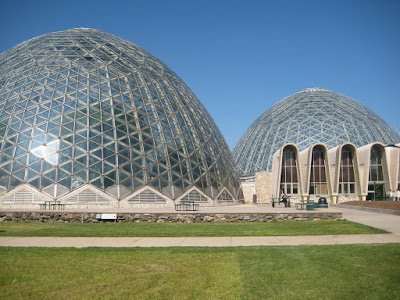
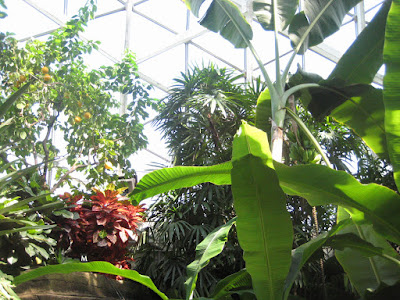
We hit the ground running here in Milwaukee. Not only did I get to stay at the historic Ambassador Hotel the first night, I also got to visit the Domes, three modernist greenhouses that are a part of the Marshall Park Conservatory. If you think the exterior looks cool, check out the inside….the three domes had flowers and plants from a tropical ecosystem, a desert ecosystem, and the final one, which demonstrated the human effect on landscapes and flowers.

Then we had the second annual THATCamp NCPH. If you remember from last year this is an unconference, an informal learning experience having to do with digital and new media in the humanities. The sessions I attended had to do with the future of blogging, the issues surrounding bringing scholarly publications to the digital realm, and a closer examination of branding and promotion for organizations and projects. I walked away, as usual, with a plethora of really cool websites and links.

I’m hoping to do a more analytical post about content at the end of the conference but I wanted to emphasize my goal for the next two weeks as I experience Milwaukee and travel to Texas:

I’m feeling the pull — that urge to make sure that I don’t miss a minute, a site, or a story, and to walk away from both these places seeing them as more than just a meeting room space.

Guest Post: Coming Home for the First Time

Note from Priya: From time to time I like to open my blog up to friends who have had great experiences with public history. One of the most common ways that we connect with the past is through our family. Here is one story of making that connection.

By William Blake
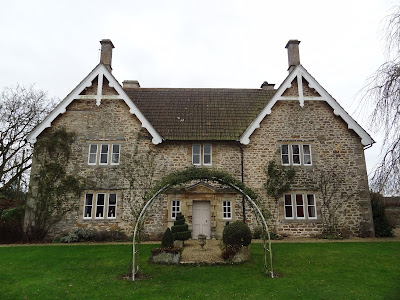
When I was young, I asked my dad where I got my name from. He explained to me that I was not, in fact, named after the poet. I was named after my ninth-great-grandfather who left England and settled in Boston in the 1630s. His son, James, built a house in Dorchester, just outside the city, that still stands to this day. One year for Thanksgiving, my dad took me and my brother to Boston, where we had the chance to see the Blake House and visit a nearby cemetery containing Blakes from many generations ago.

My dad did not know much about the Blake family in England, but that didn’t bother me. For any young American interested in history, that is an amazing enough story. Many of my friends cannot trace their origins back more than one century. In the last year, I have discovered I can trace my origins back eight centuries, back to the days of Magna Carta. Along the way, I have found connections to a coat of arms, members of parliament, the poet (who is likely a 12th cousin), and a cousin nicknamed the “Father of the Royal Navy,” who is buried at Westminster Abbey.

When my then-fiancée suggested that we spend our honeymoon in England over Christmas, I couldn’t have been more thrilled. After we got married, I spent my summer studying for my grad school comprehensive exams. I broke up the monotony of studying by doing genealogical research (if you have not tried ancestry.com, you should!). I connected with a distant relative in Australia who has been researching the Blake family for years. He opened my eyes to a great deal of information about the early Blakes in England.
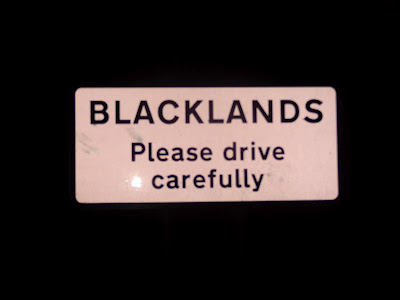
I now have a more precise answer as to where my name comes from. Blake is the old English word for black, and years ago I read speculation that the name was applied to an ancestor with black hair or dark skin. Surnames were often adopted to tell two people with the same first name apart. This was not the case with our family. About two hours west of London lies the county of Wiltshire. In 1194, Richard I established the parish of what is known today as Blacklands just outside the market town of Calne in Wiltshire. The parish contains only about 500 acres, and it name refers to the dark forest that once existed there.

The original name of the parish, however, was Blakeland (or Blakelonde). It was a common practice for Norman nobles to adopt surnames based on the location of land they owned – given to them by a Norman king. DNA tests of other Blake descendants reveal Norwegian markers, which could also indicate Norman ancestry. As far as I can tell (and this is a rough estimate), my 24th-great-grandfather was John de Blakeland, born ca. 1200.

Just to the west of Blacklands is Pinhills Farm, a house that dates back to the mid-17th century. It was built, in part, out of materials from a much older manor house that was burned during the English Civil War. The old manor house is listed as the possession of one of Alfred the Great’s grandsons in the 10th century. The Blake family acquired Pinhills sometime in the 14th century and lived there for about four centuries. The Blake family supported Parliament during the Civil War, and Pinhills stood as a garrison for Cromwell’s forces in Wiltshire, and a moat was added to protect the manor. Unfortunately, that area of Wiltshire fell to Royalist forces on December 28, 1643, and Prince Rupert ordered Pinhills to be destroyed.

I was able to get in contact with the current residents of Pinhills Farm, and they graciously gave us permission to visit on our trip. On December 27, we rented a car and set off from London for Wiltshire. It was difficult restraining my excitement, but I had to in order to navigate the hazards of driving on the wrong side of the road. The English countryside was more beautiful than I could imagine, and I think could England could be described as the Emerald Isle just as easily as Ireland. We exited the highway, drove through the town of Calne, and onto Pinhills.
The family currently living at Pinhills could not have been kinder to us. They gave us an expert tour, allowed us to take plenty of photographs, and then invited us in for a proper English tea – complete with China and homemade cake. We had a nice chat about history and politics. Although we did not take pictures inside the house, I did have the chance to touch some very old ceiling beams, which likely were part of the materials salvaged from the original manor house. It was truly awe inspiring to have such a physical connection with a place that has so much history, especially so much history connected with my family.

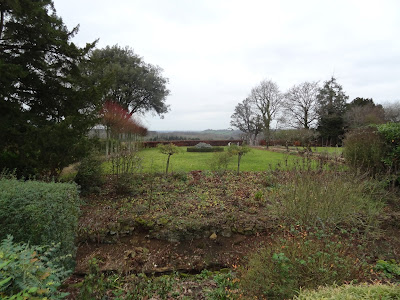
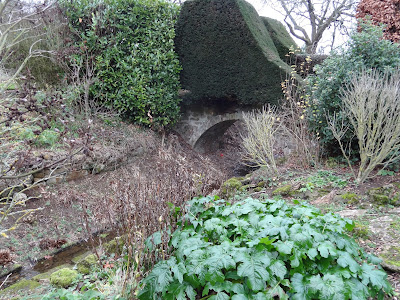
The grounds of Pinhills have been kept in immaculate condition, including the moat. When originally constructed, the moat was about 15 ft. deep. As a result of erosion, it is only about 5 ft. deep. The area inside the moat, where the original manor house once stood, has been converted into a beautiful garden. I felt such an incredible sense of inner peace being there. Our hosts pointed out one old tree under which George Prothero, an English historian, wrote one of his manuscripts. My reaction was that I would be so much happier to write my dissertation under that same tree than anywhere else on Earth.
As if the family connections on our trip could not get any more enjoyable, the next day we drove back to London and I went to Westminster Abbey. At first it looked like I was not going to be able to go in, as I arrived close to time from the last admission. I told a marshal that there are memorials to two of my cousins in the Abbey – the poet and Admiral Robert Blake. The marshal called her boss, the head marshal, and when he heard my name, I got VIP treatment. I was whisked inside without waiting in line or paying admission. I got to see parts of the Abbey usually out-of-bounds to tourists, which was a good thing because the memorial to Robert Blake is located just off the tourist route.

All-in-all it was a truly magical trip, but I already have a long list of genealogical and historical things I want to do on the next trip.
Flinging Ourselves into the Unknown: The Preservation Lesson of Buffalo

Delay. Delay. Delay. I’m going to be honest—this post has been a challenge to conceive and write. Not because I had nothing to say, but because I didn’t know how to frame my lessons from the 2011 National Preservation Conference. Much of this has to do with the fact that I wasn’t able to see the closing plenary—which serves not only as an end cap to a week of knowledge sharing, and networking, but as a launching point for where we are going.

Thankfully, that changed with the magic of the internet. First, the usual acknowledgement: I wasn’t a normal attendee of the conference. My daily job was to serve as conference staff—sitting in on sessions, passing out evaluations, taking tickets, which meant that with the exception of a session or two (and the major plenaries) what I saw and heard was often confined to the room in which I was assigned (or the Twitterverse), but what I did hear and learn afforded a glimpse into the future.

In closing her speech (and the conference), Isabel Wilkerson, author of a book about the migration of African Americans from Jim Crow South, quoted Richard Wright re his decision to migrate to New York City.

“I was leaving the South
to fling myself into the unknown . . .
I was taking a part of the South
to transplant in alien soil,
to see if it could grow differently,
if it could drink of new and cool rains,
bend in strange winds,
respond to the warmth of other suns
and, perhaps, to bloom”

This may be an awkward analogy but preservation is, has been, migrating. In the last ten years alone, the way we do business, the way we interact with others has changed dramatically. And it all started by sticking our toe, and in some places, jumping right headlong, into the unknown. We’ve seen how important our work is in regards to community development, we’ve stepped up about the importance of character, and how where we live, how we live, and why we live there matters. We’ve also spoken out about the importance of existing buildings in the sustainability movement. We are getting involved, making partners in ways that those outside the movement don’t expect.

But we are a reflection of events in the larger, broader world—where we as a country, as a global system have to re-think the way we’ve always done business or else run ourselves into the ground. We have to change the way we live in order to survive. Everything will not just work out “in the long run.”

That’s a pretty awful phrase, “the long run.” Often a justification to keep doing things the way they’ve always been done, because in “the long run” everything will work out the way it was meant to. It isn’t a phrase we can depend on anymore. As preservationists—heck, as historians—we have the ability to see where we’ve been and embrace change—bucking perception of our work. This conference showed me this. That all around this country there are preservation professionals taking risks, and finding new ways to meet the challenges of the coming years. So perhaps that is the biggest preservation lesson of Buffalo—that change is going to come, whether we want it to or not—but that we as a movement are prepared to meet it, to take our ethic, and transplant it in new directions, to cultivate it to respond to the the warmth of other suns…and bloom.
~~~

There are a few ways to catch some of the sessions from this National Preservation Conference. Visit www.preservationnation.org/conference for more information.

Awestruck, Inspired, and in #buffalove

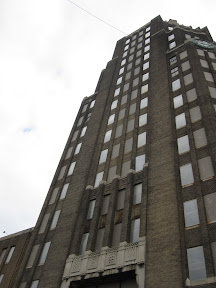
The tower at Central Terminal in Buffalo, NY

Update 11/3/11: The full documentary is now online!

Have you ever been somewhere where it was clear that the residents had so much pride in where they lived that they defied expectations? Next time you are in New York, forget the Big Apple and head North to Buffalo and you’ll see how this city has wiped away the illusions of the so-called rust belt and are actively rebuilding and investing in the future rather that allowing others to write them off.

Nothing says this more than Buffalo Unscripted, a documentary by the National Trust for Historic Preservation (yes, my employers). Earlier this year three of my co-workers went up to Buffalo and interviewed over 500 people about the city in which they live. The result is an hour long documentary that not only pulled at my heartstrings, but also made me see possibilities where I might have previously dismissed it.

The power of place is a phrase embraced by public historians. It reveals how much of our shared past is connected to where we live, where we interact, and and where we dream. For ordinary Americans it is not the site of major monument or a historic house, it is our neighborhoods, our churches and temples, our restaurants, and our homes. The power of place is the grit and the polish of an urban and rural setting; or the civic parks and landscapes where we meet. The power of place is in its community.

Two weeks ago I was in Buffalo for the National Preservation Conference and got to attend the premiere of Buffalo Unscripted. For months I had been hearing about the beautiful buildings, the enterprising people and was excited to cap off my visit in a theatre full of Buffalonians listening to how important their city was to them.

It is easy to be proud of a place like New York City, which in the media and the world’s eye exudes cool. It’s the same for cities like Chicago, DC, Dallas, San Francisco which have a reputation based on a particular image and idea of the cities personality. For places “in decline” it’s an uphill battle. How do you hold on to that pride when others put you down? How do you encourage investment when no one is able to see the promise? I say you do it Buffalo style and paint your own picture of growth, your own vision of rejuvenation, and invest in yourselves in a way that that takes the cultural capital of the past and leverages into a very real future.

The people of Buffalo are saving their historic buildings, rewriting their zoning code, and rebuilding their neighborhoods one school at a time.

Through Buffalo Unscripted I found myself encouraged by those who have made their lives and homes in a changing city. For them, where they live isn’t limited to a single building or block, rather it is about making a dream reality for an entire city. The power of place is in Buffalo’s people.

For more information about Buffalo Unscripted visit www.buffalounscripted.org, or follow hashtag #bufunscripted on twitter. The full documentary will be online soon, until then enjoy this clip about “Buffalo in one word.”

Buffalo In One Word: Authentic from PreservationNation on Vimeo.

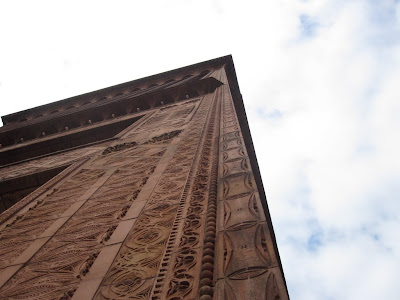
I am in #buffalove, and want to emphasize that if I could marry a building it would probably be the Guaranty Building.

You can view the rest of my pics here, and keep an eye out for more on the National Preservation Conference next week!

Bring it on Buffalo

It is October! Which means I have been spending a full week here in Buffalo, NY for the National Preservation Conference. Last night I made a decision that instead of trying to write a bunch of posts for each day I would wait until I came home to share my thoughts. It will be a little bit more focused with less summary and more interpretation/reflective than I usually do. So stay tuned!

In the meantime you can follow along with the events in a variety of ways online.

Live Streamed Sessions: www.preservationnation.org/conference
Twitter: #presconf, or follow just me (but where is the fun in that) at @pc_presnation
Flickr: Preservation Nation Flickr stream
Blog: Preservation Nation blog.
Facebook: National Trust Facebook page

And check back here next week for more observation and thoughts.

Be an Upstander: Youth Programming and the 2011 AAM Conference

By guest blogger Linda Neylon

This year’s American Association of Museums Annual Meeting in Houston, Texas, was the third of these that I have attended. And while each year varies in usefulness to me,  this year’s conference in Houston proved to be one of the most interesting I have been to. Though it has been a few months since the conference I still have many thoughts running through my head from the sessions, as well as from the city itself.

I have never been to Texas, and was looking forward to the experience. One of the people I met at the conference grew up in Texas, and told me that people often ask her if she rode a horse to school.  While I did not think that would be the lifestyle, I will say I was surprised that the only people I saw in cowboy boots at the conference were from the north.  Besides the clothing expectation, I am not sure exactly what I thought Texas would be like—but Houston was definitely not it.

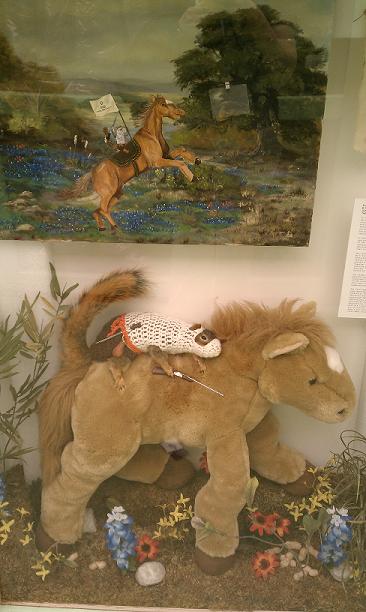
PODS ArtThe city was sprawling, and parts of it reminded me of Levittown, Pennsylvania.  But the area around the conference (downtown, and near Minute Maid Park) was great.  There is a park there call the Discovery Green, that I wish I could have brought back to Pennsylvania.  There were basic science experiences, such as seats with concave backs where two people could talk from a distance and still hear each other.  There were PODS set up in which artists had created pieces, including a “box of curiosities” with an exhibit about Joaquin Squirrelieta: The Battle for Campo De Los Cacahuetes.  This particular art piece spoke to me, seeing the artists’ interpretation of what museums—particularly history museums, are.  And if this is the case, it needs to change.  It was a funny and creative parody, but it would be a sad, sad museum.

So how should we be moving forward with museums?  Many of my colleagues and I are realizing that we need to think beyond the traditional methods of interpretation in museums, and to look at perhaps the scariest audience group we have…teenagers!  I think many of us have something to learn from the Holocaust Museum Houston.

The mission of this museum is: “Holocaust Museum Houston is dedicated to educating people about the Holocaust, remembering the 6 million Jews and other innocent victims and honoring the survivors’ legacy. Using the lessons of the Holocaust and other genocides, we teach the dangers of hatred, prejudice and apathy.”  This mission is summed up very succinctly throughout their website, marketing materials, and gift shop, in sentences like “Stop Hate.  Starting Here.”  The museum is a very powerful one, with a very active group of volunteers who are also survivors.  The topic, artifacts, and exhibits are moving, but every step of the way, visitors on a guided tour are reminded of a triangle that the docent carries.  This triangle has three points- “perpetrators,” “bystanders,” and “upstanders,” with “victims” in the middle.  The triangle is used to show that everyone outside of the victims, or targets of hate, have a choice in how they handle it.  Will you pretend that you don’t hear your friend making racist jokes?  Will you stand up for the people your friend is making jokes about (be an “upstander”), or will you participate in making those jokes?

This idea is carried throughout the museum and its programming.  Its program,  Youth and the Law, takes these ideas to at-risk juveniles, as part of the city’s anti-gang task force.  Listening to the educator, I became truly inspired.  She told us that the recidivism rate (the number of times someone re-offends) for teens in her program is lower than that of the standard punishment for juveniles considered at-risk for gangs. While not every museum has the content and ability to participate in something exactly like this, I do think we all have the ability, no matter how hard it is to see at first, to connect to our youth in an important way.

While most of the conference was full of thought-provoking sessions, the time spent at the Holocaust Museum Houston has stuck with me.  It has reminded me of what is possible, and where I have been.  When I worked at the York County Heritage Trust, I worked with teen volunteers (ages 13-18) each year, teaching them history and how to interpret.  Today, many of the teens that have reached college age are studying history in school.  They connected to their history, and it has had a lasting impression.  I feel like I have lost sight of that possibility in recent years, and my time in Houston reminded me of my love for working with teens, and the endless opportunities this age group really does present.  If the Holocaust Museum Houston can have the impact it has had on teens, imagine what more our history museums can accomplish!

~~~

Linda Neylon is a public historian with experience in youth and adult education and interpretation.  She is a graduate of American University’s Public History program, and most recently directed the education program at Eastern State Penitentiary Historic Site.

A is For Arizona

I can’t believe that April is nearly at an end.  In a month that saw prep work for THE BIG EVENT in less than three weeks, and the NCPH conference in Pensacola I also had a quick, mini-vacation in Scottsdale, Arizona.  While we spent a good amount of time by the pool enjoying the warmth (it was still very chilly in DC, something that is no longer the case) there was an opportunity for some good eats, hiking, and a moment to take in a historic house tour.

I’ll be honest and say that this trip had an agenda–it was my sisters bachelorette party–and the goal was relax, relax, relax. So while we did take a lovely hike up Camelback mountain (you can see me in the slideshow sporting my PreservationNation.org shirt) the rest of the time pretty much just involved….

Food

Mohitos!

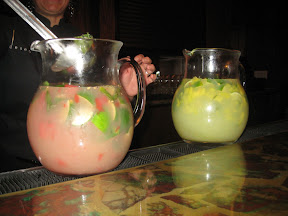
While in Scottsdale we ate at a lot of places. I did want to take a second to mention that as great as the food at Deseo was , the private mixology class where we learned how to make three different types of mohitos was fascinating–historically speaking of course. The instructor gave us a brief history of the drink and explained the different variations of rum and how they are developed. From some of the courses I took on foodways I remember thinking about the different regions of the world that make the liquor and how the histories of those nations were affected and transformed by production.  Specifically the history of sugar and the slave trade. If you want a really good book about the subject check out Sydney Mintz’s work Sweetness and Power: The Place of Sugar in Modern History.

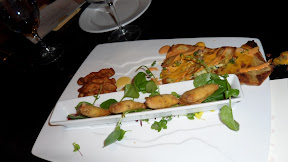
Food at Deseo

We also ate at…

Old Town Tortilla Factory

In addition to perfect weather, this restaurant had amazing southwestern/Mexican cuisine.  Built from a 75 year old Adobe, diners at the Old Town Tortilla Factory sit in the open air.  I would recommend getting the green enchiladas.

Hotel Valley Ho–Cafe Zu Zu

French Toast at Cafe Zu Zu

Brunch at Cafe Zu Zu was the perfect way to start our leisure filled Saturday. It also gave me an excuse to visit a very chic modernist hotel (part of the Historic Hotels of America collection). With awesome chandeliers, and a pretty trendy lobby–I thoroughly enjoyed my french toast.  If you love mid-century modernist hotels I recommend visiting the Valley Ho–or just read about its past.


Olive and Ivy

Our first stop when we landed was getting some food at Olive and Ivy. Despite it being the hottest day of the year (so far) in the area, we decided to sit outside. While we tried a lot of different food–the Sweet Corn and Tomato Flatbread was (to me at least) the star of the meal.

And Now for the History: Taliesin West

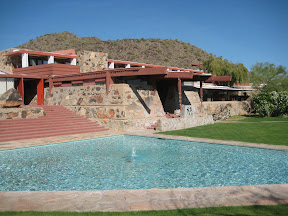
View from the front of Taliesin West

Earlier this week I posted this post over at PreservationNation about the perfect house tour. It stemmed from my general dissatisfaction of a tour I had received at Taliesin West. I wanted to elaborate on this a little. For me the typical house tour is symbolic of a time when great men dominated our history lessons. So while many tours work very hard to look “downstairs” or interpret slave quarters occasionally you get to a tour that hasn’t quite made the leap.

Now of course, the difference with Taliesin West is its connection to Frank Lloyd Wright and his influence on American architecture–but the same principals apply. Instead of trying so hard to convince the captive audience of his greatness, the tour may have been better if his concepts and ideas were relayed narratively, using the house and the school to illustrate the points.  Instead, as an audience member, the conversation felt a little condescending. Rather than talk about the school in a way that talked curriculum and how it uses Wright”s vision to train new architects, we got discussions of accreditation and how many students are accepted. It felt, at times, much like an advertisement for applicants rather than a  story of Wright’s legacy–continuing on beyond his lifetime.  I am willing to concede, as I mention in the post above, that the temperature may have contributed to the ineffectiveness of our guide–or that it was a particular off day–but when you feel like the hour long tour could have been concluded in half the time, there is a problem.

Detail of a statue at Taliesin West

The tour aside, if you do have a  chance to visit this masterpiece do so. Every angle produces a new vision — of sky, water, stone against Arizona’s natural landscape. A is for Arizona–which means it was absolutely amazing.

Note: Speaking of historic moments. While we were in AZ, some of the party attendees stayed up all night to watch the final cricket match of the cricket world cup between India and Sri Lanka. At this moment the Indian team was playing against a team that had dominated the series, while they had fought tooth and nail to make it to the end. It was a team that had not made the finals since the year I was born (1982). While very much an important part of Indian culture, I found myself unexpectedly caught up in witnessing the exciting win–and felt like I was a part of a nationwide moment of joy. So I say Bravo India!

View the full album of pictures.

A House Tour – Just Like a Building – Should be Greater than the Sum of its Parts

This blog has been re-posted from the PreservationNation blog.

Chris Madrid French’s recent blog post on Phoenix modernism on Preservation Nation reminded me of a recent weekend jaunt I took just a few miles east in Scottsdale, Arizona.

While there I did what any self respecting historian/preservationist would do and dragged my two cousins and my sister to see a Frank Lloyd Wright masterpiece, Taliesin West. I’m going to start off by admitting that I do not know much more about Frank Lloyd Wright and his architecture style than his overarching building ethic of having structures that are “in tune with nature.” I love the way they mirror the landscape, providing an almost abstract art-like vision, modernist masterpieces that are close to the earth. They remind me that the soul of a building is much more than the sums of its parts—as Taliesin West exhibited with its tilted roofline, low ceilings, and sunset colored walls.

As magnificent as the building was, I found myself contemplating another art form—the art of a house tour. Being an interpreter is a tough job. No tour is alike—as I well know from giving historic house tours when I was in college. A guide has to be on his/her toes ready to pull from the reams of knowledge they have amassed. My experience—both in giving and attending—tells me that moving a house tour from good to great also involves the following:

  • Know your audience—at the start of the tour it is fine to ask your group about where they are from—but delve deeper. Find out how much the group knows about the site and why they’ve come to visit. And then ADAPT.
  • Show—don’t tell. Obviously there is a reason that this home/structure/architectural wonder has been preserved. However, a repeated exclamation stating that it is wonderful is not instructive when the evidence is right in front of us.
  • Time. I’ve often found that one of the biggest problems with house tours is the need to fill a specific time frame. It is important to recognize when you don’t have enough material—so as to prevent repetition. It is better to produce a tight program, rather than one that rambles and is repetitive over the course of an hour.
  • Tell us a story. This is a personal preference of mine. The house tours I tend to gravitate to make the broader connections between the architect, the place, and those who lived there. It is that interconnectedness that makes a space come alive and makes those past lives tangible.
Taliesin West

Maybe the early morning 95 degree heat in late March may have had something to do with it, but the last point is why I found the tour at Taliesin West slightly unfulfilling. We had the building, we had the great story of an architect whose work dots the American landscape in many forms, but we also had this amazing living history of a school—and the students who lived (and continue to live) there. However, as we moved around the main area, each of these pieces remained disconnected from one another; each existing as a part of their own separate sphere, ultimately lacking the organic, natural flow emphasized by the teachings of Wright.

As our guide stated—entering a Frank Lloyd Wright house is like listening to music. Each element blends seamlessly with the other—low entryways opening up into a robust chorale of space—with its own volume and tone leading to a symphony of nature in something that is man-made. This is how a great house tour should be: elements building upon one another, sifting through the potential cacophony of information creating seamless (with occasional improvisation) orchestration.

See pictures from Taliesin West.

Learn more about my trip to Arizona.

Pursuing Pensacola: Final Thoughts

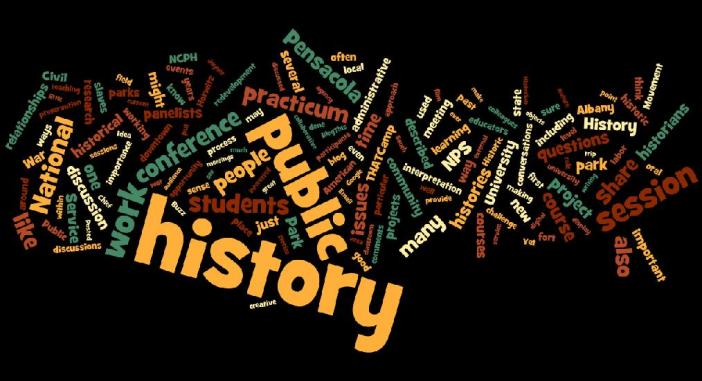
Wordle Map of the NCPH 2011 Conference by Cathy Stanton

In the last week I’ve written a bunch of blog posts about Pensacola….

NCPH 2011: Shared Authority, Creating a Commons–Another Day at THAT Camp
NCPH 2011: A Public History “Spring” Break (blog.preservationnation.org)
History that is Difficult to Do (NCPH Conference Blog)
Preservation Roundup: Public History Edition (Part 1)
Preservation Roundup: Public History Edition (Part 2)

…and this one is the last. As always NCPH brought with it a meeting of minds, and a reminder of why I love history so much. The commitment and passion that comes with this yearly gathering forces me to look at how I work, and how I see the past with different tools and audiences. Often, I leave with a lot of great ideas, without enough time to bring them to fruition–and I would love for this year to be different. Specifically, I am excited about the next five years and what the commemoration of the 150th anniversary of the Civil War (which started this morning with shots being fired at Fort Sumter) will mean for the growth of historical discourse and memory in this country. How can we look to and learn from other commemorations to make sure that this volatile and game-changing period of America’s past is understood to  its full measure?

It’s an exciting time for public history–and I am proud and exhilarated to be a part of it.

Food. Food. Food.

What would a blog post about my travels be without a conversation about food. While I did eat at various places in the Historic Pensacola Village, there are three that I wanted to highlight

Dolce in Historic Pensacola Village: I really should only have to type out the following words–home made ice cream. With chocolate flavored with beer, or vanilla with fig each of the flavors at this store were great to eat. Especially in the lovely spring weather. The fact that it is located inside one of the Village’s restored homes makes it even better.

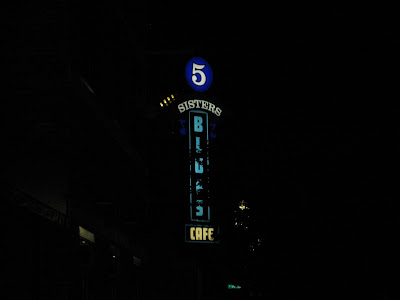
Five Sisters Blues Cafe: The marquee at the left may give you an idea of what the ambiance of this cafe was like. With live blues music, and perfect fried chicken and macaroni I was left in a puddle of southern home cooking goodness. I ate far too much for my own good, but would tell you that even if you eat until you can’t eat any more, you must try the mashed potatoes.

Nacho Daddies: I know the name is slightly ridiculous, but I loved the pineapple-mango salsa on my vegetarian/chicken tacos. It’s a great, independent fast food place with an excellent vibe. The sopapilla‘s were flaky and sweet and complimented the light nature of the tacos.

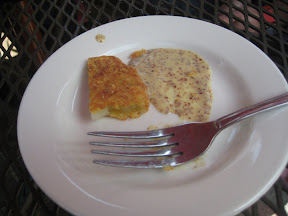
Everyone ate ate at least one Fried Green Tomatoes while in Florida. Yum!

Pictures!

NCPH 2011: Shared Authority, Creating a Commons–Another Day at THAT Camp

THAT: The Humanities and Technology Camp

Last May I attended THATCamp prime in Fairfax, VA where I investigated digital storytelling, local history, and social media in the non profit world. This two day event was incredibly rewarding, and so it was natural for me to sign up for another round at the 2011 National Council on Public History conference in Pensacola, Florida this weekend. As with the first THATcamp I attended each of the sessions served as discussion points for larger conversations about public history and the digital humanities.

First, though I would like to encourage you to head over to twitter and check out the hashtags #thatcamp and #ncph2011, both of which should give you a glimpse into the real time conversations that went on during this day long event.

For our purposes here I am going emphasize a discussion from two separate sessions. The first one looked at how institutions across the historical spectrum deal with user generated content–and how reactions to UGC effects visions of historical authority while providing valuable interaction with an engaged audience. More specifically we talked about crowdsourcing and social media–and how institutional transparency can effect the narrative in a different way.

The second session on social media that I went to actually ended up to be about the creation of a public history commons (check out the post by Kate Freedman on the NCPH conference blog), and how to collaborate within the profession on existing platforms.

In both cases we had to ask ourselves the essential question about audience–who is this project for, and what do we hope to accomplish. In the first instance, it had more to do with institutions and the idea of relinquishing “authority” and “expertise” over the objects and the past, so that the visitors interaction with history rather than the factual nature of this interaction became paramount ( and how to walk that fine line). For the second, since the audience would end up to be public historians, the idea was to provide a space for collaboration within the digital world and so we talked about what content might prove useful and be cross purposed.

The purpose of THATCamp is to spur conversations you would not usually get through traditional conference models–it serves as a spontaneous brain collective where inquiry and experience work together to find solutions. After attending discussions on oral history and web publishing the camp capped off with an overview session that asked philosophically “What is digital history?” followed by the alternative question “Is all digital history public history?”

The answers varied but in the end we asked how much do the definitions matter and is it enough to identify shared values between those who identify as either digital or public historians (a point brought up by @publichistorian). She pointed out that the National Council on Public History has one–visit the website and look for the code of ethics.It is definitely something to consider and I’ll be thinking about it as the week progresses.

Tomorrow I am attending a myriad if sessions, so stay tuned…as I try and bring some of this sunshine and spring weather to the page.