1785 Forever

1785Does preserving old places–and the memories they represent–matter? Do the individual and collective memories embodied in old places help people have better lives?

Tom Mayes, a colleague of mine who is spending six months in Rome as a recipient of the 2013 Rome Prize, asks these questions in his latest post investigating “Why Old Places Matter.”

As I’ve read his series it has brought back my own thoughts on memory and memorializing–where stone structures on a battlefield or ever-living trees bear witness to the past. At this intersection of memory-place-monument these objects of remembrance serve as a physical manifestation and encapsulation of a collective connection to the past.

Old places provide a tangible reminder that something happened–that humans stood in this exact spot and did something. That we interacted, enacted change, or fought for a cause.

They are questions that I am also thinking about as I prepare for my last day at 1785 Massachusetts Avenue, the soon to be former headquarters of the National Trust for Historic Preservation.
Continue reading “1785 Forever”
Finding What We Need: Native American Heroines and the Creation of Historical Myths

This post originally appeared on the FANgirl blog.

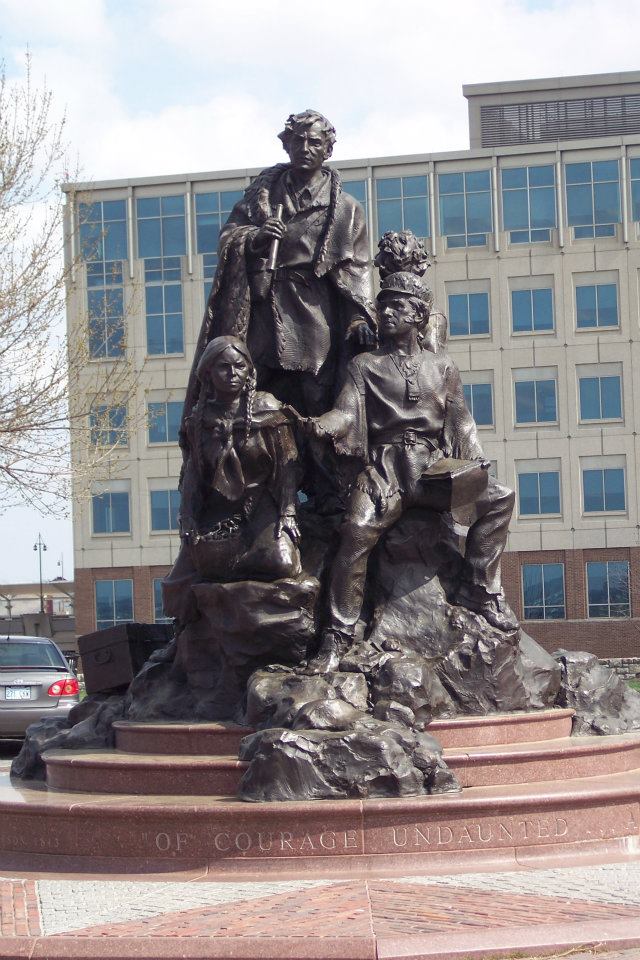
The Corps of Discovery in Kansas City, MO, which features Sacagawea
The Corps of Discovery in Kansas City, MO, which features Sacagawea | Credit: Kristina Downs

On FANgirl we talk a lot about heroines – who they are, what makes them strong, how they represent and influence the culture we live in. Often these discussions involve looking at the process of myth-making and storytelling; stereotypes and archetypes – and how they reflect real world needs and ideas. These ideas specifically are rooted in our historical narrative.

For a long time the history we learned was told from a singular perspective: the white male, the victors, the overseers, the husbands. Since the 1960s historians have worked to fill that gap looking at the same history from additional viewpoints including African-American, immigrants, Native-Americans, and women. While we have some primary sources written by members of this specific groups, sometimes our understanding of these lives come from folklore: stories, myths, music, and literature.

Folklore gives us a sense of iconic figures and representations that reflect the age in which they were written. These historical mythologies are transitional and ever shifting from decade to decade, just as our heroes and heroines in science fiction have changed based on where we were in time.

About a month ago I sat down with a friend of mine, Kristina Downs, to talk about her dissertation on Native American heroines. We’ve known each other for about ten years through a mutual love of Shakespeare and science fiction at the College of William and Mary, but it was only recently through a random post on Facebook that I realized she was in the process of getting her Ph.D. in folklore. Continue reading “Finding What We Need: Native American Heroines and the Creation of Historical Myths”

What We Really Do: Changing Perceptions

Preservationists say “no.”
House Museums are “behind the velvet ropes.”
Historians live within an “ivory tower.”

Does this sound familiar?

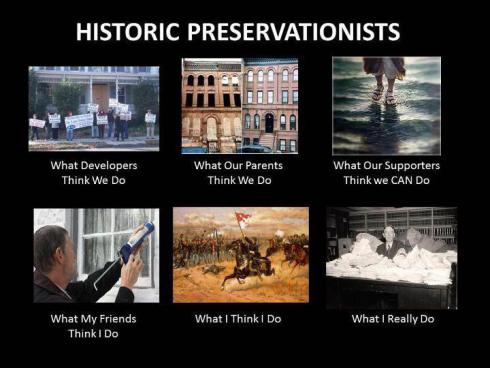
Historians serve as stewards of the past, disseminating history to a variety of different publics. However, segments of that public view historians and preservationists as obstacles–individuals who set up barriers, keep research confined within the academy, or prevent progress. Despite our efforts, this is how they perceive the work of history professionals.  Of course, those of us who work in the field know that history professionals are working to broaden outreach in museums (albeit with increasingly limited budgets), to spread literature and research, and to present a more open and accessible past by saving places across the country.

hpwhatwedo
Credit: Peabody’s Lament

This past week I staffed the National Preservation Conference in Indianapolis. While I didn’t get a chance to fully attend sessions, I observed a discipline actively working to remove barriers. Sessions sought to think past restrictions and standards and focused on aligning the needs of preservationists with the needs of community.

Continue reading “What We Really Do: Changing Perceptions”

Culturally Appropriate or Cultural Appropriation? A Few Thoughts

This story was origionally posted on the Indian American Story the blog for the Smithsonian’s Indian-American Heritage Project.

In early April, pop star Selena Gomez incited media buzz when she appeared in public wearing a bindi. She is not the first celebrity to wear something Indian, but I have to ask:

Should I feel offended that someone has chosen to appropriate a piece of Indian cultural identity for entertainment? Or is it another sign of how elements of my heritage have trickled into the American subconscious? If she “meant well,” is it OK? Or is it never OK for someone who is not Indian to wear such a symbol without preserving its meaning? And, at what point does something go from being culturally appropriate to cultural appropriation?

Let’s consider three scenarios.

Scenario 1: So You Think You Can Dance contestants perform a Bollywood-style dance number. The performance includes elements of hip-hop and classical Indian styles.

Scenario 2: Selena Gomez hires a composer to add tabla and sitar to a song to give it a strong beat. She attends performances wearing Indian clothing, and composes a video that includes elements of Indian dancing. Continue reading “Culturally Appropriate or Cultural Appropriation? A Few Thoughts”

Hodge Podge: Ordinary, Occasional, Spur-Of-The Moment

The silence on this blog hasn’t been so much due to a lack of inspiration, but rather the time — or the quiet — to put it all down on paper. A lot of what I’ve had to say comes between the lines of real-life events, catching up with friends, and spending pool side time with a book.
None of these moments are particularly revelatory. In fact, they are ordinary, occasional, spur-of-the-moment flashes of joy. Like nerding out every time the John Adams theme plays at a Washington Nationals game.

So the latest Hodge Podge is a look at 500 episodes of This American Life, A few short book reviews, and a round up of a mish-mash of things my brain stopped to examine in the last two months.

This American Life at 500

It would be funny to joke that the radio show was five-hundred years old, but really five hundred episodes of top-quality storytelling is something that deserves a few lines. When I first started this blog almost four years ago my intention was to spend every week commenting on the latest TAL episode. While that hasn’t exactly come to fruition, I still find myself listening every week and thinking about the people that are profiled, their lives and what they say about living and being a citizen of these United States.

So some of my favorites from the last two years in no particular order: Continue reading “Hodge Podge: Ordinary, Occasional, Spur-Of-The Moment”

Stand Up, Speak Up, Speak Out and…Get in the Way

We have also come to this hallowed spot to remind America of the fierce urgency of Now. This is no time to engage in the luxury of cooling off or to take the tranquilizing drug of gradualism. Now is the time to make real the promises of democracy. Now is the time to rise from the dark and desolate valley of segregation to the sunlit path of racial justice. Now is the time to lift our nation from the quicksands of racial injustice to the solid rock of brotherhood. Now is the time to make justice a reality for all of God’s children. -Reverend Dr. Martin Luther King Jr. (August 28, 1963).

Yesterday was the 50th anniversary of the March on Washington. I’d like to say that I spent my day at the edge of my seat watching the news coverage and the live streaming…but I didn’t. I spent most of my day watching my three week old niece cry, sleep and overall just be adorable.

While the television wasn’t on I did follow my Twitter feed, read reactions on Facebook, and read transcripts of the speeches by Presidents Carter, Clinton and Obama. This morning I listened to the short remarks by the only still living speaker from that day in 1963: Representative John Lewis.

Continue reading “Stand Up, Speak Up, Speak Out and…Get in the Way”

Line of Sight Part Deux

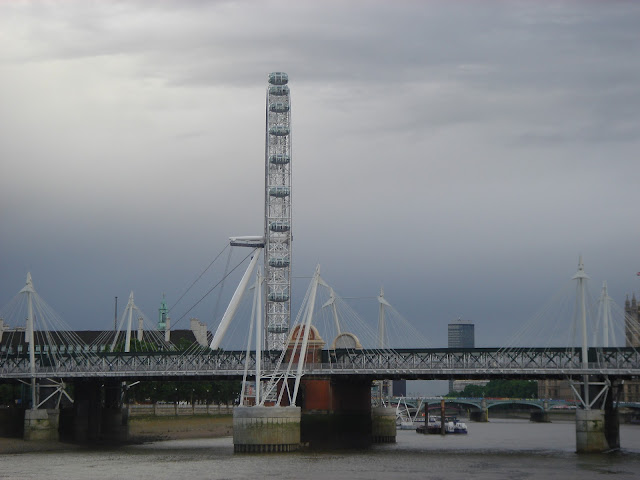
When I was in graduate school I spent a lot of time reading about the technological sublime. That feeling of overwhelming fullness, sensory overload, you get when standing beneath awe-inspiring feats of human engineering. Crafted and designed by human hands these structures stand as a counterpart to the natural sublime that comes when beholding formations like the Grand Canyon and Chimney Rock.

When I stand at the edge of a city, I perform the same action, over, and over again. I close my eyes, open them and let my gaze sweep along the horizon, pinpointing the tallest structure I can see.

Then click. Snap. I take a picture.

Continue reading “Line of Sight Part Deux”

Damn, Victoria! History, Mystery and Whodunnit

Excerpt from the final scenes of Mulgrave Manor:

DAVIS (shaking his head): When we really first met. We were in London they had just announced the end of the war and you were there taking care of Lady Weschester….that night…it changed my life. It gave it meaning.

S. HARROW (shaking her head violently): We talked. Nothing more. You’re reading into it too much–what about Lady Victoria.

DAVIS: Damn Victoria! It is you that I love.

The invitations were sent. The silver polished. Footman stood at the ready for one of the finest soirée’s Buckinghamshire had ever known. All that was left was for the director to call action.

For the last two years I’ve participated in a murder mystery club. It started with a friend’s birthday party which was set in the 1920’s–your typical murder mystery out of a box with villains, heroes, heroines and of course……murrrrrrrrder.

Somewhere along the way three of us started to write the mysteries ourselves, taking a gander at figuring out motive, means, opportunity and a gaggle of red herrings to confuse and bewilder our guests. In the past these investigative forays took place in the Wild West, the land of fairy tales or at an intergalactic peace accord signing (guess who wrote that one). For this spring’s adventure I embraced my love of pop culture, gossip and history and set the tale on the set of a Downton Abbey rip-off called Mulgrave Manor.

Continue reading Damn, Victoria! History, Mystery and Whodunnit”

Prepping for Paris

Note: Check out the PreservationNation Blog later this week for a piece on what I am calling “The Return“.

writingWhen this post goes live you’ll find me thousands of feet in the air flying toward a week in Paris.
Paris. It sounds incredible right? I honestly think when we first booked our tickets all I could think about was food. Crepes, chocolate, pastries. Mmm. Mmm.

But then the historian (the imaginary angel that sits on my shoulder) shook me out of my mental sugar high. She reminded me that I wanted to do this trip right, to land already knowing a little about what I was about to see.

To take advantage of this visit to explore, experience, and to defy expectation.

So I prepped like I was prepping for a marathon (well a 5K) and in a month was able to read three memoirs, one history book and skim two additional titles on myth and architecture in Paris.

Continue reading “Prepping for Paris”

Diary. Letter. Novel. Movie. Hologram. History.

This essay contains spoilers for David Mitchell’s Cloud Atlas.

There is a moment in the second half of Cloud Atlas when physicist Isaac Sachs posits a few theories on the nature of the past.

“Exposition: the workings of the actual past + the virtual past may be illustrated by an event well known to collective history, such as the sinking of the Titanic. The disaster as it actually occurred descends into obscurity as its eyewitnesses die off, documents perish + the wreck of the ship dissolves in its Atlantic grave. Yet a virtual sinking of the Titanic, created from reworked memories, papers, hearsay, fiction-in short, belief-grows ever “truer.” The actual past is brittle, ever-dimming + ever more problematic to access + reconstruct: in contrast, the virtual past is malleable, ever brightening + ever more difficult to circumvent/expose as fraudulent.”

This is nothing revelatory to those of us who work in the public history field–memory is fickle, the objects we interpret can only tell a fraction of the story and for every oral history produced a recognition of perspective is taken into account. In graduate school we spent days talking about authenticity trying to determine what exactly is the nature of historical truth. Continue reading “Diary. Letter. Novel. Movie. Hologram. History.”